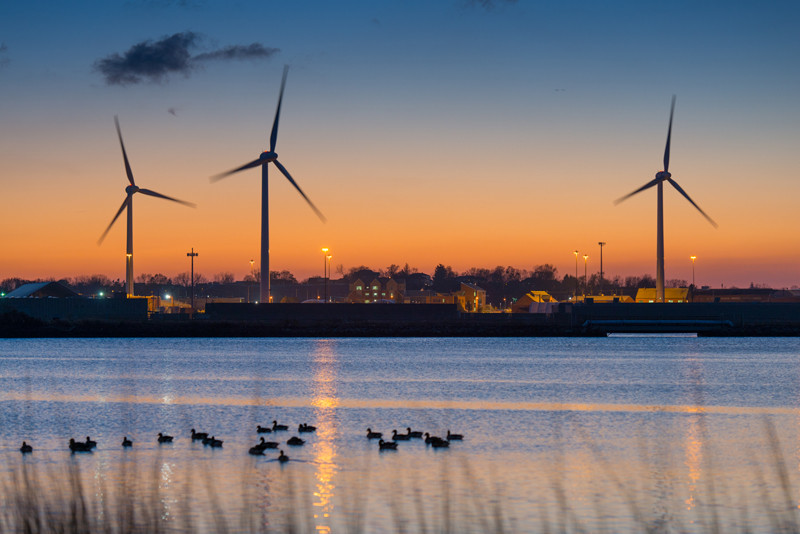
Three wind turbines standing 365 feet tall at the Narragansett Bay Commission’s Field Point Wastewater Treatment Plant in Providence are visible reminders of the promise of wind energy and the state’s efforts to be a national leader in the industry.
“We’re among the first wastewater-treatment plants in the country to be using wind energy,” said Narragansett Bay Commission spokesperson Jamie Samons. She estimates about half-a-dozen wastewater facilities are using wind power. The new turbines were commissioned Dec. 3. They are expected to save $800,000 to $1 million in annual energy costs, about 40 percent of the energy bill, at the Field’s Point facility, Samons said.
For much of the past year, however, local news in the industry has been less about its promise than project delays or second thoughts tied to concerns about cost and regulation. A high-profile failure in Portsmouth has also renewed questions in many communities about the financial merits of wind energy.
In Portsmouth, municipal leaders are stuck with a nonworking wind turbine and $2.3 million remaining of the $3 million debt. The gear box, supposed to last 20 years, failed after three years. A study on the gear-box failure, done by a Seattle engineer, was completed in October.
“As it turns out, gear-box problems are throughout the industry,” said Gary Crosby, acting town planner for Portsmouth.
To complicate the troubles, the town bought the turbine in 2009 from AAER, a Canadian company that went bankrupt in 2010.
“We went with the lowest bidder,” said Crosby. “If we had gone with a more reputable manufacturer, I’m sure we would have still been in operation.”
So what’s to be done with the 336-foot-tall burden on taxpayers?
“There are people in the town who think we should take it down and sell it for scrap,” Crosby said. ”But the cost of taking it down would almost equal the scrap value.”
Crosby said other options under consideration include: buying a new gear box for about $280,000 and having the town remain as owner and operator of the turbine; or, preferably, working out a public/private partnership with a company that would maintain and operate the turbine.
The Portsmouth municipal turbine wasn’t all trouble, however.
“The three years we were in operation, we netted more than $400,000 in revenue, over and above debt service and operation and maintenance costs,” Crosby said.
Cost-efficiency of wind projects is a continuing concern. The Narragansett Bay Commission funded the Field’s Point project with $14.2 million from the R.I. Clean Water Finance Agency, Samons said.
“It’s going to be about a 12-year payback for us,” said Samons.
A threat to the development of wind projects was the expected expiration of the wind-energy Production Tax Credit at the end of 2012.
“Congress must extend the wind-energy Production Tax Credit for projects that start [in 2013] to save an entire U.S. manufacturing sector and 37,000 jobs,” Denise Bode, CEO of the American Wind Energy Association, said in a Dec. 12 statement on the organization’s website.
“As far as the wind tax credits, projects that are immediately in the stream are not going to be affected yet,” said Grover Fugate, executive director of the R.I. Coastal Resources Management Council.
Advances in technology will help bring down the cost of wind energy, said Fugate, who is project manager of the state’s Ocean Special Area Management Plan, which provides guidance for development of offshore renewable energy resources.
“From the marine side, Rhode Island is one of the national leaders in wind energy,” Fugate said. “And we intend to keep that lead, if we can, from the science side, the engineering side and the environmental side.”
The sale of offshore leases for large-scale wind developments will also put Rhode Island in the forefront of wind development in the United States, Fugate said.
Providence-based Deepwater Wind has submitted plans to the federal government to be considered for a large offshore project. The proposed 150-turbine project, called the Deepwater Wind Energy Center, would be located about 20 miles south of the Rhode Island coast between Block Island and Martha’s Vineyard.
“I think the majority of the citizens in Newport, and certainly our policymakers, are very interested in green energy and sustainability,” Howington said. “At the same time, wind energy may not be the most appropriate in some areas.”
Westerly officials faced that reality last July, when the town abandoned a public-private partnership with North Kingstown-based Wind Energy Development LLC to build two turbines on town land because of resident opposition.
An eight-to-10 turbine project has long been envisioned by the East Bay Energy Consortium, made up of the municipalities of Barrington, Bristol, East Providence, Little Compton, Middletown, Newport, Portsmouth, Tiverton and Warren.
The consortium has received about $500,000 in funding and has been conducting studies for the proposed project, including a tower in Tiverton currently collecting wind data, said Newport City Councilwoman Jeanne-Marie Napolitano, chair of the consortium. She said the consortium is negotiating for a site owned by the town of Tiverton.
The consortium was denied nonprofit status by the General Assembly, but Napolitano said the group plans to reintroduce the request early in 2013.
“I think people forgot what it was like to sit in the gas line. People forgot what it was like to have a shortage of oil. Other countries explore options to find what’s most viable. That’s what we need to do,” she said. •