Miriam Hospital trains staff in top-shelf service, inspired by luxury hotels
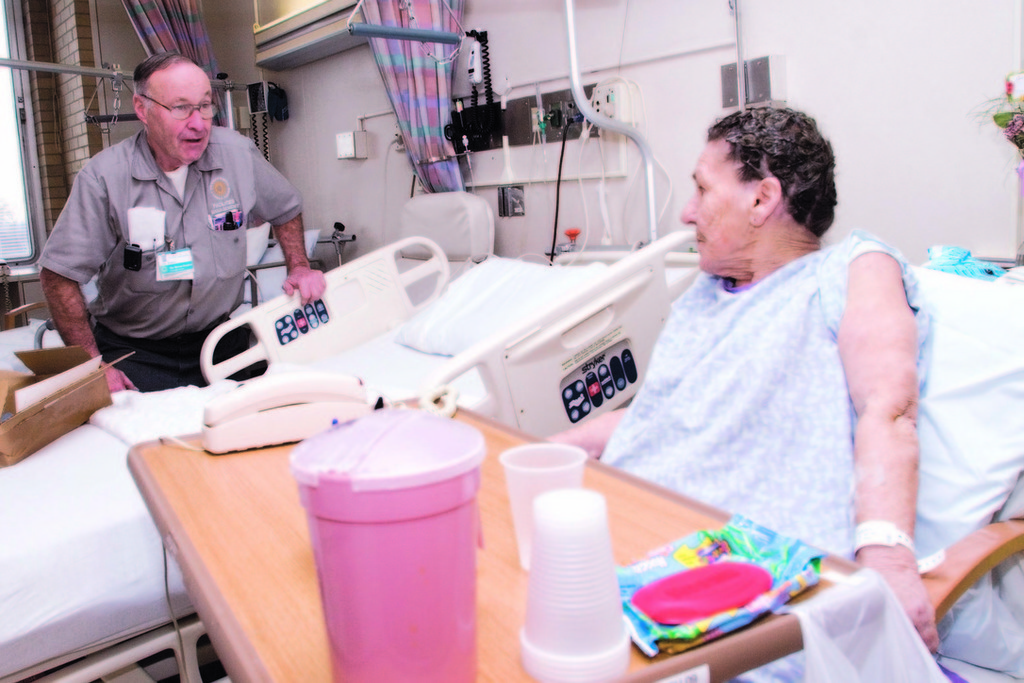
Jim Bolster has been a mechanic at The Miriam Hospital for almost 20 years. He assembles and fixes equipment – stretchers, wheelchairs, cafeteria counters. He replaces light bulbs. He takes care of plumbing problems and repairs broken nurse-calling systems.
It’s all unglamorous, behind-the-scenes work, not like repairing hearts, replacing hips, or battling cancer and AIDS.
But as Sandra Cheng, vice president of support services at Miriam, sees it, people like Bolster are immensely important. If they do their jobs well, patients and their families will be more comfortable, relax a bit and focus on healing.
“What we do might not be significant enough to directly affect clinical care,” Cheng said, “but we are the ones who give that subtle message, to let people know, ‘We’ll take care of you.’ ”
Miriam tries to send that message in many ways: It provides free valet parking, for example, and offers free coffee in its waiting rooms. In the inpatient wings, a worker goes around with a pastry cart and coffee for family members who might not want to leave a loved one’s side.
Now, to take that concept to the next level, Miriam is putting its entire support services staff – more than 200 employees plus about 200 volunteers who work at the help desk, as greeters, etc. – through a customer service course loosely based on the Ritz-Carlton hotel chain’s program.
“I describe the hospital as a medical hotel,” Cheng said, “and a five-star hotel differentiates itself by the service it provides. We have good people, and I thought, ‘With some training, they can provide five-star service.’ ”
The course was developed by Joyce Butler, an organizational consultant in the Lifespan Training Institute, an in-house professional development center financed and run by the hospital system of which Miriam is a member.
Butler researched the Ritz-Carlton customer service philosophy and practices, which have made the chain the only two-time recipient of the Malcolm Baldrige National Quality Award. She visited the Ritz-Carlton in Boston and watched the staff at work. And she shadowed Miriam employees, from mechanics to cooks to housekeepers, making note of the things they did that seemed to really make a difference to patients and their families.
When a patient asked one worker for a blanket, for example, and Butler offered to get the blanket herself, the worker told her: “Get the one on the top. That’s the softest.”
She saw the dietary staff making small efforts to please patients, such as bringing them a scoop of their favorite ice cream. She saw people anticipating patients’ and their families’ needs and offering help before it was requested, or offering to do more than was requested.
Those gestures, those attitudes, became the foundation of the two-and-a-half-hour course, which Miriam workers began going through, in groups of about a dozen at a time, last November. (The entire team is expected to have completed the course by Jan. 31.) “It doesn’t have to be Ritz and glitz,” Butler explained. “It’s about meeting the needs of the person, in that moment, and also making the person the most important person when you’re with them, regardless of the time demands that you have on you.”
At a session last Wednesday, taught by Brion P. Carroll, director of the Lifespan Learning Institute, housekeepers, call-center operators, a security guard, front-desk staff and volunteers were asked to share their own stories about what they do that makes a difference.
Lisa Mirabella, an operator, talked about how many callers are upset – because they’re worried about a loved one, because they’re sick themselves, or because they’ve been trying in vain to connect with the right person.
“You reach them on different levels, but most of the time, you’re going to reach them in a very agitated state,” she said. Given the volume of calls, she can’t stay on the line very long, Mirabella said, but in the short time she’s there, “your tone of voice sets the tone.”
If she’s calm and soothing but not patronizing, and she’s genuinely helpful, it will make the callers feel better. “They want to hear, ‘OK, I understand. I hear you,’ ” she said. And with a small extra effort, she may even be able to solve their problem.
Roland Ribeiro, of the housekeeping staff, recalled seeing someone in a waiting room who was eager for a cup of coffee. The attendant had a rigid schedule for brewing coffee, however, so the person was being made to wait. Ribeiro found a cup in a different part of the hospital.
Debora Aguiar, who cleans individual rooms, talked about assessing patients’ moods as she goes about her duties and intervening when she sees someone is upset. Maybe the nurse has been too busy to help them, but she can quickly get what they need. Or maybe they just need a bit of human contact, so she’ll chat with them.
“If I talk with the patient for one or two minutes, it makes them happy,” she said.
Butler said the goal of the program is not to give workers a specific script or procedure they must follow, but rather to “let people be themselves” – with some extra guidance.
The curriculum does directly address two basic principles of the Ritz approach to customer service: empathy – putting yourself in the customer’s/patient’s/family member’s shoes; and “anticipatory service”
– predicting what a person’s needs will be, and meeting them.
Bolster, the mechanic, said looking at his job from that perspective has been invaluable.
“I wish I’d had this training 10 years ago,” he said. “It doesn’t change the way I work – it has no effect on the way I work. But what’s changed is, I appreciate more how much people are going to enjoy what I do for them. It makes me look at service from their angle. If there’s anything else I can do for them, now I ask them. It saves me time, too, because I get everything done and don’t have to come back again later.”
The course also quotes a Ritz-Carlton motto that Cheng said she really
likes: “We are ladies and gentlemen serving ladies and gentlemen.” The idea, she said, is to let the service workers know, “you are very good at what you do, and we respect who you are.”
Many on the support staff don’t have a lot of education, and many are immigrants with limited English proficiency, so they’re not used to thinking highly of themselves, Cheng said. This motto, as she sees it, says, “We are service professionals, we are good at what we do, and we are providing this service to other ladies and gentlemen who deserve the best from us.”
The message is coming through, said Irene Arruda, a supervisor in food services. The dietary staff can make a big difference in patients’
experience at Miriam, she said, whether they’re fulfilling special requests or just ensuring that the food is warm and the tray is within reach.
“We’ve had a very positive response from this program,” Arruda said.
Employees have a new sense of the importance of their work, she said, and “I think they’re more vocal about the things they’ve done for patients when they go above and beyond. … It’s kind of like competitive, in a good way.”
Certifications seen as crucial to gain a competitive edge Pbn photo by stephanie ewens KARYN RHODES, who recently earned a national human resources certification at Bryant, has been hired as a senior HR manager at New England Ambulance.
By David Ortiz
Ortiz@pbn.com
PMP. PHR. CFP.
The acronyms that follow a person’s name after he or she has received a professional certification are increasingly sought after by employers.
As a result, a greater number of financial planners, human resource managers, project managers and others who work in a field that offers a professional certification are taking the national exams, local experts said.
“If I’m looking to move ahead in my company, if I sat for a national exam, and I have three little initials after my name, I have a competitive advantage,” said Annette Cerilli, director of Bryant University’s Executive Development Center.
Like the bar and CPA exams that lawyers and accountants must pass, passing the Project Management Professional exam or the Certified Financial Planner exam is a signal to employers that a job candidate is aware of best practices and has the requisite skills for a given profession, Cerilli said.
Unlike the bar and CPA exams, professionals working in financial planning, project management or human resources are not required to have these certifications – which have existed for less than a decade – in order to advance in their fields. But, increasingly, it helps.
In the last few years, employers have begun putting more emphasis on such national certifications as those professions have become increasingly specialized and complex, said Brion P. Carroll, director of the Lifespan Learning Institute.
Lifespan – like several other organizations that rank among Rhode Island’s largest employers – now sends project managers, financial planners and human resource professionals to earn professional development certificates at Bryant’s Executive Development Center.
Last year, 20 of Lifespan’s human resource professionals began the center’s human resource certification course. The six-class program, which takes anywhere from six months to two or more years to complete, concludes with an optional 13-week preparatory class for the Professional in Human Resources, Senior Professional in Human Resources or Global Professional in Human Resources exam.
Another cohort of 20 to 25 Lifespan employees will begin the center’s professional development certification program in the spring, Carroll said. While Lifespan does not require its HR staff to pass the national exam, it does encourage them to do so, he said.
“It is a helpful credential,” he said. “We believe that our human resource professionals need to be exposed to the broad range of competencies and content areas that now comprise modern HR.”
Of the handful of relatively new national certifications, the national Project Management Professional certification has experienced the greatest jump in interest over the past five years, followed by the Professional in Human Resources and Certified Financial Planner certifications, said Bryant’s Cerilli.
As a result, enrollment in those certificate programs at the Executive Development Center has been steadily increasing in recent years, she said. And about eight in 10 professionals who complete the certificate programs eventually take the national certification exam in their field.
Many people who study to become nationally certified in their field are in mid-career and looking to ratchet up to a higher job title.
Others see the certification as entry into a new career they hope to transition into, or are professional mothers returning to the work force full-time, Cerilli said.
Such was the case for Karyn Rhodes, who recently accepted a job as director of human resources for New England Ambulance in Johnston, after completing Bryant’s HR certificate program and passing the Senior Professional of Human Resources exam.
Rhodes, a former benefits manager at Citizens Financial Group, had been out of the work force for several years while raising children, and she decided to get the certification to make herself a more attractive job candidate.
The exam was rigorous; only 54 percent of those who take it pass it the first time, Rhodes said. She studied about seven hours a week while taking Bryant’s 13-week test-prep course and crammed around the clock in the days before the test.
Rhodes said she believes the acronym recently added to the end of her name helped her land the job she wanted. And, as another result of her strong performance on the national exam, she was recruited to teach the human resource certificate course at the center.
“In my opinion, it is something that you need if you are serious about your career and want to move it forward,” Rhodes said. “Companies are really picking up on the fact that a certification is an important addition to a person’s résumé.”
It’s about
more than
accounting
New degree at Bryant
teaches ‘softer’ skills
By Nicole Dionne
dionne@pbn.com
There is more to being a good accountant than accounting. At least that’s the message that Bryant University had been getting from employers.
In response, the school has developed a new “master of professional accountancy” program, slated to begin next summer, that will meld advanced accounting training with other useful business skills.
“Most accounting programs think in a linear way and think the more accounting courses they have, the better they’ll be,” said Keith Murray, associate dean of Bryant’s College of Business. “But much of what young accountants have to get done when they are on the job has more to do with management, leadership and communication skills – and we acknowledge that, to make our program distinctive.”
The new program, Murray added, “appeals to the marketplace. When we worked with the partners at accounting firms, they agreed with us entirely and thought that adding to the curriculum of accounting courses was a real plus.”
Dennis Bline, chairman of the accounting department at Bryant, said the development of the program was informed, among other things, by visits to nearly 20 accounting firms “from Hartford to Charlestown.”
“We talked to large firms, small firms and not-for-profits,” he said.
“They said that students get out with technical skills, but that they are missing the corporate skills. Corporate governance, project management and communication – those are the skills they find students to be less prepared in.”
To teach those skills, the new two-semester, 10-course master’s program will include corporate-focused courses such as corporate governance, strategic cost management and multinational accounting, as well as project management for accounting leadership and research and communications.
These courses are intended to complement the five technical accounting courses that are required for most graduate accounting degrees.
“The five technical accounting courses are very common, but the rest are not as common,” Bline said, adding that project management and research and communications “are very unique.”
“We’re trying to weave together a concise group of courses that will prepare students for entry-level, mid-career and advancement,” he said. “And the firms were excited about these, because it helps them understand the corporate environment they will be in when they work with clients.”
Angela Paolino, human resources director at DiSanto, Priest & Co. in Warwick, said the new program will better prepare Bryant graduates for accounting careers.
“We applaud their program and we are totally committed to supporting any undergraduate student that wants to pursue it,” she said.
“Bryant has always turned out good graduates with strong technical skills for a position in a CPA firm,” she explained, “but we find that they’re often lacking those soft skills, the leadership skills that become important to accountants as they develop to senior roles and have to generate their own business.”
Those skills are hard to teach in the workplace, Paolino said, “so we feel that if they get exposure in college, then they understand it when they are coming into a firm rather than discovering five years from then that they need to work on their interpersonal skills.”
The problem at Bryant, Bline said, was that there simply wasn’t enough time to teach all those skills as part of the undergraduate program.
“There are undergraduate courses like speech and writing, but they aren’t focused on the professional requirements,” he said. “While there are things that we would love to have, we just can’t fit that into 123 credits.”
The program also helps satisfy the additional credits that are needed to get from a bachelor’s degree to becoming a certified public accountant. Accountants need 150 educational credits to become CPAs, but most undergraduate programs, like Bryant’s, fall short of that total.
Therefore, Murray said, the new master’s program is geared primarily to recent graduates and those who have been working for a year or two.
And though the extra credits for a CPA don’t need to be earned in accounting or business or as part of a master’s program, Bline said the trend is to get a master’s degree in accounting.
“They could take additional credits in anything – they simply must have 150 credit hours of education,” he said. “But it’s about competition. A lot of your competition will have a master’s degree, so the bulk of people going into public accounting will get master’s degrees.”
And, according to Murray, competition is also Bryant’s reason for launching this new program. “The special curriculum is very distinctive,” he said. “It equips students to start a career, not just get a job.”