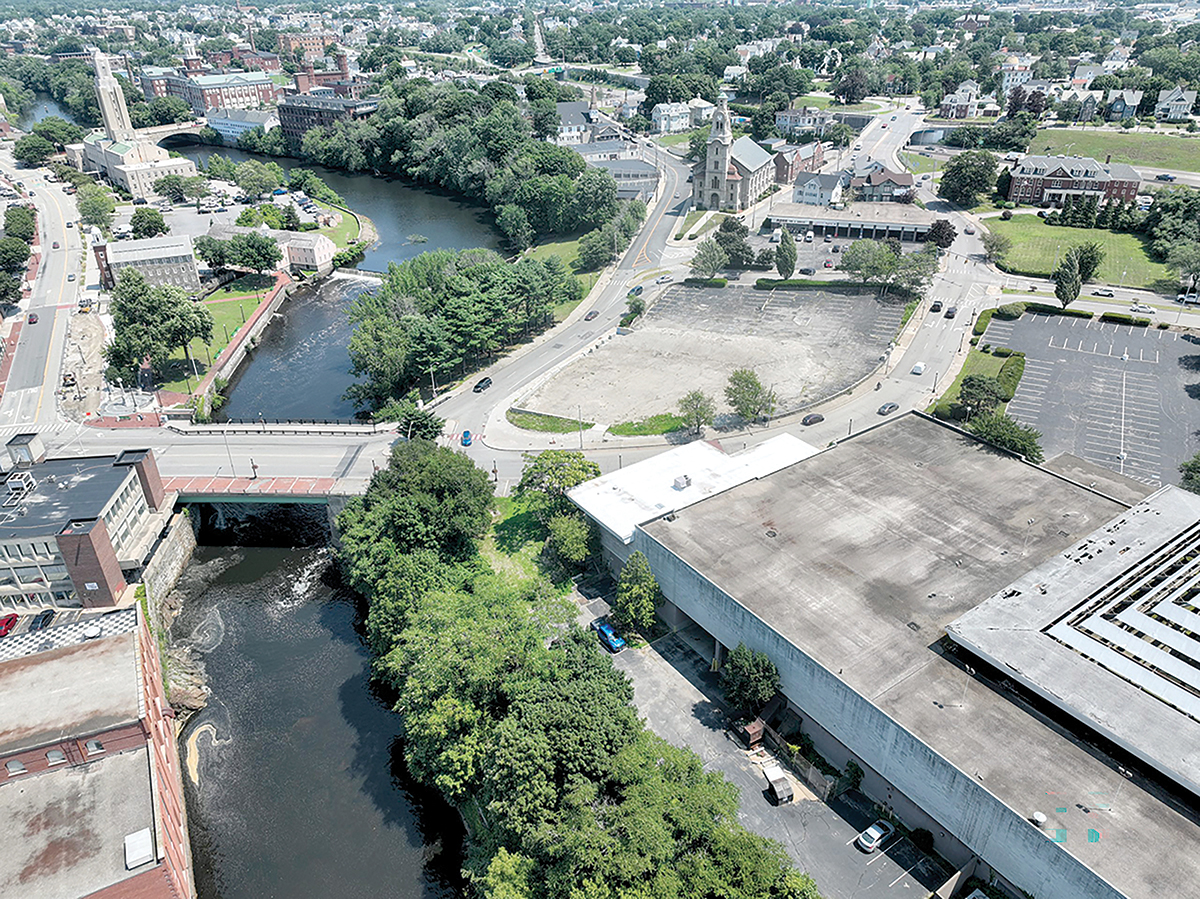
After more than six months of review, Pawtucket officials have narrowed six proposals for the former Apex department store property to three finalists, pushing the long-stalled riverfront parcel into its most advanced redevelopment stage in more than a decade.
Mayor Donald R. Grebien said a decision on the roughly 20-acre Seekonk River site could come as soon as early July, potentially setting the course for one of the city’s largest remaining development opportunities.
The move follows years of stalled concepts, false starts and shifting visions for the former retail property – a highly visible site just off Interstate 95 that city leaders now see as central to Pawtucket’s next phase of growth.
But unlike earlier attempts, Grebien said the city is now negotiating from a stronger position, with major surrounding projects moving ahead.
“We’re in a position now where we can really shape what happens next,” Grebien said.
On June 22, city officials announced a $30 million infrastructure package for the so-called Phase 1B of the Tidewater Landing redevelopment, funding a new pedestrian bridge across the Seekonk River, expanded riverwalk connections and stormwater upgrades that will allow private developers to add to the existing 10,000-seat stadium that’s already there.
For Grebien, the timing matters.
For years, Apex and Tidewater were often discussed as separate pieces of the city’s redevelopment puzzle. Now, he said, they are increasingly being viewed as interconnected.
“It’s making it an active zone that connects with Slater Mill and the other side of the river,” he said. “What I want to see is something that’s active. Something that connects everything together.”
Pawtucket Foundation President Gaetan Kashala, who serves on the Apex selection committee, said the vision for the area has evolved.
“We view this really as a historic opportunity to transform the urban landscape,” Kashala said. “Apex is kind of the front door.”
Kashala said recent milestones – including Centreville Bank Stadium, the new Pawtucket-Central Falls Transit Center, and Tidewater’s continued infrastructure buildout – have helped create the kind of momentum earlier Apex efforts lacked.
“The momentum is palpable,” he said.
Kashala said the clustering of transit, housing and entertainment projects is beginning to create the kind of development “ecosystem” Pawtucket has been trying to assemble along its riverfront for more than a decade.
The Apex site itself has cycled through multiple redevelopment concepts since at least the early 2010s, including a proposed Pawtucket Red Sox minor league baseball stadium at the site in 2017 and a later potential expansion site for Hasbro Inc.
None moved forward.
But now, Kashala said Pawtucket is drawing more-serious interest from developers.
“There’s increasing recognition of the city’s assets,” he said, pointing to rail access, highway visibility and a growing entertainment district.
The city acquired the Apex property in 2021 and launched its current redevelopment process through a formal request for proposals last year.
Officials say that the process has been more structured than previous rounds, with outside evaluators and city planners working alongside the Pawtucket Redevelopment Agency to narrow submissions.
Grebien said the current review has moved beyond conceptual planning and into financial analysis.
“They’ve evaluated all the bids, they’ve evaluated the concepts, and now they’re going a little deeper to see the finances,” he said.
While the proposals remain confidential, Grebien said all three finalists are centered on residential development, with varying combinations of retail, hospitality and recreation.
“All are solid; all around residential,” he said. “Some retail, hotel and not all of them have the same thing.”
According to Grebien, one proposal includes retail, while another features a sports and entertainment component designed to complement the stadium district.
Others include family-oriented recreation concepts, mixed-income housing and condominium-heavy designs.
“There’s a variety of stuff they’re trying to capitalize on,” he said.
The city is also evaluating how much public support each proposal would require, including tax stabilization agreements and tax-increment financing incentives already attached to the district.
“Some are looking for subsidies, some offsets, tax stabilization agreements,” Grebien said. “We have an obligation on that property. We’re balancing that out as well.”
For city leaders, the question now is less about what can be built there and more about what should be.
Grebien said the goal is to maximize long-term tax revenue while ensuring the project fits into what he described informally as an emerging “S-E-A district” – a broader sports, entertainment and arts corridor stretching from the stadium through downtown and beyond.
“In terms of big properties, there’s not a lot left,” Grebien said. “Apex is one of the next biggest ones.”
After more than a decade of plans that never fully materialized, both Grebien and Kashala said the city finally has enough pieces in place for the riverfront plans to finish taking shape.
And that vision, Grebien said, is finally shifting from plans on paper to projects moving in lockstep.
“This is really all starting to come together at the same time,” Grebien said. “And that’s the difference.”