SMITHFIELD – Women who climb the corporate ladder can relate to being the only one in the room.
But being the only women doesn’t have to be a disadvantage. Instead, it offers an opportunity, a platform to share your voice and perspective with an audience who is often especially curious on what you have to say because of that “only” status.”
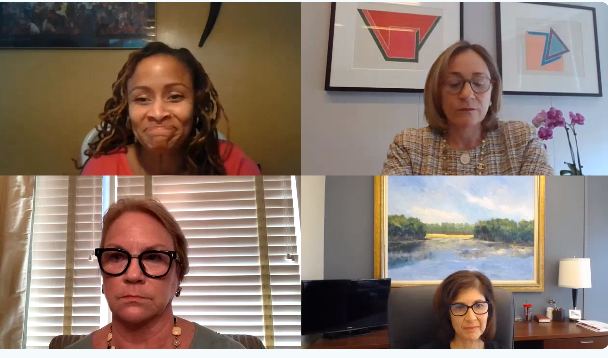
So said Cathy Bessant, chief operations and technology officer for Bank of America, during a panel discussion at the Bryant University Women’s Summit on Wednesday. Bessant, like fellow panelists and Bank of America executives Christine Katziff and Katy Knox, drew upon her own experiences in offering advice for what to do – and not to do – to succeed in a male-dominated setting.
Wanting to be a “team player,” Bessant recalled how she would often hold back during staff meetings, waiting to let others speak first. By the time she was ready, the rest of the group had moved on to another topic.
She urged listeners to take initiative, to speak up – often made easier in the age of virtual video meetings with “raise your hand” tools in Zoom and Microsoft Teams.
Knox, private bank president, was quick to add that while being a woman has presented challenges, there are advantages too. Strong multi-tasking skills and the ability to network and bring people together should not be underestimated, she said.
“As women, we have to pull from those strengths,” she said,
Equally important is a network of mentors, advisers and supporters to help you through these times, to bounce ideas off, and even, sometimes, to challenge you. Katziff, the bank’s chief audit executive, recalled a particularly “disastrous” presentation to the bank’s board of directors in her early days. She had solicited feedback beforehand from a number of people, all of whom agreed with her.
Looking back, she should have continued getting input from those who might disagree or offer a different perspective, she said.
The board presentation was just one example among many the three panelists gave of setbacks and even failures experienced along their paths to success. Bessant was once demoted, and had half her portfolio taken away. Key to her comeback was her attitude, using the events as an opportunity to improve while doubling down on a commitment to be her “authentic” self.
Bessant explained,“authenticity doesn’t mean you get to yell at someone, it doesn’t mean you get to be petty in a meeting. Authenticity actually requires, I think, a lot of care so your authenticity comes through in how you behave.”
While it can be onerous to make yourself vulnerable, to stay true to yourself when the corporate culture might say otherwise, doing so sets an example and a tone for others to follow, Knox said, adding that she makes it a point to get to know her younger employees and mentees, to learn who they really are and to support them in practicing that authenticity in the workplace.
Patrice Wood, Bank of America’s senior audit director who moderated the panel, spoke to the value of her own mentor relationship with Katziff. She was among the friends and allies Wood consulted when deciding to dreadlock her hair – a nerve-wracking decision in a traditional banking institution like Bank of America. While Katziff is white and does not share Wood’s experience as a Black woman, she still could offer insight.
The lesson, according to Wood, “know your circle. They may or may not be exactly like you but they themselves can be a very strong ally for you.”
Nancy Lavin is a PBN staff writer. You may reach her at Lavin@PBN.com.