Providence has had its share of conventional performing arts: stage plays, philharmonic music, Broadway shows, ballet. But increasingly, it also offers more cutting-edge fare, from Cambodian dance, music and puppet theater, to music by a string quartet backed by projected images and NASA recordings from outer space.
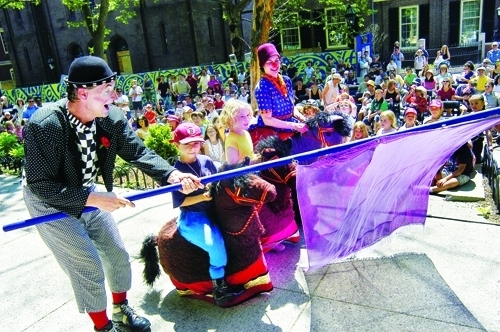
One of the drivers of all this unusual artistry is FirstWorks, a four-year-old arts organization that produces the FirstWorksProv festival in the fall and the FirstWorksKids festival in the late spring. The festivals include a heavy dose of community outreach, in which musicians, dancers and storytellers fan out to schools and neighborhoods to talk about their art and encourage kids and adults to give it a try.
FirstWorks is a direct outgrowth of First Night, the organization that produced 18 successive New Year’s Eve festivals before it turned out the lights for the last time on Jan. 1, 2003.
Even before First Night folded, the corporation that ran it did some strategic planning to determine what sort of arts organization, if any, should follow it, and Kathleen Pletcher, artistic director of First Night, led an effort to create the group that is now FirstWorks, for which she became executive artistic director.
The group’s earliest ally was the city’s then-new Department of Arts, Culture and Tourism. The young FirstWorks hastily pulled together its first biannual festival in spring 2003.
Since then, FirstWorks has produced the biannual festivals on an annual budget of about $500,000, said Pletcher. Sources of funding are corporate and other sponsorships, ticket sales, grants from the National Endowment for the Arts, and state and city grants.
“FirstWorks – especially its children’s festival – fulfills a niche that no one else does,” said Cliff Wood, a city councilman and vice-president of the FirstWorks board. “The arts are important as a contributor to the breadth of the city.”
Normand Benoit, treasurer of the board, added, “There are many different connotations of art. FirstWorks brings in something new, something fresh.”
The shift from First Night, producing a gigantic, one-night event, and FirstWorks, producing two smaller festivals a year along with continuous involvement by artists in local neighborhoods – was an outgrowth of several trends converging in cities all over the country.
First Nights across the nation, which began in the 1980s with a message of alcohol abstention and wholesome fun on New Year’s Eve, have been losing their oomph over the years. And First Nights are expensive – the cost of Providence’s last First Night was about $500,000 – so fundraisers were straining to raise money.
After the catastrophe of Sept. 11, 2001, Americans began to turn inward to family and simple pleasures, and corporations – a major source of First Night sponsorships everywhere – began to change their philanthropic emphasis toward social services, community betterment and youth education, even as they were besieged by a growing number of nonprofits asking for money.
“In a world at war, art for art’s sake is a hard sell,” said Lynne McCormack, director of the city Department of Art, Culture, and Tourism.
“There is tremendous competition by nonprofit organizations looking for support from corporations, and the sources of funding are not able to keep pace with them,” said Frederick Butler, president of the FirstWorks board and a Textron Inc. executive. In addition, he noted, several major Providence corporations have moved away or been absorbed by outside entities, leaving fewer companies the nonprofits can ask for help.
Butler said Textron supports FirstWorks because of its efforts at community outreach and its determination to make performing arts accessible to everyone. “FirstWorks fits into [Textron’s] vision of what it is going to take to turn Providence into a leading city,” Butler said.
Providence also has joined the ranks of other attractive, mid-sized cities with talented, diverse populations in promoting itself as a dynamic place for people to live and work, and for tourists to leave their dollars.
The Sept. 11 attacks, the natural demise of First Night, and new financial and promotional pressures percolated over the first five years of the century and eventually offered an opening for a small, innovative arts organization that wanted to specialize in “firsts.”
As it’s played out, FirstWorks has become a showcase for premieres and avant-garde artists; brought young people from poor neighborhoods to their first professional performances; and encouraged people of different backgrounds, such as Brown University students and Johnston-based Cambodian monks, to mingle in the city’s downtown.
McCormack noted that a new study by Americans for the Arts states that the arts generate $111.8 million a year for Providence. But McCormack said money is only one of the benefits of public art.
“Festivals are the kind of thing that make people feel part of a community,” she said. “For example, if WaterFire didn’t happen at the time the rivers were opened downtown, people wouldn’t be gathering at the river. People learn about each other by getting together in person. This gives a community its soul.” •