
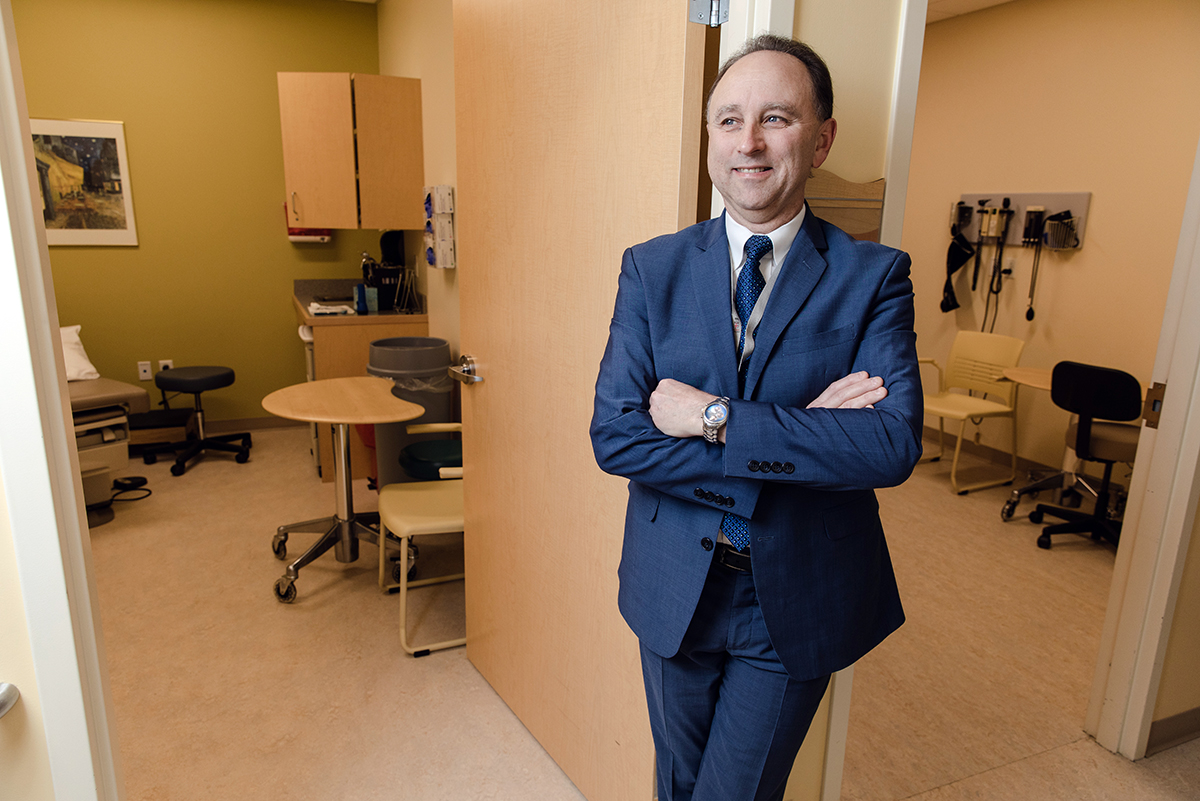
C-SUITE AWARDS 2020 CHIEF MARKETING OFFICER, LARGE PRIVATE COMPANY: Dana Alexander Nolfe | Rhode Island Medical Imaging Inc.
INSOMNIACS TEND TO be studious thinkers. They’re up all night, dissecting tomorrow before it even arrives.
Cybersecurity Awareness Month: What to Do When Your Identity Is Stolen
In recognition of Cybersecurity Awareness Month, it is important to remember that identity theft affects…
Learn More
For David Hemendinger, sleeplessness is precious fuel in the 24/7 realm that is the health care industry.
“Not needing a lot of sleep, I found that sort of fit with the paradigm of health care today,” he said.
Driven by a quest to understand how things work, Hemendinger obtained his master’s degree in health care from Bryant University. His enthusiasm for data is apparent in his current role as chief information officer at East Providence-based Brown Medicine. Hemendinger oversees the day-to-day and strategic information technology operations for a medical group of more than 200 physicians teaching, researching and practicing in numerous specialties.
Brown Medicine CEO Ann M. Kashmanian has noticed Hemendinger’s relentless energy.
“David works tirelessly in the pursuit of creating technological changes that enhance the workflow and workday of our physicians,” she said.
A smooth workflow requires a deft understanding of the technics needed to make it happen and, for Hemendinger, these changes begin in the IT department. When he arrived at Brown Medicine in July 2019, the physician group lacked a formal IT strategy. So he implemented a robust three-year plan, prioritizing physicians in the first year.
Hemendinger notes that today’s doctors deal with a multitude of both patients and data in a health care system that’s as complex as ever. He introduced improvements such as a virtual scribe program that allows for digital dictation of patient visits, and federated sign-in so doctors working at different offices can log in across scattered systems.
“[Physicians] are folks that we as technologists need to find creative ways to de-stress,” Hemendinger said. “Even prior to COVID-19, from an IT perspective, we were focusing on physician burnout.”
‘David works tirelessly in the pursuit of creating technological changes that enhance the workflow and workday of our physicians.’
ANN M. KASHMANIAN, Brown Medicine CEO
The idea isn’t to make physicians’ jobs easier but more manageable. Another initiative saw collaboration with the R.I. Department of Health on a Healthcare Training Consolidation Act, in the hopes of streamlining facility- and state-mandated compliance and credentialing. Hemendinger said centralized training can consolidate once-redundant sessions from 20 hours annually to about 10 hours.
“If [doctors] practice at multiple locations, the training is quite extensive,” Hemendinger said.
Hemendinger’s career, which includes 17 years at Lifespan Corp. and five years at HopeHealth, helps break down some of the parochialism that exists at a technology and workflow perspective.
Additional experience as a licensed EMT-B, as well as a former chief operating officer at Woonsocket-based Summer Infant Inc. (doing business as SUMR Brands) familiarized Hemendinger with nuances of health care delivery, from product design to chaotic emergency rooms to everyday follow-up visits.
Questions of preparedness have become ultra-relevant in a health care system strained by COVID-19, but one might consider Hemendinger a sophisticated prepper. He remembered Brown Medicine President Dr. Louis P. Rice’s words: “Dave, your career has been built for this.”
While doctors’ offices nationwide were scrambling to institute telemedicine, Brown Medicine was ready. Hemendinger had instituted “Televisits” within his first month on the job.
Televisits are only one part of the data-driven changes Hemendinger plans to roll out. He’s most excited for an artificial intelligence-powered project that will generate predictions that physicians can use as part of their thought process, he said. That’s in addition to more-ordinary measures, such as fortifying support for Brown Medicine’s teaching and research functions, or expanding services available to patients.
Hemendinger sees IT forming a roadmap of the infrastructure that’s needed. For him, the notion that a patient’s care might be enhanced by a computer’s foresight is idealistically bright.
“It all rolls back to my philosophy of the physician: [Gathering] all the information … at the right time, in the right way, [doctors] can consume it with the patient. Then everyone can make the next best step,” he said. “I love the ability to get us to that utopia.”