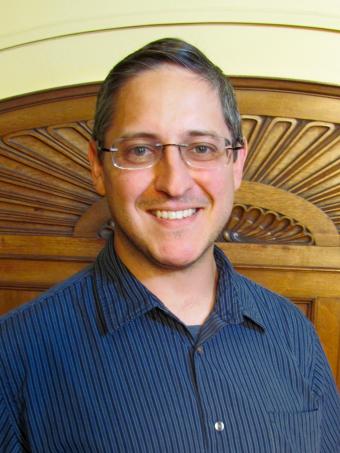
PROVIDENCE — Brown University researcher Carlos Vargas-Irwin has won a $1.5 million New Innovator Award from the National Institutes of Health’s High-Risk, High-Reward Research program to use cameras and brain electrode implants to decipher how thought controls movement in rhesus macaques.
The five-year study will help fine tune control of prostheses and provide scientists better insight into how people’s thoughts can be used to control external devices, said Vargas-Irwin.
Building a Strong Data Foundation in the Age of AI
Artificial intelligence (AI) has become a key priority in the boardroom and across management —…
Learn More
“The goal of this project is to better understand the interaction between sensory and movement-related information so that we can interpret signals related to intended actions more accurately,” said Vargas-Irwin, who is part of the BrainGate collaboration led by researchers from Brown, Case Western Reserve University, Stanford University, Massachusetts General Hospital and the Providence V.A. Medical Center.
Vargas-Irwin’s project will combine an external camera and artificial vision with the neural activity information from a neural decoder, read through baby aspirin-sized implants in the brains of rhesus macaques. To implant the devices, which contain 100 electrodes, each able to record the activity of 1-4 neurons, his team will need to open the monkeys’ skulls, and set the electrodes in the dura layer of the brains. Each implant allows researchers to record information from 50-100 neurons, Vargas-Irwin said.
Vargas-Irwin and his team will train rhesus macaques to perform different movements while they capture three different sets of information. The team will record the macaque’s neural activity, use a Hollywood-style motion capture system to track its precise movements, and record the visual environment with a camera and artificial vision. Then the team will take the motion capture information and the artificial vision information and try to predict the neural activity.
They’ll know they’ve succeeded when they can use the monkeys’ neural activity and the artificial vision information to correctly predict its movement.
The team will focus on the monkeys’ arm movements, Vargas-Irwin said.
“It’s the part of the body that’s the most dexterous,” he said, so it will provide the most information for their study.
This study marks the first in which researchers have actively modeled such signals, Vargas-Irwin said.
“But if we can understand these signals better, we can get a more accurate prediction of the intended movement, then stimulate the muscles to provide the motion intended.”
The information will be compared with a parallel clinical study under way using human subjects, Vargas-Irwin said.
John Donoghue, a BrainGate leader and Brown professor of neuroscience who has worked with Vargas-Irwin for more than 15 years, said he was pleased to see the NIH recognize Vargas-Irwin with the prestigious award.
“His project brings a clever approach to achieve much better control for brain computer interfaces by adding visual information to neural signals in a novel way,” Donoghue said. “This research will advance both basic understanding of how sensory signals contribute to coding of movement by the brain and practical knowledge on how to create useful BCIs that restore movement to people with paralysis.”
Rob Borkowski is a PBN staff writer. Email him at Borkowski@PBN.com.