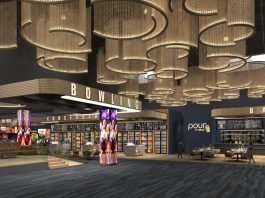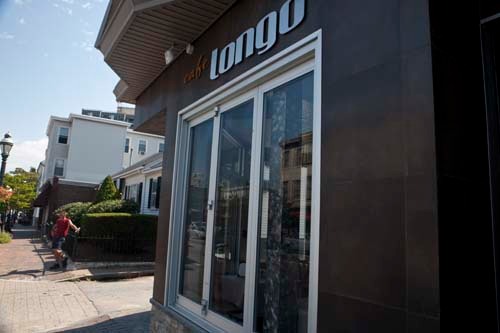
The claim of a Florida restaurateur that a Federal Hill café owner copied key aspects of restaurants that he established in Florida and Nevada raises thorny legal questions about what a business owner can and cannot borrow from colleagues and competitors.
Basilico Enterprises Inc., a Florida corporation doing business as Café Martorano, on July 28 filed suit in U.S. District Court, Providence, alleging that Jerry Longo, owner and operator of Café Longo LLC on Atwells Avenue, intentionally replicated details of the restaurant concept created by Steven Martorano “to exploit” the latter’s fame and recognition, the 23-page complaint states.
“Café Martorano offers a unique and inherently distinctive sensory experience, combining South Philadelphia, Italian-American food with a high-energy dining experience,” the complaint states. As they eat, diners watch clips from movies such as “Scarface” and listen to music by such performers as Frank Sinatra, both movies and music played at exceptionally loud volumes for “an experience similar to dining in the middle of the dance floor of a nightclub,” according to the lawsuit.
Martorano has restaurants in Hollywood and Fort Lauderdale, Fla., and Las Vegas, and, according to the complaint, he has plans for literary and television promotions, including a cookbook/autobiogra-phy. He maintains that Longo, who was once a friend of his, copied his menu and recipes, and plays the same movie clips and the same music, also at loud volumes. Longo could not be immediately reached for comment.
Martorano seeks not only an unspecified amount of monetary damages, but also profits realized at Café Longo and the destruction of all menus, signs and marketing materials that allegedly imitate Martorano’s business. Café Longo opened in the spring of 2009. Martorano established his first restaurant in Fort Lauderdale in 1993.
Zoe Argento, assistant professor at Roger Williams University School of Law in Bristol, said that the legal term “trade dress” refers to the visual image of a product as presented to customers and can include the distinctive décor, menu and style of a restaurant.
Argento said the plaintiff must prove three basic elements:
• That he owns a trade dress distinctive to his business and easy for customers to recognize.
• That customers are likely to be confused about the source or sponsorship of a business due to the alleged infringement.
• That the trade dress elements in question are not functional, i.e. a required part of doing business.
“The visual image of a product is inherently distinctive if it can be immediately identified by a consumer as an identification of source, not as functional or even as mere decoration,” Argento said. “The court views all the elements of the visual image as a totality, basing its decision on a comparison of the entire look of the visual image.”
A seminal case in trade dress infringement, Two Pesos Inc. v. Taco Cabana Inc., was decided by the U.S. Supreme Court in 1992, she said. The court ruled that Taco Cabana, a chain of Mexican restaurants, had distinctive elements immediately recognizable to a customer so they cannot be copied by others, according to Argento. Those elements included bright colors, paintings, murals, awnings and umbrellas.
In another case, Fuddruckers v. Doc’s B.R., the court found that the visual elements of the Fuddruckers restaurant were not inherently distinctive. Those elements included: food preparation areas visible to customers, self-service bars for condiments, white tiles, neon signs, mirrors and a décor of brown and white.
She said the distance between the establishments could be a factor in the Café Longo case because it pertains to “how likely it would be that customers could be confused” about ownership of the eateries.
As for the potential remedies that Martorano seeks – monetary damages, Café Longo profits and destruction of the allegedly copied materials – Argento said these are not unusual in trade dress infringement cases.
Damages also can be more if the plaintiff has registered his business’ characteristic features with the U.S. Patent and Trademark office in Washington, D.C., according to Argento. Whether the suit could result in such a drastic step as a court-ordered closure of Café Longo is not clear, she said, and would vary case by case.
If a business owner unwittingly copies the trade dress of another enterprise, that owner could still be in legal trouble, Argento said. However, in that case, damages could be less than those incurred by an owner proven to have intentionally copied a rival’s trade. •