Stonecutting tradition lives on in Newport
When John Stevens opened his stonecutting shop on Newport’s Thames Street in 1705, he had plenty of room for artistic license.
Printed material was a rarity in the colonies in those days, leaving stone carvers to rely on their own interpretation of letters and symbols. They took their mallet and chisel to a clean slate much like a painter with his brush to a blank canvass.
“There wasn’t much printed material to look at, so the stuff basically came right out of their heads,” said present John Stevens Shop owner Nicholas Benson, grandson of John Howard Benson, who acquired the shop in the 1920s from an eighth-generation Stevens.
Today, it’s as if the small shop is stuck in a colonial time warp. Much as John Stevens did nearly 300 years before, all of the shop’s letter design is original and carved by hand – keeping alive an art form that has all but disappeared amid computer graphics and mechanical carving techniques.
Hand-carved inscriptions by the shop’s progeny of artisans adorn nearly every Ivy League campus. Its signature lettering – a melding of classical Roman and contemporary styles – can be found on the Iwo Jima and John F. Kennedy memorials in Arlington, Va., and the Franklin Delano Roosevelt memorial and National Gallery of Art in Washington, D.C.
And for the past year, Benson has been toiling away on another project that will etch the shop’s place in history: the World War II Memorial, now under construction in Washington, D.C. Benson has a contract to design the inscriptions and said he likely will be selected to do the carving later this year.
Friedrich St. Florian, the renowned Austrian architect and Rhode Island School of Design professor appointed to design the World War II Memorial, has called the John Stevens Shop “our country’s premiere experts in inscriptional carving.”
Benson has come up with a special letter design that he thinks conveys the bold yet reflective mood of the memorial. His inspiration: World War II-era advertisements from old Life magazines, a sort of retro, sans serif design – but framed within the shop’s trademark Roman capital lettering.
He keeps a three-ring binder stuffed with sketches of the nearly two dozen parts of the memorial that will be inscribed. The printouts are generated from lettering that Benson designed by hand and then scanned into a computer.
“Like everything we do, the font is based on lapidary lettering,” Benson said, “on my own brushwork.”
It wasn’t always so at the John Stevens Shop.
By the time John Howard Benson bought the business from the Stevens family in 1927, it was a bit rough around the edges, its artistic identity somewhat diminished by a trend toward a rote imitation of typography, Nicholas Benson said.
“A customer would see a design and say they wanted that exact same font and style, rather than leaving it up to the carver,” he said. Some carvers, he added, even stooped to sneaking into cemeteries and re-carving colonial-era work to reflect the popular style of the time.
But Benson’s grandfather, a Newport native who harbored a particular fondness for the Newport Common Burial Ground, decided to buy the shop with the intent of making gravestones in the tradition of the colonial carvers, injecting artistic integrity back into the shop’s trade.
John Howard Benson was a printmaker and painter (he was the original designer of the Rhode Island School of Design’s diploma and seal). He reintroduced the use of a broad-edged brush for designing inscriptions and emphasized painstaking attention to letter design.
He died relatively young, in 1958, and his son, John Everett Benson, (Nicholas Benson’s father), eventually took over the business. A sculptor by training, he brought a naturalist style to the trade, and was commissioned to carve high-profile projects such as the headstones for John F. Kennedy, Robert Kennedy and Jacqueline Kennedy Onassis.
Nicholas Benson, now 38, took over the shop in 1993, after studying calligraphy and letter-form design at the Basel School of Design in Switzerland.
Headstones remain the shop’s bread and butter, accounting for about 90 percent of its revenue. A well-heeled clientele is willing to pay top-dollar – sometimes as much as five times the average price of a headstone – for John Stevens craftsmanship.
There’s good reason for the premium, said Nicholas Benson, who doesn’t hide his disdain for what he calls the “monument industry.” Most large carving operations are able to cut, design and carve headstones – mostly via computer applications – in a day. Carving a typical tombstone takes Nicholas Benson about a week-and-a-half.
Paper mockups of headstones and faded posters of hand-brushed letters plaster the walls of the dimly lit, wooden-beamed shop, housed in a dark-green colonial storefront on a residential section of Thames Street. It’s just a block or two from the Common Burial Ground, where hundreds of the shop’s headstones mark the final resting place for generations of Newporters.
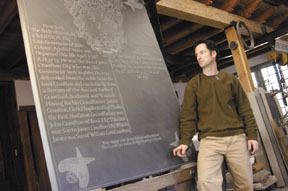
In the back of the shop, a massive headstone, about 6 feet tall and weighing 1,400 pounds, stands propped on a large wooden easel. The granite slab is a replica of Rhode Island Gov. John Cranston’s headstone, which has stood in the burial ground since 1727. Since July, Nicholas Benson and his apprentice, Cristine DeMarco, have been designing and carving the replica, which will replace the crumbling original sometime this spring.
The original stone is an “early John II,” Benson said, and despite the stature of its original designer, Benson and DeMarco decided to tweak the lettering just a bit, in an attempt to replicate John II’s later work.
“His early lettering was pretty funky,” Benson said. “But as he got older, he got really, really good.”