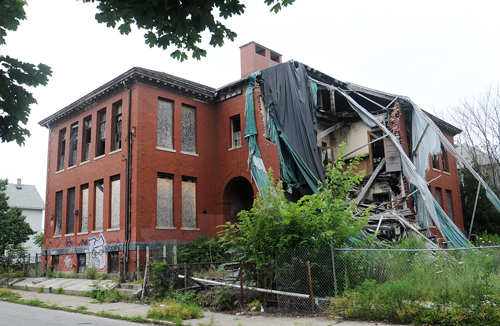
Contractors who walk through the former Grove Street School – a 109-year-old building Michael A. Tarro and his siblings inherited from their late father, Stephen A. Tarro, and partially demolished in 2007 – all react similarly, says Tarro.
“When I show them the building and they see the inside, they say, ‘Oh my God,’ ” Tarro said recently. That’s right before most say the building’s condition makes it “unsalvageable,” he added.
But late last month, Providence’s Department of Inspection & Standards issued an order saying that Tarro has 30 days to get all the proper work permits to stabilize it. The order would prevent Tarro from doing what he wants with the building, which is tearing it down. At least one neighborhood group has argued for the building’s preservation, citing its historic significance as part of the Broadway-Armory Historic District.
The city order came just a few weeks after the R.I. Supreme Court issued a decision that puts the power to authorize demolition of the building back into the hands of the city’s building inspector – who previously had called for it to be stabilized, according to Edwards, Angell, Palmer & Dodge Partner Deming E. Sherman, an outside attorney the city hired to represent it because Tarro is an assistant city solicitor.
In a nine-point list, the city is asking Tarro to repair the floors and roof, to “shore up” rafters and seal up the building.
The Grove Street School issue began percolating in February 2007, when the Tarros started demolishing the building without a city permit. The contractor, Bilray Demolition Co. Inc., got through about 10 percent of the building, according to court records, before the city could halt progress. Then Kelly Anderson, the city’s building official, in a July 23, 2008 order told Tarro that he had to stabilize the building.
Tarro appealed that order. After a fall 2007 trial, the R.I. Superior Court made it clear that the Tarros shouldn’t have started knocking the building down, but also instructed building officials to order the building’s demolition.
The city appealed the order and the high court’s ruling, written by now-Chief Justice Paul A. Suttell and released on July 2, overturned the lower court’s ruling for Anderson to order the demolition.
“It … requires the building official to take action,” Sherman said, “but it doesn’t say what action he has to take.”
Neither Anderson nor Mayor David N. Cicilline’s office have returned calls for comment in the last two weeks.
For members of at least one neighborhood organization, there’s a possibility for redevelopment at the 0.36-acre site.
Kari Lang, executive director of the West Broadway Neighborhood Association, recently pointed to a 36-page report from Charles Hegenah Architects as proof that the building could be reused.
Mayor Cicilline “deserves much praise for standing behind this important Federal Hill building that taught generations of Federal Hill students,” Lang said in an e-mail. “The court ruling is a victory for the neighborhood and preservationists. It gives the school a second chance and the good news, as [Hegenah’s] report proves, is that the building is sound and reusable.”
In a 2007 structural review, architect Wilbur E. Yoder, a Rhode Island School of Design professor and principal at Yoder + Tidwell Ltd., said the building’s structure “is in very good condition,” except for the demolished section, the windows, doors, interior finishes and mechanical systems. “The architectural challenge would be to develop a scheme for its reuse and restoration,” Yoder added.
But Tarro has also hired contractors to give their opinion on the building. Gerald Vezina, a structural engineer and member of the International Building Code Council, has stated the building is unsafe and at risk to collapse.
Tarro said that if there was a viable plan to save the building, it likely would have been proposed by now.
He says he’s unsure whether he will continue to fight the ruling. He’s had two offers for the building: $100,000 and $115,000. He added that both were too low for a property that the city assesses at $227,200, about 95 percent of which is attributed to the land.
In the early 1980s, Stephen Tarro bought the building – a two-and-a-half-story brick structure in a residential neighborhood on the city’s West Side – for about $10,000. He had planned to knock it down and create a parking lot. The school had closed a few years prior to the purchase. But Stephen Tarro never reached a written agreement with the city on the plan. •