
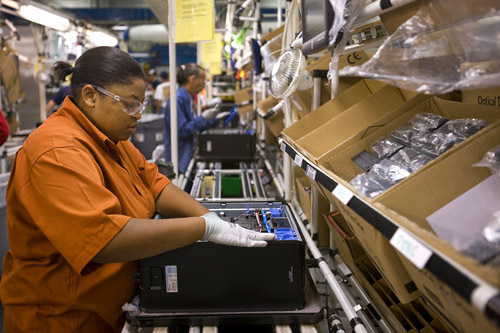
Proving Kermit’s adage, Dell Inc. spent three years building 25 prototypes before the computer maker found a way to twist bamboo into a natural fiber exterior for its new “Hybrid” desktop machine.
The personal-computer industry, like Jim Henson’s gangly Muppet frog, is finding it isn’t easy being green. Creating biodegradable packaging, eliminating toxic chemicals from components and using energy-efficient chips means throwing out designs used for almost 30 years and starting over.
For Dell and Hewlett-Packard Co., fighting for sales in a market with some of the tightest profit margins in technology, the numbers are starting to add up. About 25 million shoppers say they would pay more for “greener” PCs, a Forrester Research Inc. study found. And expenses have dropped, with estimates showing it costs just 3 percent more to produce the new PCs.
“This is going to be a deciding factor for customers now,” said David Daoud, an analyst at Framingham, Mass.-based IDC who researches green technology.
The Forrester study found 12 percent of the U.S. adult population would pay more for earth-friendly PCs. Half of businesses surveyed in April 2008 say they use environmental impact as a criterion in purchasing decisions, twice as many as in 2007, Cambridge, Mass.-based Forrester said.
The credit crisis and possible economic recession may hamper those intentions. While these PCs lower energy costs and save money, the vendors still have to prove consumers and corporations will spend the extra money up front.
The PC shift comes as consumers and businesses take steps to be ecologically aware, from replacing plastic grocery bags with reusable ones to replacing the corporate fleet with hybrid cars such as Toyota’s Prius. Companies are buying compostable cafeteria utensils and signing contracts to use renewable fuel to power offices and plants.
Round Rock, Texas-based Dell bills its Studio Hybrid, released in July, as the company’s “greenest PC ever.” Aimed at consumers and small businesses, the bamboo-clad computer starts at $599, about mid-range for the consumer desktop PCs on Dell’s Web site. A version with a plastic sleeve, recyclable in some communities with extensive reuse programs, is $100 less.
Gone is the boxy design. This desktop is 80 percent smaller and the plastic sleeve comes in colors like Ruby and Quartz. The 16-inch by 6-inch by 18-inch machine is now 8.8 inches tall, 3 inches wide and 8.3 inches deep and uses as much as 70 percent less energy. The bigger boxes, designed to be filled later with more drives and memory, are rarely used that way, wasting the electricity.
“Our big epiphany is that you cannot walk away from the principle of appeal,” said Ken Musgrave, who leads Dell’s research into how customers relate to the feel and appearance of computers. “Unbelievable as it may seem, Dell and chic are being uttered in the same sentence.”
Green PCs cut energy costs 21 percent a year by adding a new power supply system that costs $20 more, said Hewlett-Packard’s Kirk Godkin, senior product manager for corporate PCs.
A business that buys 2,000 would spend $40,000 more. Each desktop saves $6 to $25 in energy costs annually. Companies that leave computers running around the clock would save $50,000 and recoup their investment the first year, he said.
Still, even with these steps, PCs are not as earth-friendly as they could be, Forrester analyst Christopher Mines said.
“H-P and Dell are making credible strides, but remember that these guys have PCs to sell this month, this quarter,” he said. “The greenest thing the PC companies could do would be to lengthen the lifecycle and warranty of their products, making PCs more upgradeable and modular – so they don’t have to be purchased and thrown away so often.” •


