
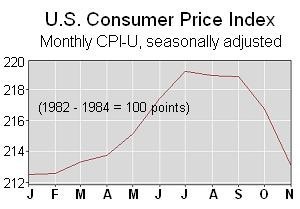
WASHINGTON – The decline in consumer prices accelerated last month, eclipsing October’s record plunge, the U.S. Department of Labor’s Bureau of Labor Statistics reported today. Excluding food costs and falling energy prices, however, the core index was unchanged from the month before.
The nationwide Consumer Price Index for All Urban Consumers (CPI-U) fell a seasonally adjusted 1.7 percent in November, compared with the month before, extending its decline to a fourth consecutive month. The index fell 1 percent in October – until last month, the sharpest decline since record-keeping began in 1947 (READ MORE) – after falling 0.03 percent in September and 0.14 percent in August.
The decline matched the most pessimistic of estimates in a Bloomberg News survey of 71 economists, whose median forecast called for a 1.3-percent decline. (Their estimates of the index’s November decline ranged from 0.4 percent to 1.7 percent.)
The core CPI-U excluding food and energy products was steady last month – lagging the survey’s estimate of a 0.1-percent gain – after falling 0.1 percent in October and rising 0.1 percent in September and 0.2 percent in August.
Food prices edged up 0.2 percent month over month, slowing from increases of 0.3 percent in October and 0.6 percent in each of the preceding two months. Energy prices, however, plunged 17.0 percent in November – in their fourth consecutive monthly decline – after falling 8.6 percent in October, 1.9 percent in September and 3.1 percent in August. Gasoline prices led the decline, falling 29.5 percent compared with September, to 47.0 percent below July’s record high.
Compared with a year ago, the CPI-U rose 1.1 percent – to a November level of 212.425 points (December 1999=100) that was the lowest since this February – after rising 3.7 percent in October. Analysts had expected a 1.5-percent gain.
The core index rose 2.0 percent year-over-year, slowing from gains of 2.2 percent in October and 2.5 percent in September. Food prices rose 6.0 percent compared with a year ago, slowing from October’s 6.3-percent gain, while energy prices fell 13.3 percent year over year, erasing October’s increase of 11.5 percent.
In the Northeast, the CPI-U rose 1.7 percent year over year to 232.354 points (December 1977 = 100). Food prices rose 6.4 percent compared with November 2007. Energy prices in the region fell 9.3 percent, led by a 24.6-percent decline in the price of gasoline.
“We had a bubble in oil, the bubble has burst,” David Wyss, chief economist at Standard & Poor’s in New York, told Bloomberg Television. “One thing recessions are really good at is bringing down inflation.”
With inflation out of the picture, analysts were predicting that Federal Reserve policymakers – who this afternoon wrap up their regular two-day meeting – will pare their benchmark federal funds interest rate to 0.5 percent, from the current 1.0 percent, rather than slashing the rate to 0 percent as some had been predicting.
Meanwhile, average weekly earnings adjusted for inflation – “real” weekly earnings – rose 2.3 percent compared with October, the BLS said in a separate report. A 0.3-percent decline in the average workweek was more than offset by a 0.4-percent increase in average hourly earnings and a 2.1-percent decline in the cost of living, as measured by the Consumer Price Index for Urban Wage Earners and Clerical Workers (CPI-W).
Compared with November 2007, real weekly earnings rose 2.2 percent. Before adjustment for inflation average weekly earnings rose 2.2 percent, to $618.73 from the year-ago $594.13, the BLS said.
Additional information, including the 18-page Consumer Price Index report, is available from the U.S. Department of Labor’s Bureau of Labor Statistics at www.bls.gov/cpi; the five-page Real Earnings report can be found at www.bls.gov/ces.