You can’t really understand nursing homes until you put yourself in the elders’ shoes.
The members of the Nursing Home of the Future team knew that going in, but spending whole days with residents of the Tockwotton Home, hearing their stories, watching them in their rooms, in the dining area, in exercise class, at the card table … that really opened their eyes.
They saw how hard it is for seniors on walkers to use the bathroom. Realized how they might just stay in their wheelchairs for hours just because moving is too difficult. Noticed that even with all the activities on the calendar, there’s really very little to do all day.
And even at Tockwotton, which is widely considered one of Rhode Island’s best nursing homes, they saw how institutional, rigid and unhomelike life can sometimes be.
That is what this project aims to change. (READ MORE) Armed with reams of information gathered through site visits, interviews and research, and helped by partners from health care and academia to industrial design, the team hopes to reinvent long-term care for a generation of baby boomers.
“The Nursing Home of the Future is exactly the reason we created the Business Innovation Factory,” BIF founder, Chairman and “Chief Catalyst” Saul Kaplan said in a recent interview. “To bring a community of innovators together to come up with solutions to an issue we all face.”
In this case, the goal is to ensure older Americans get “the kind of experience as they age that they deserve.” But it’s also a test of a new model that Kaplan said he believes could make a national and international impact: take on problems on a big-picture, “systems level,” collaborate across disciplines, and test new ideas in real-world settings.
“We want to create a series of laboratories where we can roll up our sleeves and come up with solutions,” said Kaplan, who recently resigned as executive director of the R.I. Economic Development Corporation (EDC) to focus on his efforts at BIF. (READ MORE) “We want to work in health care, education, in the consumer space, in the citizen space, looking at public safety solutions.”
“And we want them all to be connected,” he added, “so that we can learn from each of the experiments, borrow ideas that work in one area and leverage them in another area.”
The nursing home project began in the spring, as a collaboration between BIF, Tockwotton and a diverse group of experts, including the MIT AgeLab, Brown University and Rhode Island School of Design faculty, Quality Partners of Rhode Island and the design firm Tellart. (READ MORE) In addition, the project attracted the support of two major consumer goods manufacturers, MASCO and SCA; as well as Ximedica, a local medical-device maker. And more partners keep joining the mix.
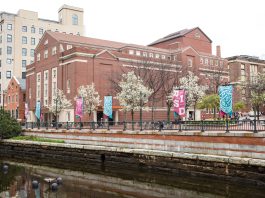
For Phase I, which started in early summer and cost about $160,000, Kaplan, project director Melissa Withers – who also recently left the EDC, where she was director of communications (READ MORE) – and 14 others set out to document every aspect of life at Tockwotton, a 30-bed assisted living center and 42-bed skilled nursing facility in Providence’s Fox Point neighborhood.
They had group discussions and one-on-one interviews with the Tockwotton staff, residents and family members. They learned how everything is done – how meals are served, medications dispensed and transportation arranged. They watched the staff give manicures, style hair and do makeup; they sat in on exercise sessions, games and TV time.
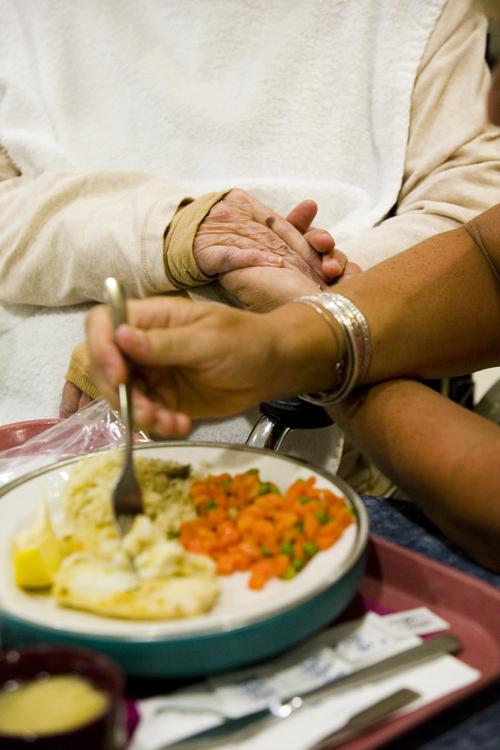
And they learned about life as a frail elder, watching seniors struggle on walkers and in wheelchairs, and nurses’ aides feeding residents when they couldn’t feed themselves, carrying them in and out of bed and escorting them to the toilet and the shower.
Team member Allan Tear analyzed every part of the bathrooms, quickly identifying design flaws such as the toilet paper’s placement behind the seat, where it would be hard to reach, and the sink so far and inconvenient that many seniors on walkers don’t even try to use it.
In the shower room, team member Julianne Gauron noted the clutter and wrote afterward, “Bathing should be calming, rejuvenating and a treat, but it doesn’t seem likely that it is here.” Residents can shower anytime, but most do so only once a week. She empathized.
“I sat in the shower chair, where the PVC piping of the structure, the medical green synthetic backing fibers and the jammed wheels it rested on, along with the toilet seat for a chair, did nothing to make me relax,” she wrote. “I tried to imagine sitting there naked as someone washed me … I felt ill at ease and exposed.”
Speaking with the seniors was especially instructive, the team found.
On one hand, they realized what extraordinary people were living at Tockwotton – a potter who once taught at the Museum of Modern Art in New York, a photojournalist’s widow who manages a collection that includes historic photos of John F. Kennedy, and an actress who was arranging a play with a director from the local arts community. They met a couple now separated by disability, she on the nursing home side, he in assisted living, still deeply in love, always together during the day. They tried to do a blood pressure clinic and instead found themselves teaching CPR to the seniors, who didn’t want to be reminded of their illness but relished the new experience and new acquaintances.
They learned about time and how, in some ways, it moves very slowly, Withers said, because many elders, especially if they have sensory disabilities, “don’t respond well to your jumping in and doing things quickly.” Yet seniors’ lives can also change very rapidly, she noted, when a fall or a health problem strikes. One resident who was among the project’s most enthusiastic participants, she said, was fine one day and devastated by a blood clot the next.
So how do you take all this knowledge and translate it into better nursing homes?
That is the challenge for Phase II, which is set to begin in the next few weeks and continue for about 18 months, Withers said. That’s when active experimentation will begin, guided by an “opportunity map” the team used to set priorities in different areas.
To better care for seniors’ bodies and minds, they want to create stimulating games and activities; design special furniture and technologies to maximize comfort and reduce pain; and come up with innovative low-risk physical activities, among other ideas.
They want to re-design bathrooms – toilets, sinks, shower areas – to make them easier to use, more welcoming and much safer, not just in the nursing home, but in assisted-living homes and for seniors’ own homes, so accidents that lead to institutionalization are prevented.
They want to use assistive technologies for a wide range of purposes, from remote monitoring of bathroom visits and wireless biometric monitoring, to communications devices and medication reminders for seniors who might forget their pills.
And across the board, they want to use technology, architecture and public-policy changes to not just make nursing homes better, but help elders stay healthier and more independent, so they don’t need institutional care at all.
“If we want to create the nursing home of the future, part of that is going to be keeping people out of it,” said Michael Lye, a team member and industrial design professor at RISD. People may be able to get the care they need at home, he said, in the community, or in more homelike environments, which is not only more dignified, but also far less expensive.
Indeed, the cost and logistics of caring for the baby boomers as they age is a big incentive to make big, dramatic changes in elder care, the team members stressed. Already, there are more than 15,000 nursing homes in America, and $125 billion was spent in nursing home care in 2006. But with the boomers, the elderly population will more than double.
“There is no scenario where we just keep building warehouses to put old people – it’s not feasible,” Withers said.
Nursing home “culture change,” a movement within the industry that aims to make facilities more homelike, is making a difference, but not enough, team members said. Seniors can stay up late if they want, for example, but Tockwotton feels eerily quiet and dark at night.
With the input of industrial designers, consumer goods makers and other outsiders, however, the team believes it can help realize the promise of “culture change” and go even farther.
And using Tockwotton in particular as a lab – “an exceptional place,” as Withers described it, with a progressive staff, lively and engaged residents and supportive family members – makes it easier to focus on areas where the project can make the biggest impact, team members said.
“If we can find ways to make the environment there better, think of what we can do with a bad nursing home,” Lye said. •