in Portsmouth.
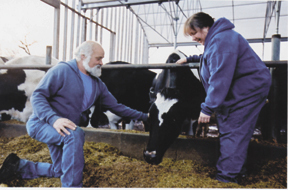
Rodney Bailey is a man of few words, the kind of fellow who expresses himself through his work and who lives who he is – and Bailey is a farmer. His ancestors have been dairy farmers at The Bailey Brook Farm on South County Trail in East Greenwich since the 1890s.
But the farm is losing money in recent years, and Rodney Bailey is thinking about ending his family’s century-old subsistence on dairy production. The up-with-the crows-and-at-the-cows routine, the bucking of the 20th century bucolic existence, could all come to an end on South County Trail.
Bailey said simply that the idea of shutting down the dairy farm that has been in his family for more than a century “wouldn’t feel very good.”
But that is what Bailey and his wife Judy face, and they aren’t the only ones. All dairy farmers are spending these days trying not to become the latest casualties in a dying industry and way of life in Rhode Island and throughout New England. In 1977 there were 102 dairy farms in this small state. Today, there are 22, according to the Rhode Island Department of Environmental Management Division of Agriculture.
And the problem is getting worse at a faster clip as time goes on – 10 dairy farms have closed in Rhode Island since 1999 alone, according to statistics. Every dairy farmer spoken to for this report said that 2002 has been the worst year they can remember for their farm’s business.
The causes of the crisis are complex and plentiful, say experts: Lower milk prices, rising farm costs, an abrupt decrease in dairy consumption by consumers, recession, market volatility as a result of Congress’s decision not to renew the Northeast Dairy Compact, price gouging by major grocery store chains, and increasing competition from mega-dairy farms in the West.
The crisis has increased in recent years because the price that local dairy farmers get paid for their milk has dropped precipitously since the New England Dairy Compact expired last year. The Dairy Compact was enacted in 1997 and compensated dairy farmers if prices fell below a certain point. The compact was a strong program for protection of dairy farmers, and eliminated price volatility, according to Ronald W. Cotterill, director of the University of Connecticut’s Food Marketing Policy Center.
The current drop in milk price is expected to continue for another year, according to industry forecasts.
In the summer of 2001 most New England dairy farmers were paid an average of $17 per hundred pounds of milk. Today the average New England dairy farmer is getting paid just $12 dollars per hundred pounds, while it costs the farmer between $14 and $15 to produce the same amount.
The price of milk dropped as low as $11.40 this summer. The last time dairy farmers got that price, Jimmy Carter was President. If that continues, the handful of remaining dairy farmers in Rhode Island won’t have enough to get their corn in, come spring, they say.
“There’s a question of whether they can last,” said Cotterill. “There’s a need for stabilization of milk prices so farmers can plan. No business finds it possible to survive if their price is fluctuating by as much as 50 percent, and they’re stuck at the bottom price for as much as two years.”
Congress passed the 2002 Farm Security and Rural Investment Act earlier this year, a three-year program that provides base payment to farmers. But many farmers say the bill helps only the smallest producers, leaving the majority of milk producers without any compensation if milk prices plummet.
A 2- or 3-percent discrepancy of milk supply with consumer demand will move the price that farmers receive for their milk by as much as 30 percent, said Robert Wellington, senior economist for Agri-Mark – a phenomenon of market volatility that Wellington has dubbed “the 10-fold rule.”
Agri-Mark is a dairy cooperative that markets milk under the Cabot brand name to dairy dealers and returns the profits to its members.
“That volatility wreaks havoc on the industry,” said Kenneth Ayars, chief of the Rhode Island Division of Agriculture.
“Farmers don’t control the price of milk – they sell to a middleman, and under the middleman system the price has stayed the same or declined in the last 10 years. The farmers aren’t making the money, other people are making the money off their product,” said Ayars.
Cotterill said that because farmers can’t control prices, they have produced more milk in an attempt to break even. The practice has exacerbated the problem by creating a supply glut.
Nationally, an increase of milk production with stagnant demand has caused milk prices to plummet for farmers. Consumers are buying fewer dairy products this year than they have in decades, said Wellington. That trend has developed in part because fewer consumers are dining out and the cheese industry has taken a hit. Since the incidents of Sept. 11, 2001, business at fast food restaurants, including pizza parlors which use cheese heavily in their menus, has dropped off sharply. The majority of milk produced in the country is used to produce cheese, Wellington said.
Farmers here are also being squeezed by mega-dairy farms in Western states that milk as many as 10,000 cows every day. Idaho produces twice the volume of all the New England states combined, said Wellington. The Western mega-farms are expanding dramatically, at a clip of about 10 percent a year.
That’s not the case here – Rhode Island produces less milk than a year ago. Most dairy farms here milk less than 100 cows. But our prices are set on a national basis by the federal government, said Wellington.
“I’m losing money every day. It’s hard for me to look forward and try to be optimistic,” said Louis Escobar, owner of Highland Farm in Portsmouth. “They tell me that very large farms are very efficient and that is the trend in the industry.”
Highland Farm averages 450 gallons of milk per day, by milking 100 cows. Escobar said he grew up on the farm working for his father, who bought the farm in 1937. He has never worked for anyone else a day in his life. He bought the family farm in 1972.
As if that weren’t enough, New England consumers are being overcharged by about $1 per gallon by huge supermarket chains such as Stop & Shop and Shaw’s, even while the prices dairy farmers earn from their milk have dropped over the last year, according to a recent study.
The study, conducted in early November by Cotterill of the University of Connecticut’s Food Marketing Policy Center, found that consumers are paying high prices for milk because retailers are price gouging.
Cotterill said he decided to study milk prices in New England this fall, after the convenience chain Cumberland Farms and milk processor H.P. Hood accused the small grocery chain Midland Farms of undercutting prices.
Midland Farm charges $1.49 for a gallon of whole milk.
Cotterill’s study discovered that big chain supermarkets overcharged by an average of $3.01, with New England’s two leading chains, Stop & Shop and Shaw’s, charging an average of $3.09 and $2.98 respectively. Consumers in Rhode Island supermarkets are paying an average of $3.03 per gallon, according to the study.
“Dairy farmers in Rhode Island are receiving the lowest price they’ve received in 25 years. So basically, the dairy farm in Rhode Island is being poorly served by the market at this point,” said Cotterill.
In fact, it’s happening everywhere in New England, and all the dairy farmers are upset – in Maine a couple of weeks ago a group of dairy farmers reportedly dumped 10,000 gallons of milk into a manure pit to protest the falling prices.
But while some are throwing away milk, farmers in Rhode Island are getting angry and organizing to save their livelihoods and way of life, with the help of local government and industry advocates.
Rhode Island dairy farmers are currently organizing their own cooperative, which will sell milk directly to consumers and negotiate with grocery chains, bypassing a middleman, said Karen Menezes, executive director of the Rhode Island Center for Commercial Agriculture, who is coordinating the effort.
The new brand of Rhode Island dairy farm milk will cost slightly more than other milk, but farmers here hope Rhode Island consumers will be willing to pay more to support the local dairy industry, said Menezes.
Analysts are forecasting an up-tick in milk prices for dairy farmers next fall. In the meantime, dairy farmers still doing business are waiting out the dry spell, finding other ways to make money on their farms.
At Highland Farm, Louis Escobar recently started charging the public to get lost in a corn maze he maintains on one of his pastures.
“I definitely intend to stay in business until [the price of milk rebounds,]” said Escobar. “At that point I’ll decide if I want to keep doing this. I love what I’m doing; that’s why I do it. But I need to be able to pay my bills.”
For the complete current issue, visit our subscription Web site, or call (401) 273-2201, ext. 227 or 234.