Conventioneers are plenty used to the goodie bags, the “Hello! My name is …” noose, and the chicken lump entrée. But few people attend a convention that ends with a cocktail party on a theater stage within the set of a professional ballet performance.
That is, unless they attend a convention at the Veteran’s Memorial Auditorium Arts & Cultural Center in Providence, familiarly known as VMA or just “Vets.”
A few years ago, the Rhode Island Council for the Humanities wanted to meet at the VMA in the week the Festival Ballet Providence was performing “Giselle” there. Cultural collision? Nope. “We just married the needs of the two organizations,” said Stephen Habl, general manager of VMA. The council’s meeting ended one day with conventioneers clicking wineglasses with some of the dancers at the cocktail party onstage.
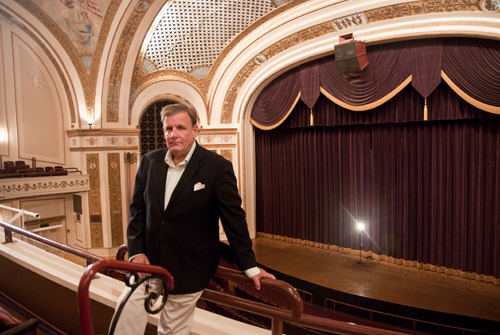
The theatrical presence of the opulent stage and performance space, along with the building’s storied history from its Masonic origins, make the VMA an intriguing and unusual draw for groups planning conventions in the Northeast.
A neoclassical structure on Smith Hill, the VMA has a long and colorful history that’s been linked, unlinked, and re-linked to the Masonic Hall (now the Renaissance Providence Hotel) next door. Construction on both buildings began in 1926 as a headquarters and auditorium for the Masons. Construction stalled for lack of funds in 1928, and, later, the Great Depression and World War II struck a death knell for the project, which was abandoned.
Around 1950, the city acquired the present VMA building only, and finished constructing it as a live theater. More renovation and updating on the auditorium took place in the 1990s. The VMA was placed in 1993 on the National Register of Historic Places. It is the home of the Festival Ballet Providence and the Rhode Island Philharmonic.
Meanwhile, the Masonic Hall next to VMA remained an empty and blighted shell from 1928 until it was purchased in 2004 and rebuilt as the Renaissance Providence Hotel, opening in 2007. The two buildings have different owners, but they are linked by a connecting building and the hotel’s ballroom is underneath the auditorium. Their managers cooperate extensively on serving the needs of guests and groups.
Habl, the VMA’s general manager, said the auditorium provides useful meeting space for conventions, often serving groups staying at the Renaissance Providence. The VMA has 1,900 seats and three lobbies that can accommodate breakout groups. Beyond the practicalities, Habl said, “We are a nice change from the usual square-box, corporate-meeting location. We are a theater, so we can add a little theatricality to meetings.”
In fact, some conventions need performance space. The National Association for Music Education held its conference in Providence in March 2009, and 650 student musicians performed at VMA during the three-day conference.
Allen Tinkham, executive director of the Rhode Island Music Educators, said, “Vet’s is probably one of the finest auditoriums for musical events on the East Coast. If we can give students the experience it is worth the effort.”
Habl, the VMA general manager, said the American Association of Choral Directors is convening in Providence for four days in 2012. “It is using several spaces in the city, including VMA, for performance space,” Habl said. “The choral directors looked at three to five cities and picked Providence. The beauty of the architecture and the theater’s infrastructure helped [attract the choral directors].” •