Dentists and state labor specialists say there’s a shortage of dental professionals – doctors, hygienists and assistants – in Rhode Island, and it could get worse. The biggest reason, they say, is that often the pay is better elsewhere.
Dentists say that reimbursements for dental care are so low – compared to actual costs and to reimbursements in neighboring states – that dentists often don’t want to start a career here or have left to practice in other states.
Dentists are aging and carrying heavier workloads, while seeing some of their competitors leave the state, according to the Rhode Island Dental Association. And dentists who wish to retire have trouble finding buyers for their practices.
According to the dental association, 44% of Rhode Island dentists are age 55 or older. The R.I. Department of Labor and Training says the state had 652 dentists in 2020 and predicts 184 job openings for dentists by 2030.
The American Dental Association’s Health Policy Institute says the supply of dentists in Rhode Island, at 52 dentists per 100,000 residents, is below the national average. Over a five-year period, Rhode Island has seen a net loss of 4.4% of the dentist workforce under the age of 40, due to migration to other states. Some insurers, however, have disputed the perception of a shortage, citing claims data that suggests the number of practicing local dentists has grown over the past decade.
Regardless of the actual number, Dr. Andrew Gazerro, president of the Rhode Island Dental Association, says it’s been hard for Rhode Island dentists to cover their costs because of low reimbursements by insurers. This also hurts in recruiting new graduates from dental schools, who may be starting their careers with heavy debt.
Financially, “it makes no sense to come here to practice,” Gazerro said. Over the last 15 to 20 years, Gazerro added, reimbursements from insurers have stagnated but dental practice costs have “increased dramatically.”
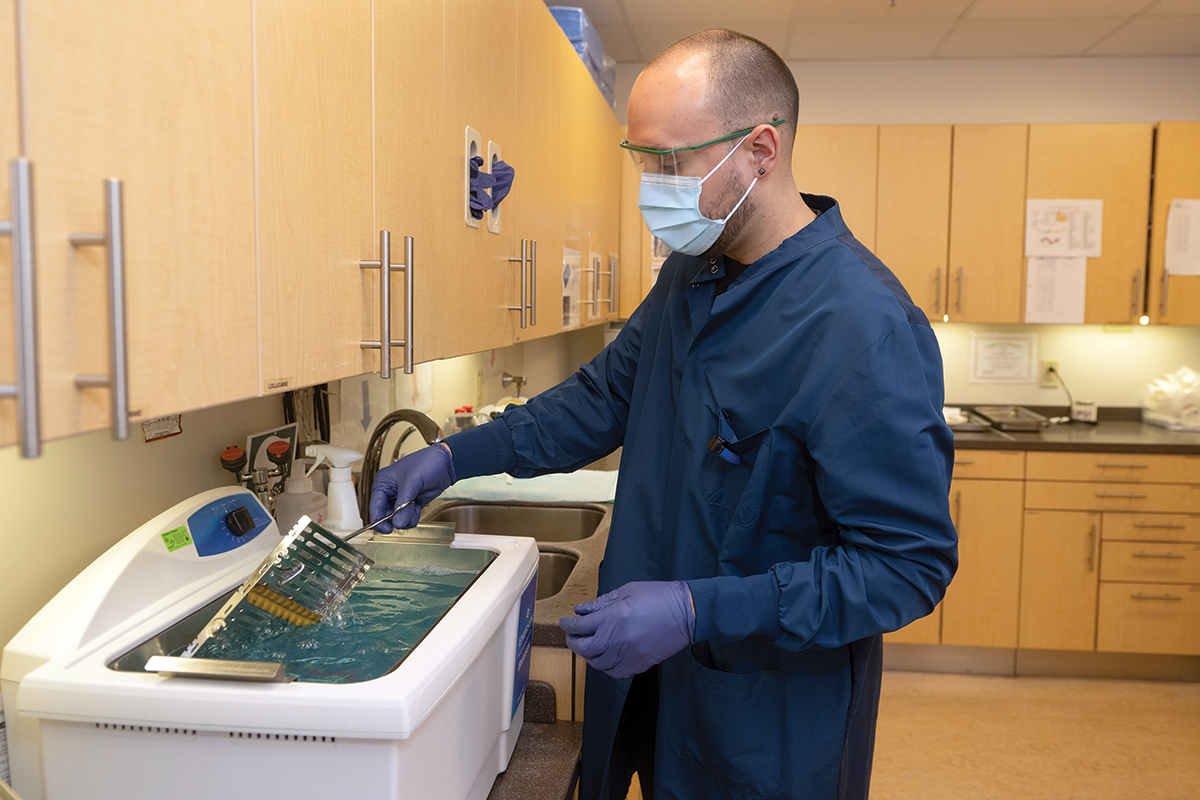
[caption id="attachment_477669" align="alignright" width="394"]

WIPE DOWN: Anderson Mendoza wipes down a patient area and dental instruments at The Providence Community Health Centers Inc.
PBN PHOTO/PAUL J. SPETRINI[/caption]
IN THE TRENCHES
A similar shortfall exists for dental hygienists and assistants, positions projected to see 642 and 896 job openings, respectively, by 2030, according to the DLT. Hygienists and assistants can often earn a higher wage in Massachusetts and Connecticut, making it harder to fill local jobs.
The Community College of Rhode Island offers the only two-year educational program in the state for certified dental assistants. Dental assistants may be trained on the job, but they cannot be certified. The median hourly wage for certified assistants is $23, according to the DLT.
CCRI also offers the state’s only course for certified dental hygienist, a professional who has a greater depth of scientific knowledge and who works on patients. These professionals must take continuing education and get licenses renewed periodically. Their median hourly wage is $37.
Kerri Friel, dental assistant program director at CCRI, said there is a high demand for graduates but “the problem is getting students in the door” to take the program. The most recent graduating class had 13 people; the class could have accepted 24.
But, Friel said, “our graduates go to Massachusetts for better pay.” She said higher insurance reimbursement rates “lead to better pay. This affects everyone in the office.”
Friel thinks the profession is not promoted well to career seekers. She said when people consider a medical career, nursing is more visible. “Dental assistant used to be seen as a great career,” Friel said. “Now, it is not valued.”
Lizz Hanke is workforce education director at the The Genesis Center, which offers a training program for dental assistants, but not at a certification level. The demand for classes “is not as high as I would like,” Hanke said. “There are not as many people interested in that career path.”
Ashley Soares, president of the Rhode Island Dental Hygienists Association, says there are not enough hygienists in the state. She said the absence of an in-state college for dentists and limited programs for assistants and hygienists is a problem. Solutions, Soares said, should include more publicity for career potentials and more dental schooling in Rhode Island.
SOLUTIONS
The R.I. Executive Office of Health and Human Services has been working on several fronts to improve pay for dental work and to push oral health care out of clinics and into places where people live.
Two years ago, the state increased its fee for services for Medicaid. The fee for service had not changed in Rhode Island since 1992, said James Rajotte, EOHHS director of strategy and planning. Now, he said, the Medicaid “services that dentists provide will be at national benchmarks” in Rhode Island.
Next, Rajotte said, new money is going into moving dental care from clinics and out into homes, serving people who cannot travel to a clinic. This includes adding training for oral care for certified nursing assistants. Also, EOHHS is investing in training at CCRI for public-health dental hygienists. These are certified hygienists who get additional schooling that allows them to work with patients at a home, community center, or even at a school, under the purview of a dentist’s office.
Next, Rajotte said, a pilot program is underway to create a communications network among dental offices, hygienists and home health agencies, which employ certified nursing assistants. The idea, Rajotte said, is to create a “referral pathway.”
Regarding insurance reimbursements, a debate that has been going on for many years, legislation introduced in the General Assembly this year would have required insurers spend no less than 85% of dental premiums on direct care for patients. Massachusetts passed similar legislation last year.
Opponents of the bill included the R.I. Office of the Health Insurance Commissioner and Delta Dental of Rhode Island. Delta Dental said the proposed formula “would mostly evaporate the 15% of revenue remaining after the imposition of a dental ratio as high as 85% … leaving next to nothing with which to operate the business.” It concluded, “Dental carriers … will have no choice but to raise premiums.”
In the end, a compromise was reached and signed into law that dropped the 85% threshold in favor of a multiyear study by OHIC of what that so-called medical loss ratio should be, according to Gazerro.
The earliest OHIC could set that ratio after General Assembly approval would be 2026, but “it’s a start,” said Gazerro, who credited legislators for bringing the two sides closer to a system in which more patients can afford and get needed care.
“[Providers] make money as patients can get more treatment done,” he said. “Let us [do that] treating our own patients.”