
For the first time in three years, hundreds of companies from across Massachusetts will be required to apply for a federal permit that regulates the amount of contaminants in storm water running off industrial sites.
Businesses from recycling centers, to hazardous waste treatment facilities to various types of manufacturers must file a “notice of intent” by Jan. 5, signaling to the U.S. Environmental Protection Agency that a plan to address the storm-water regulations is in place.
The EPA officially issued the new permit requirements in late September, three years after the previous permit – known as the Multi-Sector General Permit (MSGP) – expired. The agency had “administratively continued” the former permit until the new one could be released.
After Jan. 5, businesses that don’t comply with the revised storm-water requirements face up to $32,500 in fines, per day.
David Webster, EPA’s chief of industrial permits in the New England region, said the new requirements mandate more stringent monitoring and reporting of pollutants and sediment, among other things.
Webster figured the MSPG applies to about 500 Massachusetts businesses across 29 industries, including power plants, food processors, textile mills and construction companies.
Massachusetts is one of only five states that follow the EPA regulations on industrial storm-water runoff. Most other states have their own versions of the permit that is administered by a local agency. In the case of Rhode Island, that is the R.I. Department of Environmental Management.
Eric Beck, supervising engineer of DEM’s Pollutant Discharge Elimination System, said the state last revised its permit in 2006 and will be required to do so again in 2011. Right now, the state’s storm-water permit for industrial sites closely resembles the previous EPA permit, which was crafted in 2000.
About 170 Rhode Island businesses hold the permit, including a majority of the estimated 150 marinas in the state as well as transportation companies, like trucking firms. In the case of transportation businesses, Beck said, the permit is only required for the location where vehicles are fixed, fueled or cleaned.
“If a business conveys or channelizes their storm water at all – a roadside gutter, swales, pipes – it may need the permit,” Beck said.
While the EPA’s new MSGP has no immediate effect on Rhode Island businesses, it will eventually. That’s because when the state’s permit expires in 2011, its regulations will likely be retooled to match the 2008 EPA MSGP, Beck said.
Environmentally, the EPA permit is critical to Rhode Island’s Narragansett Bay. John Torgan of the Providence-based environmental group Save The Bay noted that 60 percent of the bay’s watershed is located in Massachusetts.
“Storm-water runoff is one of the greatest threats to the water quality in the bay,” said Torgan, the baykeeper for Save The Bay.
Up until about 18 years ago, businesses didn’t have to worry about contaminants in the water that came from the sky. It could run off things such as hazardous materials stored outside at an industrial site, and then carry toxins to nearby storm drains or streams.
Agencies enforcing the federal Clean Water Act were “really only concerned with point sources, meaning [contaminants] that were coming out of pipes that could be tracked,” said Amanda Czepiel, legal editor for environmental compliance at Business and Legal Report, a public company for compliance and regulatory materials.
That changed in 1992, when the EPA issued the first storm-water permits for industrial facilities and large municipalities. In a later phase, site-specific construction work and small municipalities were added.
In most states, local rules and permitting programs supersede the federal regulations, but the National Pollutant Discharge Elimination System is in effect in five states – Massachusetts, New Hampshire, New Mexico, Alaska and Idaho. The EPA rules also apply to Indian land, such as the Narragansetts’ property in Rhode Island. (Beck said he didn’t believe there were any activities on the Narragansett land that required an MSGP to be issued.)
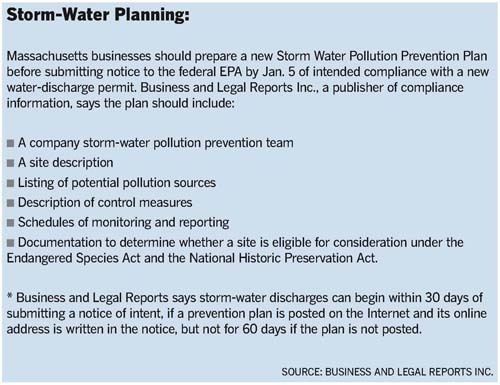
To apply for the MSGP, businesses must draft Storm Water Pollution Prevention Plans, which outline how a specific company would address the permit requirements.
For instance, the plans could specify that containers holding certain materials will only be stored in covered areas, or that the containers have to be made from specific materials.
The plan could also propose the installation of curbing to contain possible spills.
Now the new EPA MSGP contains several changes, including a clarification on storm-water controls needed to meet water-quality requirements for effluents. The MSGP also revises self inspection and monitoring requirements, and it requires annual reporting of the inspection results – and corrective actions – to the EPA.
“There’s a lot of clarification with the Storm Water Pollution Prevention Plans,” said Czepiel. “What kinds of practices have to be in place in order to meet the [effluent] limits, what can be in the water that’s being discharged.”
There will be more monitoring required and revised quarterly benchmarks, but Czepiel said the new permit shouldn’t be any more onerous.
“Probably, once [the companies] get use to it, it’ll be fine,” she added. “It’s not a ton of more work; it’s just putting in a different format.”
Why did it take three years for a new MSGP to be finalized after the previous one expired?
Webster, of the EPA, said the drafting was slowed because of the number of comments made by industry during the public-input stage, spurring agency officials to rework the initial proposal.
In the meantime, the EPA did not actively purse permit violations. But Webster said the agency will enforce the new permit regulations after the Jan. 5 deadline. •


