(Editor’s note: This is the 66th installment in a monthly series speaking with minority business owners and leaders. Each will be asked their views on minority-business conditions in the state and for ways to improve those businesses’ chances for success. See previous features here.)
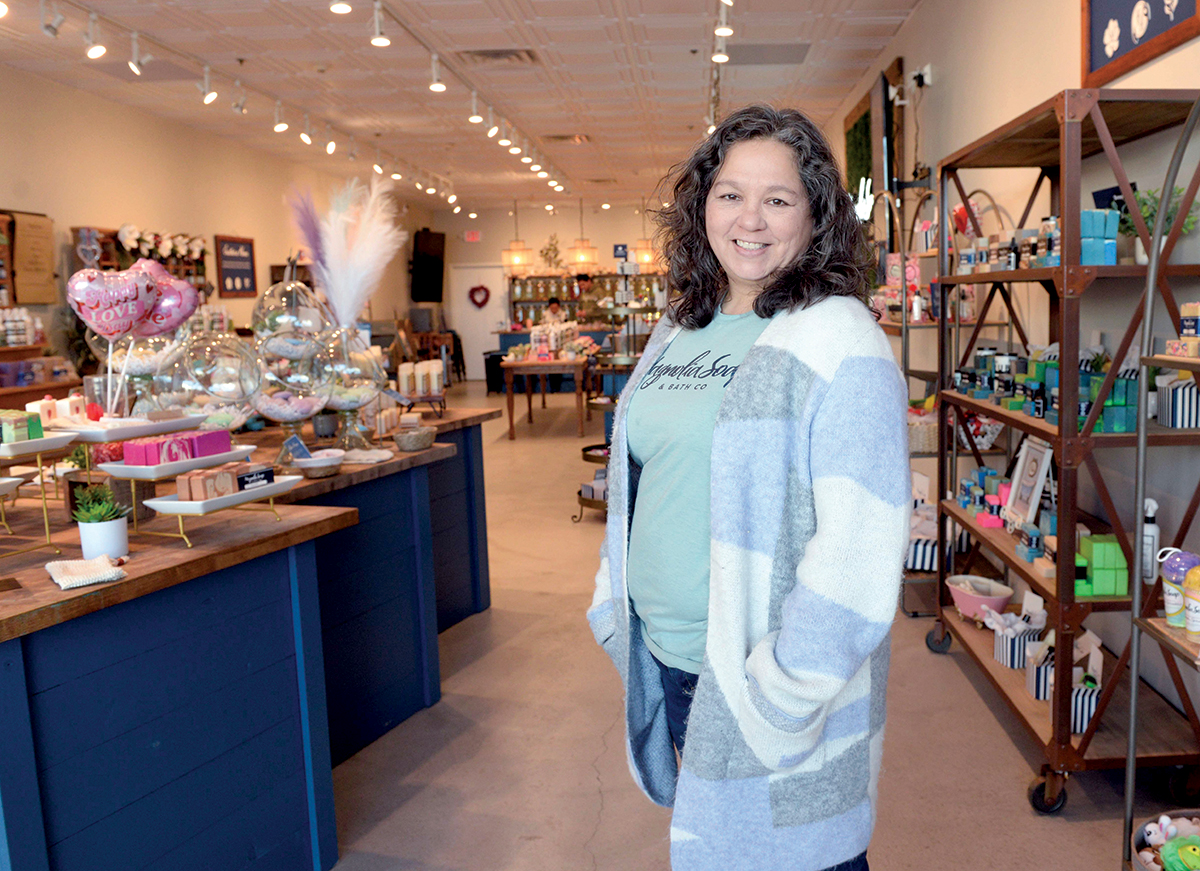
Yolanda “Yolie” Rome never set out to run a soap business.
After 15 years advising college students at Brown University and raising three sons, Rome, a Filipino American, found herself drawn to something more tactile, creative and hands-on – a venture that would bring her family together and let her connect with her community in a whole new way.
What started as a chance discovery during a family trip slowly turned into a leap she never expected to take.
“It was kind of serendipitous,” she said. “I went to visit one of my oldest sons out in Montana and I saw a soap store, and there was something about it that stuck with me. I was like, ‘Wow, this could be really fun.’ I ended up emailing the store to ask them some questions about the business, and it just picked up from there.”
That small spark of curiosity has turned into a full-fledged career pivot. Magnolia Soap & Bath Co. East Greenwich is the first location in the Northeast, part of a brand more commonly found in the Southern and central United States.
Rome opened Magnolia Soap at 1000 Division St. in East Greenwich nearly two years ago, determined to build it into a family business.
“My youngest son created an Ocean State-scented soap, my middle one created a Driftwood scent and my oldest created one we call Walk in the Woods,” she said.
Rome and her sister, Naomi, run the shop day to day, alternating shifts to open the store, process orders and manufacture soaps on-site, blending oils, scents and colors.
Their mother covers the store when Rome and her sister are off, helping with front-of-house duties, while Rome’s husband and sons help when they can.
But for Rome, the business is about more than products and daily operations – community and connection are just as central. To that end, Magnolia hosts workshops, private parties and pop-ups, giving people a chance to make their own bath bombs, candles and soaps.
Local groups, including Girl Scouts troops, come in for events, and Magnolia partners with other Rhode Island businesses for pop-up collaborations and wellness workshops.
“We’ve had Playbreak RI come in, Cravings Cart RI, we’ve done a Gallantine’s event. … It really is about building community, especially after COVID,” Rome said. “People are looking for human connection. You can’t help but smile when you’re in the store.”
Rome said she values the visibility her work brings to Rhode Island’s Filipino American community, which makes up just 0.63% of Rhode Island’s population, according to the most recent 2019–2023 U.S. Census Bureau American Community Survey estimates.
Rome highlighted Andy’s Kitchen, a Filipino pop-up cooking business that hosts events at Narragansett Brewery, as another local venture contributing to the community’s presence.
In a state where businesses are so closely connected, Rome said fostering these kinds of relationships makes all the difference. Her advice to other aspiring business owners is simple: Build your network, work hard and embrace the connections you make along the way.
“I have met so many interesting people through this store and talking and trying to make the community connections and just telling people what I love about all of our products,” she said.
For Rome, success isn’t measured only in sales; it’s in meeting great people and getting involved in the community.
“The past two years have been so fun,” she said. “Opening a place that people gravitate toward … I can’t think of anything more fulfilling.”
1. Do you believe racism is keeping minorities from starting businesses in the Ocean State or succeeding when they do? My family and I have lived in Rhode Island for 24 years, and we love it here. We are fortunate to live in a state where people are generally inclusive and supportive. The same goes for all the local and state agencies that I have dealt with in Rhode Island – everyone has always been super helpful. Speaking for myself, I have not experienced any racism in starting or scaling this business.
2. How dependent is your business on the support of other minority groups? Is that a sustainable business model? My business is dependent on the support of anyone who believes in the power of small business – not any particular group. We are fully embedded in the community and collaborate with a number of nonprofits and small businesses. As one example, we work closely with The Sargent Center, which has a transition program for young adults to experience different types of job opportunities.
One awesome thing about our store is that we promote it as a place where people can build relationships and community. We have events where people of all ages can make their own products – soap, candles, bath bombs, shower steamers – and we also collaborate with other small businesses to host their own pop-up events like knitting, mahjong lessons, storytelling, themed playdates, jewelry making and more.
3. What one thing could Rhode Island do to boost the odds for minority-owned business success? I have been blessed in many ways throughout my life and have also worked very hard to be right here, at this moment. I am now in a privileged space, which allowed me to start this small business with the support of my family. It is my belief that there are likely improvements that would help anyone start and succeed in business in R.I., but I am no expert on this.
4. Have you had to turn somewhere other than a bank for a loan? Do you believe the state’s lending institutions generally treat minorities fairly? We looked into SBA [Small Business Administration] loans but chose to go a different route. I have not experienced any unfair lending practices.
5. If another minority entrepreneur asked you where they could turn to for support, where would you direct them? I have had great experiences with the Rhode Island Small Business Development Center, Center for Women & Enterprise and SCORE [Service Corps of Retired Executives] and would advise any entrepreneur to take advantage of all they have to offer.