At the invitation of the R.I. Economic Development Corporation, reporter Natalie Myers joined a group from Rhode Island on a trade mission to the Bahamas from May 13 to 16. Daily dispatches appeared on PBN.com during her trip. Last week, after follow-up interviews with some of her travel companions, she wrote this article.
We decided to walk up a side street off Bay Street, which is the main street in downtown Nassau. As we passed a pink building to the right, John Grosvenor, a principal of Newport Collaborative Architects, said he could see a boutique hotel there.
The design of the building was typical of what we’d seen on the island of New Providence in the Bahamas. And the fact that it was off the main street, tucked beneath a canopy of tropical trees, made it seem quaint and serene – ideal for the boutique hotel he was envisioning.
Grosvenor’s firm has developed an expertise in boutique hotels, having worked on the Hotel Providence and Vanderbilt Hall in Newport, among others.
We walked farther. The street inclined. At the top, on the northwest corner of George and Duke streets, there was an old, seemingly abandoned, house across from the Government House.
The roof was decaying, but the limestone frame was intact.
At first Grosvenor said no, he didn’t think it could be salvaged. But then, after a closer look, it seemed to take on a new character.
That’s how the afternoon went – walking around for a few precious hours stolen from a rigorous schedule of meetings with government administrators, business owners, contractors and distributors.
Keith W. Stokes, executive director of the Newport County Chamber of Commerce, and Grosvenor surveyed the landscape looking for opportunities – not just economic opportunities, but opportunities for the Bahamians to preserve their historical buildings, heritage and culture and showcase them as Rhode Island communities have.
That was the dual purpose of the May 13-16 trip: to look for trade opportunities for Rhode Island companies but also to exchange ideas and knowledge with Bahamians.
The nine-person delegation was organized by Maureen Mezei, international trade director for the R.I. Economic Development Corporation, and Maj. Michael Manning, coordinator for the R.I. National Guard’s State Partnership Program.
The latter has been building connections between Rhode Island and the Bahamas for about a year and a half, but the concept is even older.
The U.S. National Guard State Partnership Program started in Europe at the end of the Cold War. The Soviet bloc had collapsed, and several countries were trying to embrace democracy for the first time, Manning said. The U.S. National Guard stepped in to help them. “Several evolutions later what you have today, in 2007, is the State Partnership Program,” he said.
Today, the program is more about establishing and developing mutually beneficial relationships between states and their partner countries across all sectors – military, education and economic development.
The objective is to ensure what Manning calls, “security by other means.” Strengthening the military, educational institutions and economy of a country reduces the strife, political corruption and income disparities that can lead to unstable governments.
“That’s one less part of the world we have to worry about,” he said, adding that this doesn’t necessarily apply to the Bahamas, a stable, democratic nation with strong U.S. ties.
The Rhode Island-Bahamas partnership “was really a match made in heaven,” Manning said. “We are the Ocean State. They are an island nation. Their No. 1 industry is maritime tourism. Maritime tourism is one of our top industries.”
And through the leadership of Lt. Col. Patricia Ryan, director of military support at the R.I. National Guard, Manning said, “in the past year and a half we’ve done things other partnerships in four to five years haven’t been able to do.”
Stokes, who first visited the Bahamas last February, immediately saw opportunities for cross-marketing of tourism, such as a sailing regatta from Newport to Nassau, because both tourism destinations attract similar kinds of travelers.
“If they enjoy the Bahamas, then they would enjoy Newport in the summer,” Stokes said. “The same type of quality investors and visitors that go to Nassau are what we want to attract here.”
Yet Nassau and Newport are also opposites, Stokes noted. Nassau has some of the world’s top mega-resorts, but the historic downtown has been neglected as a tourism resource, and tourists from the resorts don’t go there to shop or dine. Newport, on the other hand, has a strong draw as a heritage tourism site and boating hub, but no large resorts equipped with all the indoor entertainment that could attract and keep tourists in the city year-round.
Upon returning from his February trip, Stokes began talking about the economic opportunities for Rhode Island companies in the Bahamas as well, and he got Mezei involved and persuaded Grosvenor and Eric Offenberg, president and chief engineer of Middletown-based Northeast Engineers & Consultants, and John Nunes, co-owner of Newport Vineyards – all members of the Newport Chamber board – to join the May trade mission.
They were joined by Chris Lee, director of Sea Fresh USA in North Kingstown, and Michael Hall, director of the master of public administration program at Roger Williams University.
Transportation to and from the Bahamas was organized by the R.I. National Guard at no cost to the participants. Transportation while on New Providence Island was also free. It was organized by the U.S. Embassy in Nassau.
All participants said they found the trip valuable for the contacts they made and the access they got to all the “right” people.
Exploring possiblities
John Grosvenor, who met with Audley Ortis of Ortis Construction & Developers during the trade mission, said there is at least a 50-percent chance that he will work with the experienced builder on mixed-use developments in downtown Nassau.
“He’s on,” Grosvenor said. “He wants me to come back down there.”
Grosvenor is even thinking about possibly setting up a satellite office in the Bahamas because of all the redevelopment and new development going on in the county. It would be a first for Newport Collaborative. This was also the first trade mission for the firm.
“There will be plenty of work down there,” he said.
And the trade mission couldn’t have happened at a better time. A new prime minister just took office, so the master plan for the redevelopment of downtown Nassau designed by the previous administration might be revisited. That would give Grosvenor a better chance to get involved and possibly make suggestions.
Newport Collaborative is the largest architectural firm in Rhode Island, with 20 employees in its Providence office and 40 employees in Newport. And Grosvenor himself has 26 years’ experience in historic renovation and redevelopment. He has designed more than 50 projects involving the historic tax credit.
As a result, Grosvenor has a lot of ideas for breathing life back into downtown Nassau, a city he thinks has a lot of potential. And those ideas resonated with David Johnson, deputy director general for the Bahamas Ministry of Tourism.
“We’re still in the early stages of shaping this [master] plan,” Johnson said during a meeting with Grosvenor. “And some of what you’ve suggested makes a lot of sense to me.”
Johnson said the Ministry of Tourism would support residential or mixed-use development that brings residents into the city. As it is now, downtown is mainly retail, with just a few restaurants and almost everything closes at 6 p.m.
“That’s not what we want,” he said.
Grosvenor also suggested that the country devise some sort of incentive program for developers, similar to the tax credits in Rhode Island. In the Bahamas case the incentives might have to involve tariffs on imported goods since the country has no personal or corporate income tax.
Grosvenor said it’s too early to say he sees the Bahamas as a major source of revenue for the company, but the potential is “enough for us to be interested and to take it seriously.”
Thinking of expanding
For Eric Offenberg, who opened an office in Baghdad for Northeast Engineers, the prospect of setting up shop in the Bahamas seems more of a sure thing than Newport Collaborative’s tentative plans.
“There’s so much work down here,” he said. “It could be a good location to have an office for all of the Caribbean.”
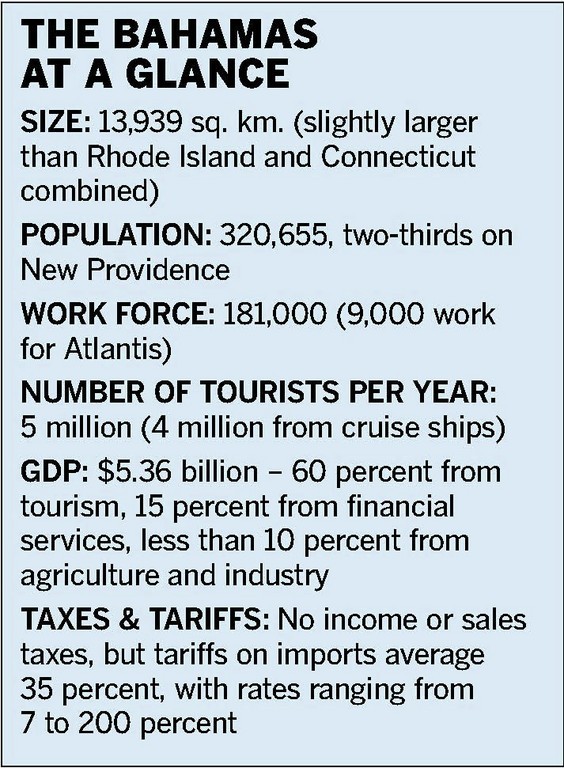
The Bahamas currently has more than 149 active development projects on 12 islands, involving a combined $18 billion in investment. Many are resort oriented, which is good for Northeast Engineers, he said, because “our specialty is resort and infrastructure. … There are a lot of things they’re doing that fit right in with what we do.”
What makes Nassau particularly attractive for Offenberg is that he can be there in four hours via a direct flight from Boston. Not having to pay income taxes is another plus. Being able to keep the revenue earned in the Bahamas there, in an offshore bank also makes the location attractive.
Northeast Engineers most likely would partner with a local firm, he said, because the Bahamian government won’t allow foreign investors to own 100 percent of a company in the Bahamas. The purpose is to protect and create jobs for local workers.
“We would probably own 40 percent,” Offenberg said, adding that a joint venture could be beneficial because Bahamians know their territory. They already know how to get through the system, how to get the right permits through the government agencies, etc.
Northeast Engineers opened an office in Baghdad about three years ago because “we want to be in the emerging markets across the world,” Offenberg said. The firm is growing fast, with revenue rising from about $3 million to about $70 million over five years, he said. The company employs about 100 people worldwide, including 65 at its Middletown headquarters.
Offenberg said the Bahamas trip not only had given him “a real good idea of how the development system works” in the country, but also information he could use in looking for markets elsewhere. He was amazed by how useful the U.S. Embassy in Nassau was in getting him into meetings with government agencies and contractors and businesses.
“I never would have thought to use the U.S. Embassy as a resource,” he said.
Selling a brand
John Nunes, of Newport Vineyards, was also impressed by the access he was given in the Bahamas.
“This is command central right here,” said Nunes over the buzz of the constantly ringing phone during a meeting with Sean Cartwright and Jose Montalvo, the main wine buyers for Atlantis, the largest resort and largest private employer of Bahamians in New Providence.
“We control everything,” Cartwright said. “Everything basically comes through here … our purchasing department only purchases what we tell them to.”
Atlantis’ wine sales average about $4 million to $5 million per year. And this year sales are expected to be even better. The resort sold $1.5 million in wine in January alone, Montalvo said.
“Wine sells like water here,” Cartwright said. “We can’t keep it.”
Nunes said selling just four pallets, or 2,400 bottles, of wine per year to Atlantis would make the investment worthwhile for the Middletown winery, which has never exported before.
Newport Vineyards, which is owned and operated by Nunes’ family, produces about 15,000 cases per year. It is the largest grower of wine grapes in New England and employs 20 people.
At the Atlantis meeting, Nunes highlighted the value of the Newport name on the labels of the 20 wines the vineyard produces.
“There is a lot of similar visitation between the Bahamas and coastal New England in the summer,” he said, adding that many resort guests might recognize the name.
Nunes brought samples of a new Newport Vineyards wine called “In the Buff,” a naked chardonnay that isn’t aged in oak barrels, as most Californian chardonnays are. The wine represents a new niche the company is trying to develop as trends suggest consumers are moving away from the oak-barreled white wines.
“I love this, this is good, I love this,” Cartwright said after the first few sips. “I would put this in Nobu” – a gourmet Japanese restaurant in the resort.
If guests have just one glass, Cartwright added, “they’ll say ‘Give me another one, give me another one. Bring a bottle to the table.’ ”
Montalvo was a little more skeptical. He said he wanted more acidity in the wine.
“We would start off with one pallet,” Cartwright said. “See how it moves … by the first month, we’ll know what to do.”
That meeting made it a successful trip, Nunes said.
“I guess my conclusion is that there is as large a market outside the country, as inside,” he said. “We were very pleased with the reaction to our wine.”
Nunes also said the trade mission made him realize that exporting to other countries is “not as difficult as I initially thought,” though he recognizes that the Bahamas, as an English-speaking country with a robust resort economy, makes it particularly easy.
The most challenging aspects of exporting would be the logistics of getting the wine to the island, aligning price points to accommodate a 65-percent tariff on imports and producing enough wine to support the export should the product take off.
Selling seafood to Atlantis
Chris Lee is not new to exporting. Sea Fresh USA, based in North Kingstown, exports 50 percent of its New England catch to other countries, mainly in Europe and Asia.
“We have been looking from afar at the Caribbean/Bahamian marketplace for seafood,” Lee said. “There are a lot of consumers down there in the tourism trade.”
Lee has been on one other trade mission, to Canada. But he, like the others, was impressed by the contacts he gained access to in the Bahamas, especially the meeting with decision-makers at Atlantis and Geneva Brass, a distributor of seafood on the island.
“Places like Atlantis, it’s hard to get into those places initially,” he said. “It helps going and meeting face to face.”
Lee also saw an opportunity in Atlantis’ 5-million-gallon aquarium, which is home to 10,000 marine animals. Most eat squid, said Todd Kemp, senior collector in the water features department at Atlantis. They eat nearly 1,300 pounds of seafood per day.
The only problem is, the water features department can only store a seven-day supply of seafood for the marine animals. That wouldn’t enough to fill a 20-foot container, so it almost wouldn’t be worth the export and shipping costs, Lee said.
The restaurant side looks more promising, he said. He is preparing samples of squid, monkfish, skate and flounder to send to the resort via FedEx.
Asked whether he thinks the Bahamas could become a major revenue generator for Sea Fresh, Lee said, “Time will tell.”
“It’s a matter of matching our product here with the tastes of that market,” he said. “But it’s nice to have a lot of contacts out there.”
Exporting education
Like his travel companions, Michael Hall, from Roger Williams, went to the Bahamas to start relationships that could turn into partnerships and/or business opportunities.
He knew there were connections, possibly exchanges of students and faculty, with the College of the Bahamas to be explored. That was a given. But what he wasn’t expecting was the high demand for professional development programs expressed by the country’s police force, teachers’ union and public service department (similar to the U.S. civil service).
Hall said Roger Williams has the capability to provide the types of tailored professional development products the Bahamian entities are looking for through the university’s College of Continuing Studies and Professional Development.
“We have the flexibility to offer what they are interested in,” he said. “We are good at customizing training.”
Roger Williams is not the first Rhode Island university to make connections in the Bahamas. In February, University of Rhode Island representatives, who had visited the Bahamas through the State Partnership Program last year, signed a memorandum of understanding with the College of the Bahamas.
Two Bahamian students already attended URI in the last semester, and all Bahamian students who enroll at URI will be charged the in-state tuition rate.
Hall sees much potential for a memorandum of understanding between the College of the Bahamas and Roger Williams as well. Though he’s not sure what the ramifications of such a partnership would be, he said, it could start with the university’s role in helping the college develop a master of public administration program.
Hall said Linda Davis, vice president of graduate programs at the college, expressed interest in offering the degree to students in the Bahamas because of all the development and redevelopment happening in the country.
Many of those developments require support from government agencies, he said. And, considering the Bahamian government is the No. 1 employer in the country, an MPA could prove to be a useful addition to the college’s offerings.
To set up the program, Hall said, Roger Williams could send faculty to the Bahamas, or it could set up a way for Bahamian students to take courses online. Overall, he was encouraged by the trip.
“I thought that every meeting I was in had an energy and enthusiasm,” Hall said. “I see some real synergies we could develop across campuses.”
Manning, of the National Guard, said that along with the economic development efforts, the educational connections will turn out to be “the true strength” of the Rhode Island-Bahamas partnership. “These relationships are taking on a life of their own.”