
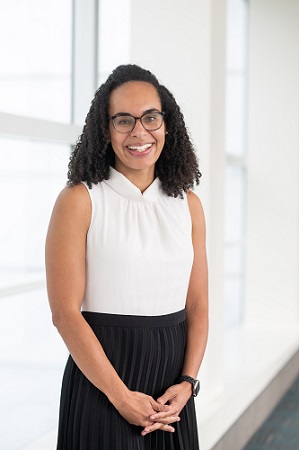
Dr. Theresa Williamson, a neurosurgeon and bioethicist, is the newly appointed director of the Center for Minimally Invasive and Endoscopic Spinal Surgery and director of the Center for Innovative Neurotechnology for Neural Repair at Brown University Health.
PBN: What attracted you to the fields of neurosurgery and bioethics?
WILLIAMSON: My interest in neurosurgery always stemmed from a commitment to understanding the nervous system, its development and its relationship to who we are and the world around us. My aunt was a special education teacher who worked mostly with system-involved [youths]. I was amazed by her commitment to her students and the way she cared for each student individually.
When I went to college, I decided to study neuroscience with the dreams of making a similar impact by better understanding the way the nervous system develops. Along the way, I developed an interest in clinical medicine and, perhaps through by background as an athlete, preferred the subspecialty of neurosurgery, where I could work on a team to problem-solve complex issues in the brain and spine.
I never let go of the interest in understanding how we interact with each other and the health system and that led to my interest in bioethics. I paid close attention to how my family members and the patients in the hospital experienced the system and their care. Did they connect with their doctor? Did they actually follow the instructions? Did anyone follow up after a difficult treatment or diagnosis? In neurosurgery, these questions were often magnified as patients often had difficult diagnoses.
I decided to formally study bioethics and patient decision-making at the Margolis Center for Health Policy at Duke [University] under the mentorship of Dr. Peter Ubel, and then through a surgical ethics fellowship at the University of Chicago Maclean Center for Ethics funded by the American College of Surgeons.
PBN: Your research focuses on how patients from diverse communities make decisions about neurosurgical care. What differences stand out across communities?
WILLIAMSON: A first visit to a neurosurgeon is scary and uncharted territory for most of our patients. My interest is in making sure that patients from all backgrounds are able to get the care they need and that matches their goals. Things like mistrust of the health system or doctors, concerns about risks of surgery, impact of taking off from work, or being a care giver or provider may impact certain patients in different ways from others leading them to shy away from certain interventions, sometimes in ways that are not in their or their loved ones’ best interest.
PBN: What are some of the major obstacles to accessible and equitable care in neurosurgery, and what solutions does your work explore?
WILLIAMSON: For any patient to get goal-concordant care in neurosurgery, a few things have to happen. They have to have access to a provider with the skill set and technology they need – think referral from a primary care provider, insurance coverage, time away from work or child/elder care and transportation to get to a visit. They also need to see a provider who offers them the technology or intervention they need and they have to accept that treatment and have the resources to follow through with the care in order to achieve a positive outcome.
My group works in both stages. We survey and talk to patients about barriers to getting the care they need and think of solutions that may be for individual patients or systemwide to help circumvent these issues. For example, we recently published a paper on reported barriers for certain patients and found that shuttle bus access to appointments is one of the most helpful solutions. Further, the conversation between patients and neurosurgical providers may determine a lot about a patient’s decision and outcome. This includes ensuring prognostication without bias and getting information to patients in ways that are clear and easy to understand. Here, we have worked to identify possible biases and to improve communication through shared decision-making.
PBN: How is neurotechnology advancing brain and spinal care, and in what ways do these developments differ from traditional approaches and results?
WILLIAMSON: Neurotechnology is rapidly advancing brain and spinal care. As our understanding of the nervous system evolves, we are both continuing to study the circuitry of the brain and spinal cord and understanding how to both modulate and circumvent it in the case of injury and disease. This includes technologies such as deep brain stimulators, spinal cord stimulators and brain computer interfaces. As AI [artificial intelligence], robotics and endoscopic surgery evolves, we are able to personalize, finetune and implant these technologies with smaller incisions and less invasiveness.
PBN: What has your previous work with the Neurotech Justice Accelerator involved, and how will your new role at Brown Health influence this ongoing effort?
WILLIAMSON: At the Neurotech Justice Accelerator, we commonly say, “If we want to accelerate neurotechnology’s potential benefits to society, then we need to activate insights because the more we can learn, the more we can change; and ideas don’t transform the world – people acting on them do.” With this as our mission, we have trained a cohort of eight summer undergraduate students, as well as three postdoctoral fellows at the intersection of health, law, policy and neurotechnology. They have engaged in projects that help understand accessibility and utilization of technology and engaged with communities to better understand their needs when it comes to neurotech.
At Brown, this work will directly overlap with that at the Center for Innovative Neurotechnology for Neural Repair. As we work to develop improved technology for spinal cord injury and pain, for example, we will work with patient groups, community members and campus experts to make sure the technology can get to the people who need it most.
Jacquelyn Voghel is a PBN staff writer. You may reach her at Voghel@PBN.com.