Two themes led much of the discussion during the first of two panels at Providence Business News’ 2018 Spring Health Care Summit: primary care doctors and savings generated by health care reform. In fact, the two issues begged the same questions – are there enough of them (doctors or savings), and how can we get more of them?
As simple and powerful as those two topics are, another one that is gaining visibility is the growing use of technology to empower patients and providers, which in its own way has potential to lower health care delivery costs.
The summit, held April 6 at the Providence Marriott Downtown, was kicked off by Joan Kwiatkowski, the CEO of CareLink and the PACE Organization of Rhode Island. She recalled that as part of her regular physical in 2017, her primary care physician noticed a change in her heartbeat from the previous year, which led in short order to open-heart surgery the day before Thanksgiving.
The successful intervention that saved Kwiatkowski’s life serves as an example of the success of primary care reforms, she said.
“As far as I’m concerned, primary care is better. It is working,” Kwiatkowski said.
But further discussion raised the question as to whether her experience is the standard across the state and what the odds are that it will be in the future.
Dr. Gus Manocchia, chief medical officer of Blue Cross & Blue Shield of Rhode Island, noted that while the current supply of physicians is difficult to pin down, increased access to health insurance provided by the Affordable Care Act, combined with the country’s aging population, will make a shortage all but certain.
“We will have a significant shortage in this country and certainly in this state over the next 10 years, of doctors,” Manocchia said.
There will be a need for another 100,000 doctors in the United States during the next decade he said, 30 percent of them primary care doctors.
Root causes of the shortage are evident. In Rhode Island there are more than 700 graduate medical positions, only 90 of which are for primary care, he said.
Of those 90 primary care doctors in training, only about 20 percent of them stay in the state, Manocchia said. The new primary care doctors in the state are not keeping up with the numbers who are retiring.
“As a result of that, in the last couple of years, we actually have experienced some access issues to primary care,” he said, including people having trouble finding a new physician, and people with an existing doctor who have trouble getting an appointment for both urgent problems and routine exams.
“And that’s one of the reasons you see now, a significant number of nurse practitioners and physician’s assistants operating in practices across the state,” Manocchia said.
Kwiatkowski’s experience confirmed that observation. Often, she said, she had an appointment with a physician’s assistant. And while waiting to see that PA, people seen by the same professional at that office would tell her they’d just seen a doctor.
“Well, I know they didn’t see Dr. Smith, they saw a PA,” Kwiatkowski said.
In fact, Manocchia said, Blue Cross has changed its policies to allow nurse practitioners to become primary care providers, with their own panel of patients, “because of the issue with access to primary care in the state.”
And even those local primary care practices having success hiring to fill slots for retiring doctors or because they are expanding the business see the issues confronting young physicians.
Coastal Medical Inc., which has 89 physicians on staff according to the 2018 PBN Book of Lists, has seen recent success in recruiting primary care physicians. One reason, says Dr. Alan Kurose, president and CEO of the primary care practice, is that Coastal has worked to help doctors cope with information overload that is burdening doctors.
“I think this is sort of an unintended consequence of our transition to [electronic medical records], and other technologies,” Kurose said.
Kurose sees that information overload can contribute to student physicians gravitating away from primary care.
“If they see a hectic experience, if they see a frustrated provider, that’s not helping us,” he said.
Manocchia agreed, adding, “They sort of see that and go, ‘I don’t really want to do that,’ ” he said.
But it goes beyond issues of information overload, he added.
“A lot of primary care physicians are dissatisfied with their work,” Manocchia said, for a variety of reasons, including heavy regulation of their practices, documentation work that overflows into evening hours and relatively low pay compared to their colleagues who work in specialized medicine. Despite their relatively low pay, he said, their student loan debt, in the hundreds of thousands of dollars, is still an enormous burden.
One way that Coastal has tried to combat the significant demands placed on its physicians is to move to more team-based care under the patient-centered medical home model. The idea is to give doctors more time to spend on care rather than documenting it.
The PCMH approach is one of a number of new payment methods that promise cost savings, but it’s not a simple solution.
Manocchia noted that while the majority of primary care in the state has adopted the PCMH approach, about 30-35 percent remain one- and two-physician practices without a lot of support, and they struggle with the workload.
With PCMH practices, he said there have been significant improvements in quality and benefits to patient health. The approach also has led to a reduction in the use of emergency rooms, and fewer in-patient hospitalizations, which has produced some cost savings.
“However, we have yet to see a significant impact on overall total cost of care for patients,” he said. “I think quite frankly, a lot of the purchasers in the room and a lot of the purchasers I’ve spoken to in the community are getting a little frustrated … and [are] wondering why we have yet to see the change they expected to see in terms of the impact on their annual premium.”
Dr. Claire Levesque, chief medical officer for commercial products at Tufts Health Plan, agreed. She said reorganizing care under the PCMH model is a complicated endeavor that will take time to make work smoothly.
“I do believe that the concept will yield savings in the future,” Levesque said.
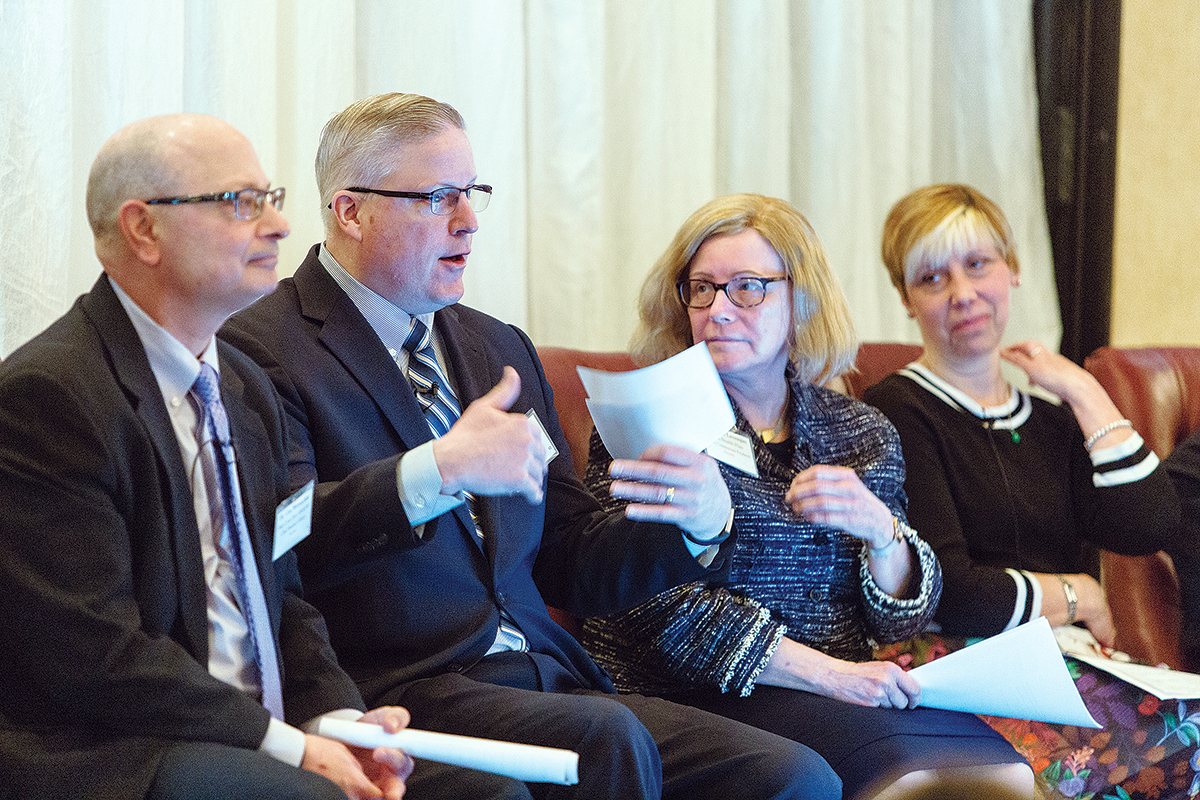
[caption id="attachment_203323" align="aligncenter" width="640"]

CUTTING COSTS: Dr. Alan Kurose, president and CEO of Coastal Medical, speaks about health care costs during the 2018 Spring Providence Business News Health Care Summit at the Providence Marriott Downtown on April 6. / PBN PHOTO/RUPERT WHITELEY[/caption]
Kurose outlined new payment models that may help realize savings. Among them, the shared-savings model, in which practices keep the fee-for-service model, but receive a portion of the savings when they lower the total cost of care.
Another model is primary care capitation, he said. That eliminates fee-for-service payments, and instead awards physicians a set amount of money for every patient they care for.
The Office of Health Insurance Commissioner is planning a pilot of primary care capitation, Kurose said.
“The jury’s out on how these models are going to work,” he said.
Kurose agreed that while primary care has improved in Rhode Island, keeping up the momentum requires proving it’s an economic success as well.
“The clock’s ticking on how much time this industry has left to show the economic benefits. … I think system-wide it has to happen for it to really be sustained.”
A growing piece of the cost equation in health care delivery is pharmaceutical care, but as Manocchia noted, health plans have no control over its costs.
Levesque noted the health care industry doesn’t treat drugs as other industries treat products, in which the more you use something, the cheaper it becomes.
“In the pharmaceutical industry, the more and more of it that is sold, the price goes up, and that’s not working for all of us in the long run,” she said.
Even without direct control over the cost of drugs, Manocchia said, Blue Cross has been able to limit wasteful use of prescription drugs by placing pharmacists inside primary care practices. The partnership between pharmacists and physicians has made prescribing safer and also saved the system more than $24 million in three years, he said.
Stephen J. Farrell, CEO of UnitedHealthcare of New England, said Apple watches, Fitbits and other wearable technology, as well as his company’s own software, help consumers track and manage their habits toward healthier lifestyles.
“Technology plays a big role in bringing that all together and making this dialogue actionable,” he said.
One way the information can help lower costs, he said, is by applying tracked goals and activity to individual and employer premiums. It’s easy to make the case that people who are more active are healthier, and therefore less of an insurance risk.
“We know, and the empirical data says, that the more active you are, the healthier you are going to be,” he said.
Consumerism in health care, in which people take the initiative to shop for the best quality care, is catching on slowly, he said, likely because older people most likely to use medical care are resisting the change in approach. Eventually, though, younger people growing up with technology will be much more enthusiastic about taking a consumerist approach to health care.
“When that happens, there will be a shift, and consumerism will take off,” he said.
One tool Rhode Island will need to get a handle on medical costs is the ability to gather information about spending, Kurose said.
“I think the state has to make the investment in the human and technology resources to be able to understand and track the performance of our health care delivery system,” he said.
Kurose mentioned Rhode Island’s All-Payer Claims Database as a step in the right direction. The database provides some information but has yet to produce detailed yearly reports like the ones Massachusetts enjoys from its system.
Many reforms will have been in place for 10 years in another three to five years, he said, and the federal government will be assessing whether the changes resulted in savings at that time. If they have not, he said, the industry may lose the tools it has been given to make a difference. The health care industry does not have an unlimited amount of time to use those tools to bring costs under control, he said.
“So we want to make sure that the participating organizations understand that,” Kurose said.