(Editor’s note: This is the 35th installment in a monthly series speaking with minority business owners and leaders. Each will be asked for their view on minority business conditions in the state and for ways to improve those businesses’ chances for success.)
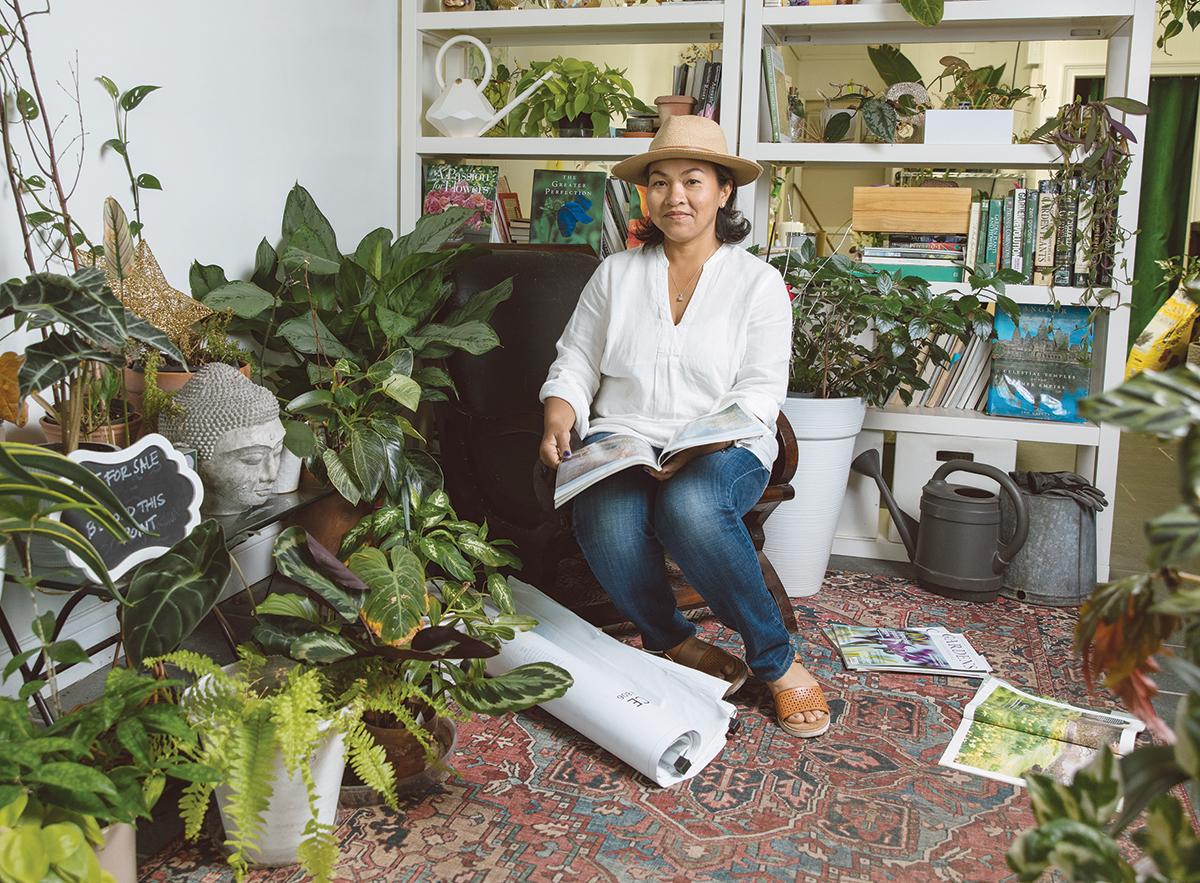
On a 6-acre waterfront property in Bristol, Sophath Toun sees a story in every flower, shrub and tree.
Toun was hired to landscape and maintain the parcel six years ago, and now it’s home to hundreds of plants. All but one – an oak tree everyone agreed was too beautiful to cut down on the once-forested land – were plotted by Toun.
There are “too many [plants] to name,” she said.
But pick any plant, whether it’s a tropical carnivorous plant, desert succulent or an evergreen shrub, and Toun can recite everything about it, from its origins and uses to which part of the property has the soil quality, sun and wind conditions to support its growth.
“I love that there’s always a story behind a plant,” Toun said while showing the property on a recent afternoon, highlighting a leafy plant that will eventually bloom into the white flowers used to make leis in Hawaii.
Her work maintaining the array of plants involves “a constant sort of nipping and tucking of plants, kind of organizing nature,” Toun said. “When things pass, you cut it back, and then something is coming forward. I call it a little symphony of plants always happening.”
The residential Bristol property is one of Toun’s more involved projects. But her clients hire her for a range of landscaping services, from design to maintenance.
Toun has been fascinated by plants since childhood. Originally from Cambodia, she moved to Rhode Island from Thailand, where she had lived in a refugee camp for a year after she and her family fled the Khmer Rouge regime.
After arriving in the Ocean State at age 5, Toun watched her uncle plant Chinese broccoli seeds in the ground. When the vegetable, which wasn’t readily available in area supermarkets, emerged from the soil, “that amazed me,” she said. “I always loved seeing things grow, and I always had that love of plants.”
Toun did her own planting in high school before attending Roger Williams University, where she studied architecture. During that time, she put gardening on hold as she focused on her other passions for drawing and building.
Her eventual shift to landscaping, prompted by her work as a landscape designer at Katherine Field & Associates Inc. in Newport, drew on this same artistry she channeled in college, “but in a different way, using plants as my medium,” Toun said.
In 2013, she launched Soto Design.
In addition to an expertise in landscaping and design principles, the role also requires an understanding of the complex ecology governing a vast array of plants and varying soil qualities, which Toun has taught herself over the years during the cold months.
“There are layers,” Toun said. “There are the shade trees, flowering trees, specimen sort of anchor trees, evergreen.”
In the front of the house, for instance, “there’s evergreen for structure in the winter, there’s ground covers, then there’s always pops of color,” she said. “So it’s a lot of ingredients, and the ingredients change with the sun exposure.”
In one of the property’s shady areas, she said, “if you put the same things here on the west side, they would be toast. They would cook.” In another area of the property where rainwater collects, all the plants thrive in wet soil.
When she wasn’t tending to a client’s property, Toun originally worked from home before renting a storefront on Main Street in Warren, initially intending to use it only as an office space. But passers-by were frequently intrigued by the greenery decorating the storefront, and at their request, Toun began selling plants under limited hours on top of her landscaping and design work.
She’s also added a bookkeeper and part-time employee to the business, with two graduate students helping in the gardens for the summer. In the future, she hopes to add more staff and expand the storefront hours.
1. Do you believe racism is keeping minorities from starting businesses in the Ocean State or succeeding when they do? No. Education, hard work and business smarts are the tools for a successful business.
2. How dependent is your business on the support of other minority groups? Is that a sustainable business model? Not dependent.
3. What one thing could Rhode Island do to boost the odds for minority-owned business success? More exposure via print, TV and radio – advertisement. I believe mentorship would really help any starting business. Can the state offer that?
4. Have you had to turn somewhere other than a bank for a loan? Do you believe the state’s lending institutions generally treat minorities fairly? I haven’t needed a loan. My business is pretty low overhead. I have sustained my business by starting slowly and staying small. As a small one-person design firm, I offer very personalized service ranging from micro and macro scale. I am blessed having great client support through the years and haven’t had to advertise, as most all my clients are through referrals.
5. If another minority entrepreneur asked you where they could turn to for support for their business, where would you direct them? If [you] have talent, a product or service people require, people will find you.