The COVID-19 pandemic left Rhode Island’s health care industry a shell of its former self, with a staffing crisis that continues to have massive consequences on care.
“It is going to take us years to rebuild the health care system that was absolutely decimated over the last 24 months,” said Lifespan Corp. CEO and President Dr. Timothy J. Babineau. “We still have long waits for elective surgery. We still have closed beds. We still have closed ORs.”
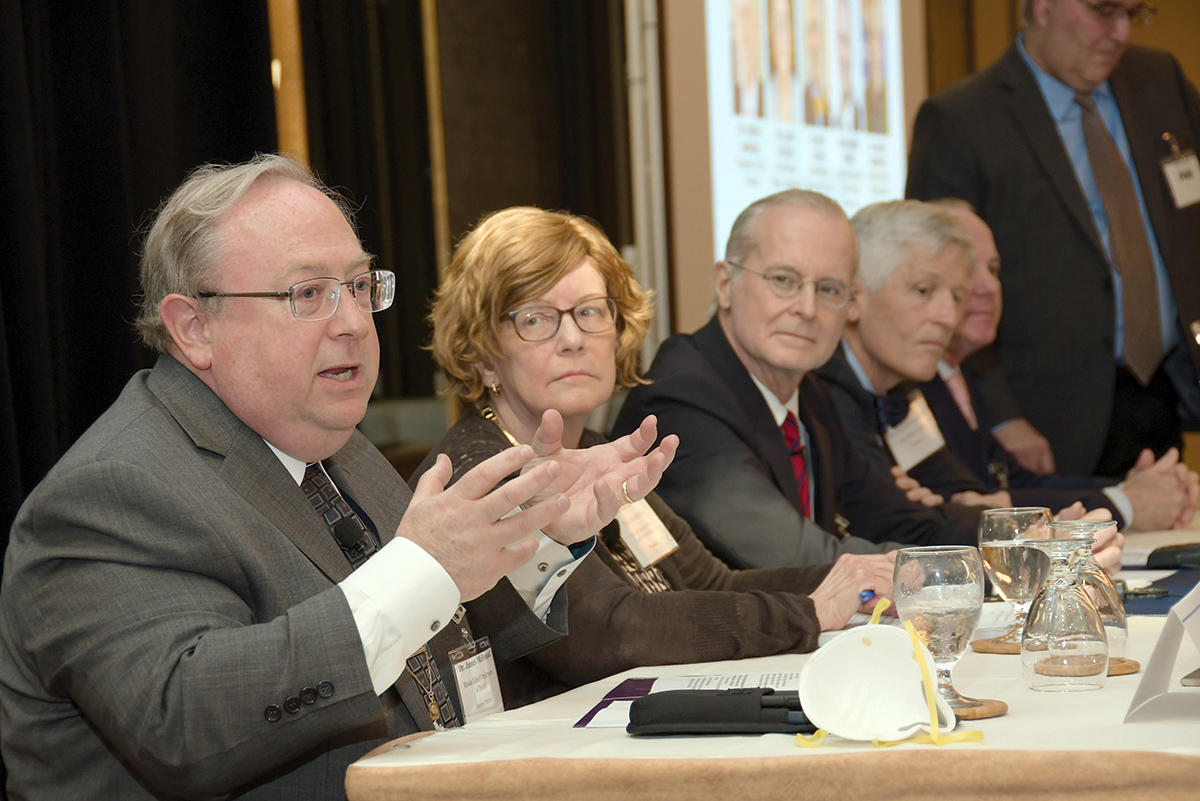
Babineau spoke about the situation facing the hospital industry in Rhode Island during the second of two panel discussions at the Providence Business News Spring 2022 Health Care Summit held on April 6, attended by about 150 people at the Providence Marriott Downtown. The panel also featured Dr. Raymond O. Powrie, Care New England Health System executive chief of medicine; R.I. Department of Health Interim Director Dr. James McDonald; Dr. Claire Levesque, chief medical officer for commercial products at Point32Health; and Dr. Matt Collins, chief medical officer and executive vice president at Blue Cross & Blue Shield of Rhode Island.
Babineau, who on April 14 said he will resign as the CEO and president of Lifespan effective May 31, and other panelists said employee burnout as a result of the pandemic has left health care organizations severely short-staffed. Lifespan, the state’s largest hospital system that operates Rhode Island Hospital, The Miriam Hospital, Hasbro Children’s Hospital and other facilities, is now contending with 2,700 vacancies when it typically runs 700 to 750 in an organization with 17,000 employees.
Babineau, apologizing in advance for using the metaphor while a violent conflict continues to rage between Russia and Ukraine, compared the situation to a war-torn country.
“Like every war, when it begins to be over, which we think it is from the virology standpoint, you start talking about rebuilding,” Babineau said. “We need every single person we can find, and I mean across the board. Although the virology of the pandemic may be fading in the rearview mirror, we have an enormous rebuild ahead of us.”
Lifespan, which recently launched an advertising campaign that enlists hospital workers to sell others on working at Lifespan, is doing “everything humanly possible at great expense” to recruit new employees, Babineau said.
And while during the pandemic Lifespan has done its best to show its appreciation for workers by rewarding those who continue to show up, Babineau said it’s time to take a new approach that involves an appeal to the nobility of a health care career as a calling.
“If you send one more pizza pie to the union, I’m going to vomit,” he said jokingly. “We’re trying to shift the narrative. … Of course, there is a thank you, thank you and thank you. We have to shift and make it all about professional pride and purpose.
“If you do come back and you did stick with us, a couple years from now you’re going to look back at this time with enormous pride of professional purpose that says, ‘I answered the call,’ ” Babineau said. “That’s really the message we’re trying to get out to the community.”
McDonald thinks he and state leaders can do more to help alleviate the situation.
“I can help licensing of health care professionals move quicker,” McDonald said. “I can try to do that if I get the staff to do that. … We need to seriously look at [Medicaid] reimbursement rates. Why is a normal spontaneous vaginal delivery reimbursed at half the rate in Rhode Island through Medicaid [than] it is in Massachusetts? These are things [Care New England CEO and President Dr. James E. Fanale] talks to me about. It’s like, ‘I don’t know, that’s a great question.’ ”
McDonald said that “it’s hard right now” to be in health care as an industry leader, and that many workers left the field due to a “moral injury” they suffered from the pandemic.
McDonald said one “interesting tool” worth exploring to help ease the staffing problem is student loan repayment for health care workers.
“I think it’s something that needs to be done on a state and national level because it makes achieving health care employment a lot more possible,” McDonald said. “Loan repayment for anyone in health care would be a great idea, no matter what your job is. It gives someone a chance to get a reasonable education at a reasonable cost, and the more likely they are to acquire the education.”
Another way to combat employee burnout that has been leading to attrition is to try to reduce the amount of paperwork employees are being burdened with. Dr. Christopher Ottiano, medical director for Neighborhood Health Plan of Rhode Island, described it as “pajama work” during the first panel held during the summit.
“That pajama work is steadily wearing,” Ottiano said. “So, of course, we want to eliminate, wherever we can, items like prior authorizations and administrative work.”
During the summit, both Babineau and Powrie said their organizations were considering the possibility of bringing back former employees who refused to comply with the state’s vaccination mandate that was enacted last year.
Lifespan said it lost 200 employees because they refused to comply with the COVID-19 vaccine mandate. Care New England, the state’s second-largest hospital system that operates Women & Infants Hospital, Butler Hospital and Kent County Memorial Hospital, said recently that it ended up losing fewer than 100 employees because of the vaccine mandate.
“We’re evaluating that,” Babineau said of possibly asking employees to return.
“We struggle with this,” Powrie said. “We’re thinking it through.”
The state’s vaccination requirements for health care workers in Rhode Island expired on March 12, said Joseph Wendelken, an R.I. Department of Health spokesperson.
Wendelken said the Centers for Medicare & Medicaid Services has a COVID-19 vaccination requirement in place for workers at facilities that receive reimbursement from the federal agency.
“Without question, my perspective is the vaccine was a plus in terms of staffing,” Powrie said. “We had more people at work, less people down, less days of transmission. … I struggle with the idea of what [allowing unvaccinated employees back] means for patients.”
(SUBS 4th paragraph to add Babineau resignation announcement.)
Marc Larocque is a PBN staff writer. Contact him at Larocque@PBN.com.