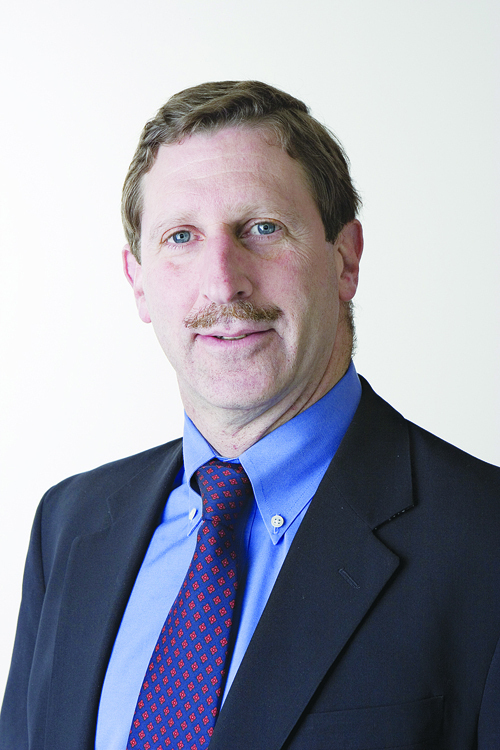
As vice president of development and campaign director at Brown University, Neil Steinberg has led the university’s Boldly Brown fundraising campaign. In August, he’ll take over as president and CEO of the Rhode Island Foundation. The foundation, established in 1916 and with assets exceeding $600 million, made grants of $25.4 million in 2007 to 1,275 nonprofit organizations. Steinberg spoke to PBN recently about his experience at Brown and plans for the Rhode Island Foundation.
PBN: Brown University has an endowment of approximately $2.8 billion, the smallest in the Ivy League and small compared to Harvard at $34.9 billion or Yale at $22.5 billion. How important is an endowment to a university like Brown and what are those funds used for?
STEINBERG: An endowment is very important. It sustains the institution. Endowments, as you know, are in perpetuity, and the investment of the endowments and the investment income provide many types of funds for the university, to fund scholarships, to fund programs, to fund faculty members.
PBN: Then the question becomes what can Brown offer the best and brightest students that they cannot get at Harvard or Yale?
STEINBERG: Brown has many things that make it unique. Most particularly is the curriculum, though. The so-called “new curriculum,” which is about 40 years old, is a differentiating point. It allows more flexibility, more freedom and more self-direction by the students. [The idea that there are no required courses] is a little bit of a misnomer. The students chart their own course in selecting different areas of study but there are requirements within your concentration, so if you’re a math or English concentrator that’s going to be your degree and there are required courses within that. But external to your own area of specialty, your own concentration, there’s a lot more flexibility and there’s not a so-called formal core curriculum.
PBN: What about increased financial aid as a draw?
STEINBERG: First of all, Brown is need-blind. Applicants are granted admission without regard to ability to pay, so it’s completely need-blind. And then we have enhanced the financial aid packages for low- to moderate-income families.
PBN: What else is special about Brown?
STEINBERG: Being in wonderful Providence, you have the blend of it’s not a city school and it’s not way out in the country. Providence is a great location. The size of the university is attractive to many kids when they’re looking at different schools. And it’s a university college, the undergraduates are taught by the faculty, all the faculty here teach undergraduate courses.
PBN: How difficult is it to raise money for Brown in these tough economic times?
STEINBERG: We’ve been in this campaign [Boldly Brown] for several years now, we just reached $1.2 billion on the way to surpassing our goal of $1.4 billion, and we still have two-and-a-half years to go. We have not seen a significant slowdown, it doesn’t mean that we’re not impacted necessarily, but we haven’t seen a significant slowdown. Philanthropy sometimes will slow down, but it doesn’t come to a grinding halt. We’ve seen anecdotal evidence [of a slowdown], but there’s a fairly large alumni base, it’s national, it’s international, so some areas may be a little weaker, some areas are a little stronger.
PBN: There’s a growing gap between the rich and the poor. How can the Rhode Island Foundation address that?
STEINBERG: It’s a great opportunity to address that because what community foundations do is they have the ability to enable private philanthropy to be directed to community needs and community causes, so it’s a perfect bridge for that. The Rhode Island Foundation, its mission is to work to build a better Rhode Island as a philanthropic resource for our own people, communities, organizations and different programs. It connects private philanthropy to the public good. What the Rhode Island Foundation does is it evaluates community issues to make grants, it promotes and builds effective philanthropy for people who want to see [their money] go to the right places, where it’s used effectively, and it’s all endowment. So what the foundation does is stewards this permanent in-perpetuity money to honor donors’ intent and match that up with current needs. The needs are very critical; many people would say they are at an all-time high.
PBN: In general, what areas do you see the Rhode Island Foundation concentrating on under your watch?
STEINBERG: There are really six major areas, human services, health, the environment, education, community and economic development, arts and culture. What the foundation does, and what I hope to do, is provide leadership and a forum for dialogue on these important issues.
PBN: Do you plan any changes at the Rhode Island Foundation?
STEINBERG: That would be premature to say. No, I look to build on what they’ve been doing for 92 years already and together to meet the ever-growing needs of the state. There’ll probably be some new things we’ll try, but this is a very well-functioning, very successful organization. It’s an honor and a privilege for me to be coming on board to help lead that effort. •
interview: Neil D. Steinberg
Position: Vice president of development and campaign director at Brown University; incoming president/CEO of the Rhode Island Foundation.
Background: After graduating from Brown in 1975, Steinberg went to work for the former Industrial National Bank and in 1990 became senior vice president of what was then FleetBoston Financial (now Bank of America). Promoted to executive vice president in 1996, he led the bank’s successful acquisition of Summit Bank, and was named president of Fleet Bank-Rhode Island in 2001 and chairman/CEO in 2003. Steinberg has been at Brown since 2004 and has led the Boldly Brown initiative.
Education: Brown University, bachelor’s degree in applied mathematics, 1975.
Residence: Pawtucket.
Age: 54.