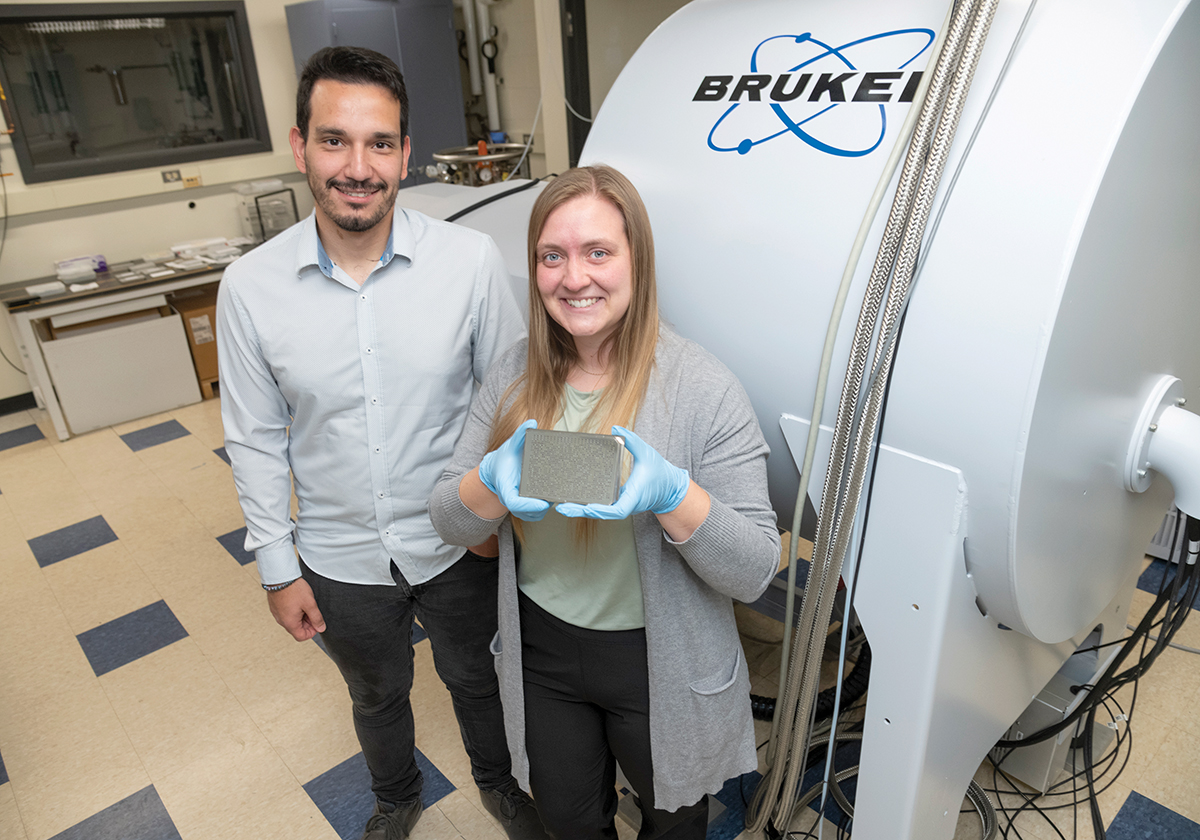
AtomICs Inc., a startup founded at
Brown University, chases an ambitious concept: molecular-level data storage that’s small and durable enough to revolutionize the market.
Co-founded by a small team of doctoral researchers and professors, AtomICs has already won plenty of local recognition: in just one year, the startup took top honors in Cox Business’ 2022 Get Started R.I. competition, placed as a finalist in the 2022 Rhode Island Business Competition, earned a spot in the MassChallenge U.S. early-stage cohort that same year and won the Brown University Venture Prize.
But achieving this early success has been an uphill battle, said Dana Biechele-Speziale, who co-founded the company alongside fellow doctoral student Selahaddin Gumus and professors Brenda Rubenstein and Jacob Rosenstein.
“Unfortunately, the infrastructure [to support the technology] isn’t currently here in Rhode Island, compared to other places nationally,” Biechele-Speziale said. And now, at the end of her doctoral program at Brown University, she says the startup isn’t long for the Ocean State.
“We wish we could stay in Rhode Island, but unfortunately, without lab space, we just can’t,” she said. Instead, Biechele-Speziale has her eye on locations with more support for “deep tech,” the relatively young sector AtomICs occupies.
It’s a type of technology that can overlap with better-known areas such as software and biotech. But deep-tech innovation, sometimes known as hard tech, stands out for its heavy emphasis on scientific and engineering research and development. Deep-tech efforts also require longer development times that require immense investments but have the potential to bring in soaring profits if successful.
The term “deep tech” itself doesn’t come up often in Christian Cowan’s work as executive director of
401 Tech Bridge and the
University of Rhode Island Research Foundation.
But it’s a type of technology that seems like it could have a place in Rhode Island, Cowan says, particularly with the state’s emphasis on clean energy and biotech, which can fit well into deep-tech innovation.
Stephen Eaves, CEO of the East Greenwich-based deep-tech company
VoltServer Inc., also says that Rhode Island doesn’t have a robust sphere for this technology focus, with limited widespread awareness and a lack of in-state funding – an issue in Rhode Island facing entrepreneurs across innovation sectors, but even more glaringly in deep tech.
VoltServer has innovated an electrical energy distribution system, and Eaves has managed to find the funding and resources needed to keep the company in Rhode Island, where it continues to increase its footprint and staffing. But it’s not a location that would naturally appeal to most in the sector, he says.
“I’m a native Rhode Islander, so I love the state,” Eaves said. But “if I was looking for money, it wouldn’t be in Rhode Island for deep tech.”
The Ocean State “has a bit of a brand for biotech,” he said. “They worked on that, and with Brown being involved, that’s a strong driver. But other tech spaces are more difficult.”
VoltServer was able to secure essential funding from local angel investors and the Providence-based
Slater Technology Fund, a nonprofit seed-stage investor. But the company also had to look out of state for its funding, which Eaves says could easily be double what’s needed for a software company.
“I think there’s an appetite for it in the financial community,” Eaves said, especially with recent attention on clean-energy startups. “There is a fair amount of funding out there from the private equity and venture capital side, but it’s mostly distributed more into California, New York, Massachusetts than it is in Rhode Island.”
Deep tech also requires a very specific type of investor, Eaves says, in part due to its longer development time because companies are working on the frontiers of knowledge and technology.
At VoltServer, “we’ve been at it for about 10 years,” he said, “and in deep tech, that’s not very long at all.
“In another tech play … you can be spinning up pretty well in a couple years,” Eaves said. “But deep tech is very long. You need very patient investors that understand the deep-tech environment because you’re changing fundamental infrastructure.”
And while Rhode Island undoubtedly loses some of its talent to Boston and Cambridge, Mass., which are both known for robust deep-tech environments, Eaves says he’s had success in attracting employees to VoltServer, in part by touting the local quality of life.
Biechele-Speziale also says that Rhode Island has its strengths in the technology sector, such as a strong network of general startup services and a lower cost of living than in larger cities.
Rhode Island’s much smaller deep-tech profile also provides opportunities for innovators to make a name for themselves in a newer sphere, she says.
“That’s where Rhode Island can really stand out and help founders who are coming out of universities like Brown,” Biechele-Speziale said. But at the moment, she added, “everyone in deep tech and biotech right now is coming out of the university then immediately going to Cambridge, for the most part.”
And while deep tech has funding opportunities and support at a broader level, Biechele-Speziale also noted, “it needs to start trickling down to states like Rhode Island, which have a lot to offer and are close to talent hubs.”
“I think there can be great success for Rhode Island in deep tech, so I hope it becomes more of a part of the conversation,” she said.