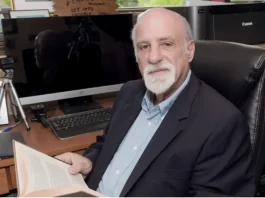
As one of the five state Supreme Court justices in Rhode Island, Chief Justice Frank J. Williams writes more than 20 decisions a year – more than any of the other justices.
And he has to manage the judiciary’s 742 employees and $86 million budget.
As Williams enters his seventh year as leader of the state’s judicial branch, he sat down with Providence Business News to talk about the judiciary’s budgeting during a statewide fiscal crisis and his plans for a Blackstone Valley courthouse.
PBN: How have you so far handled your tenure as chief justice?
WILLIAMS: One – we don’t deficit spend. I think we’re the only branch – or one of very few branches – that [doesn’t] go back for supplemental to make up for overspending our budget. We don’t deficit spend. We haven’t for six years. We stay within our budget.
Two – this is the third co-equal branch of government – it’s supposed to be – with judicial independence. We don’t get any more than 1.4 percent – 1.4 percent – of the entire state budget. That’s insignificant and de-minimus.
Three – we’re staying within our current budget for 2008, which is $86,073,000, [which is the same as figure the governor proposed for 2009]. In other words, we’re not asking for any increase. Someone may say in these fiscal times, “Why aren’t we agreeing to less?”
Well, we … just sent $800,000 back to the general treasury that was in an escrow account – trust funds. We expect to save another $4 million for not filling vacancies. So you could subtract that, really, from the $86 million.
PBN: What improvements have you made?
WILLIAMS: I’m trying to run this like a business and this is the third branch of government. … But that’s what we’ve tried to do, not just in the budget, but with management of personnel, with attention to technology improvements – like going to e-filing, which we’re working on. New courthouses have been built. A new courthouse hadn’t been built in over 25 years, and that’s the new Kent County Courthouse that we opened a year ago and the [state] Traffic Tribunal that we opened in Cranston.
Our [planned] courthouse would be in Northern Rhode Island. That’s what businesses do. And if you don’t pay attention to your infrastructure or capital improvements and maintain what you’ve got … you’re going to have a deteriorating infrastructure. And underlying all of this is the fact that we have a mission here to serve the public and provide user-friendly access to justice.
PBN: Why does a courthouse in Lincoln make sense?
WILLIAMS: One of the reasons for the need for a Blackstone Valley courthouse is not just to serve the citizens of Northern Rhode Island – who have to come to Providence now; that’s 12 communities – but also to decongest [J. Joseph] Garrahy [Judicial Complex], which before the new Kent County Courthouse and the new Traffic Tribunal was our newest courthouse, built about 1980. It was designed for 1,500 citizens a day. It serves 3,500.
PBN: When was the Lincoln courthouse proposed?
WILLIAMS: It’s been enacted in the [current fiscal year 2008] budget, but we’re [making sure we have the right location].
My representation to the people in Lincoln is that we would want to make sure it works, and we can do it without problems relating to traffic and so on. Being a good neighbor, that’s what we’re looking at now.
PBN: Can the state afford a new courthouse?
WILLIAMS: The need is only going to increase. It’s a capital improvement, and I know it means more on the debt service annually. The $69.8 million, which is the current estimated cost, doesn’t have to be appropriated in next year’s budget because it’s paid down over a couple of years. So what’s it going to be? Do nothing and the need increases, and it’s going to cost more in the long run? Like we just had to do in Warwick and Cranston?
There was some concern by the state budget office that we would need all new justices and court clerks and sheriffs and capital police and it would increase the costs exponentially. But we’re going to use – except for two or three additional maintenance people – existing judicial officers, clerks, sheriffs and capitol police.
PBN: What’s the timeline for that project?
WILLIAMS: We haven’t locked in. The budget article that passed last year deferred construction until a year later, which would mean this summer. We haven’t hired an architect, we don’t have final plans. But I would say, realistically, that it would be between four and five years from putting a spade in the ground. That’s another problem. If we delay it, we’re also putting out the completion time four to five years. •