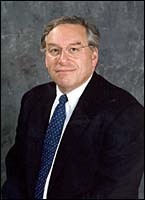
law professor Harvey
Rishikof
For industries like tourism and air travel, the effects of the Sept. 11 terrorist attacks on the United States were abrupt and obvious.
But for other fields, including the legal profession, the fallout will spread slowly, likely shaping the field for years to come.
Harvey Rishikof, a professor at Roger Williams University School of Law, said the terrorist attacks – and most importantly the government’s response to them – will have long-term effects on the practice of law in the United States. Rishikof is a former counsel to the deputy director of the FBI, where he worked on national-security and homeland-defense issues.
“There will be a whole range of legal issues dealing with privacy,” Rishikof said.
Legal challenges to racial and ethnic profiling are likely to grow, he said, as will privacy concerns stemming from an array of potential new security measures. Will Americans someday need national identity cards, coded with DNA? Will governments demand greater scrutiny of computer systems and exchange of electronic documents?
Changes to the Foreign Intelligence Surveillance Act, which regulates wiretaps and investigation of foreign agents, is likely to draw legal challenges too, Rishikof said.
“The legislation (being discussed in Washington) eventually will open up a whole new slew of Constitutional doctrine,” he said.
Already, the cable industry has raised concerns over a congressional counter-terrorism plan that includes the disclosure of subscriber records, according to Communications Daily, a trade newspaper. And civil-liberty groups have criticized proposals to soften federal standards of proof needed for wiretapping.
Rishikof said issues involving international rules of military engagement should also spawn new work for lawyers.
“The rules of war are different from law-enforcement actions that arise as a result of terrorism,” Rishikof said. “Can the military be used domestically for police actions? Will it have sovereign immunity? There will be a slew of lawyers required to think through the appropriate manner in which the military acts.”
Aside from legal issues involving national security, economic trends also are shifting the focus of some in the legal field.
Roger Williams law school was inundated with a 42 percent jump in applications last year – one of the highest increases in the country, according to Bruce Kogan, the law school dean. While Kogan said the surge is partly the result of the relatively new school’s growing reputation, it also probably has a lot to do with the bleak economy.
“A down economy winds up presenting law as an alternative for people in financial-services or technology, who thought their futures were unlimited,” Kogan said. “All of a sudden a shakeout hits and many begin to look to traditional professions like law or medicine or accounting.”
The same sluggish economy that has prompted many would-be stockbrokers and high-tech workers to pursue legal careers is also creating new opportunities for lawyers.
“Enrollment in our bankruptcy course has been very strong,” Kogan said. “I think people are sensing that there will be increasing amounts of work for lawyers as the economy slows.”
Michael Hillinger, associate dean of the Southern New England School of Law in North Dartmouth, Mass., agrees that there will be a surge in demand for bankruptcy-law services. The sagging economy is likely to not only send more businesses into bankruptcy, but also individuals, as unemployment creeps higher.
“Bankruptcy is an important safety valve for businesses that are failing or individuals who are losing their jobs,” Hilliger said. “Bankruptcy law will be big in coming years.
The flipside to the slow economy, though, will be less activity in other corporate legal areas, such as mergers and acquisitions and the financing of development projects, Hillinger said.
And there will be fewer technology startups that need legal help in getting businesses up and running. Hillinger said a number of the school’s graduates have found work at high-tech startups in the Boston area – a career path that might be drying.
But both Kogan and Hillinger say opportunities still abound in the technology field.
“Despite the downturn, high tech and the legal issues surrounding it is not going away,” Hillinger said.
Intellectual-property law will continue to grow, Hillinger said, as a wave of biotechnology and other technology-related patents continues. And Kogan says software licensing and privacy issues related to the Internet will continue to demand attention from the legal profession.