The factory went up in 1916, the year President Woodrow Wilson established the national highway system, and just three years after Ford set up the first moving assembly line. Attleboro had just been incorporated as a city, and it had bustling industrial clusters.
Frank Mossberg, a Swedish immigrant who’d later be celebrated as a “local genius” and awarded a medal by the American Society of Inventors, set up his plant on an 11-acre site on Attleboro’s Lamb Street. He produced tools, automobile starters and spring kits.
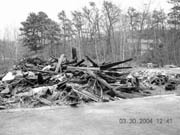
In 1937, a bankruptcy court conveyed the property to the Apco Mossberg Company Inc., which continued to make metal parts for the automobile industry, thriving for decades. Over time, however, the firm declined, and then in 1987, the plant burned down.
A new Apco Mossberg Torque Tool Co. plant opened on County Street, continuing a well-respected brand name. But left behind in the rubble was a different company legacy.
First there was the asbestos-contaminated construction debris, which the state Department of Environmental Quality (now Environmental Protection) removed in the 1990s.
Then, in 2003, at Mayor Kevin J. Dumas’s request, U.S. Environmental Protection Agency experts assessed the site and found high levels of polychlorinated biphenyls (PCBs) and “extensive heavy metal contamination,” said Melanie Morash, the on-scene coordinator.
The PCBs, for which the levels in some areas were 150,000 times what the EPA considers safe, probably came from electrical transformers that collapsed during the fire, Morash said. There were also heavy metals “typical of electroplating and heat treating” facilities, she said: lead, a carcinogen that also causes neurological disorders; cadmium, a carcinogen; and barium, a “potential” carcinogen.
The pollution was severe enough that the EPA referred the site to its Emergency Planning and Response Branch, where Morash works. A more in-depth site review documented the various problems – not just the heavy metals and PCBs in the soil and debris, but also containers of “potentially ignitable” chemicals such as paints, aerosols and compressed gas.
Morash and her team also made note of the danger to people around the site: Not only were there more than 1,500 people living within one-quarter mile, plus four schools within a mile, but there were homeless families staying right on the site and in the adjacent woods – cooking dinner, camping out and letting their children play on the contaminated grounds.
The Apco Mossberg site was deemed a time-sensitive threat, and the EPA allocated Superfund money to clean it up and secure it, starting last January. The budget was $480,000.
“We were expecting the cleanup would be limited to the footprint of the building itself,” said Morash. But the property still held more problems: two underground oil storage tanks, which the state Department of Environmental Protection agreed to remove. “They pulled out about 400 tons of oily soils, contaminated soils, and thousands of gallons of oily water,” she said.
Even worse, Morash said, the crew found large waste chemical storage lagoons in a wooded area, about 60,000 square feet of oil-soaked soil “heavily contaminated” with cadmium. There were also buried drums with cadmium and lead-contaminated oil, she said.
Morash applied for more money, for a total of $1.45 million, plus a $310,000 contingency fund, for a total of $1.76 million. Morash said as of last week, with the cleanup done but some site restoration and hazardous-waste disposal work still pending, $1.5 million had been spent. That doesn’t include the EPA staffers’ time.
For a town that’s lived with these ruins for 18 years, the project will make a big difference. The EPA is backfilling all the excavated areas with clean materials, covering them with topsoil, and seeding them with grass, non-invasive plants, and wetlands flora, so it will look like just another parcel of undeveloped land.
“It’s still not perfect, but to have that site cleaned up, to know it’s going to be rehabilitated – it’s much better than anything we could’ve ever asked for,” Dumas said in an interview.
Asked what the future may hold for the site, Morash said it’s been cleaned thoroughly enough to be reused for commercial or industrial purposes – which is what it’s zoned for.
“We will be leaving extensive property documentation with the city and the state so they can determine appropriate future uses,” she said.
Dumas has suggested moving the city Department of Public Works there and redeveloping the DPW’s current location, in downtown Attleboro. He said that’s “just one of the possibilities,” however, and first the city needs to hear in detail from the EPA.
In any case, the city can move to take the land, but the mayor said officials hadn’t wanted to in the past because of the huge environmental liability.
Under the federal Superfund law, both current and former owners of a contaminated piece of property can be held liable for cleanup costs. Morash said the EPA is already building its case to try to recover at least part of its money.