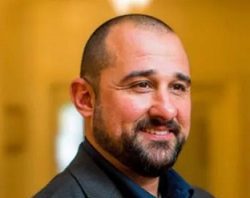
Name: Michael Rubinger
Occupation: President and chief executive officer of the Local Initiatives Support Corporation
Backround: Rubinger has more than 20 years experience in the housing and economic development fields, including serving as the Executive Director of the Fund for Urban Neighborhood Development, an external program office of The Pew Charitable Trusts.
Education: Graduate of Brown University and the Fletcher School of Law & Diplomacy at Tufts University.
Age: 54
Family: Married, two children
Residence: New York, New York
MICHAEL RUBINGER: ‘Eight or ten years ago, people were writing off cities…all of that has turned around.’
PBN: Tell me about LISC and what the organization has done for the communities it serves?
RUBINGER: We are a national organization, based in New York, with 42 offices around the country. One of the offices is here in Providence, covering the state. The business we are in is working with neighborhood-based, non-profit organizations that are revitalizing their neighborhoods. It’s in low-income areas, by in large. We do housing development and rehabilitation as well as commercial and retail development. We get into day-care programs, community security and the whole range of activities that community groups get involved in to redevelop their neighborhoods. We raise money from the business community – banks in particular – private donations, and government. Then we channel that money and those investments into local community organizations.
We provide equity – usually for housing projects – and we also provide loans and grants to help the organizations themselves to develop their capacity. LISC has been around for almost 20 years and in Rhode Island since 1991. Last year, we invested, loaned or granted almost $600 million for a variety of neighborhood revitalization projects.
The national headquarters is in New York and we have a very good program in New York, but I think the program here in Rhode Island is a very strong one as is the program in Boston. There are others in the country that are just as good, but I think Rhode Island and Boston are two of the best ones.
Your key corporate partners in Rhode Island include Fleet, BankBoston, Textron, CVS, The Providence Journal, The Rhode Island Foundation and Rhode Island Housing. How do those relationships work?
We have an office in Providence with a small staff. We raise money throughout the state of Rhode Island to support the program, which we then match with resources we raise nationally. We create a local advisory committee, usually made up of local funders as well as people who don’t fund us necessarily. They serve in effect as the local board in setting policy and generally overseeing the program. We go into local areas to raise funds, but we also go in there to engage the people we are receiving funds from. We think it is important for the banks, the corporations or foundations to understand what we do and be involved so they do more for the organization on a day-to-day business.
When we started 20 years ago it was very difficult to get banks who were willing to loan in the communities we were working with. Today there are banks vying against each other to offer these loans. That is in part due to our activities and the groups we support, but also for other things like the Community Reinvestment Act and the general state of the economy. A lot of the communities we have worked with have shown some dramatic improvement in terms of their economic situation, their physical surroundings and the lives of the people who live there. You can see it in Rhode Island (where more than $35 million was invested since 1991) in neighborhoods that have been down and out and are now coming back.
Like any organization that relies on corporate donations, I would imagine your group is concerned with the consolidation of companies, fearing you might not get as much money from the combined entity as you would from two separate companies. For example, you mentioned that both Fleet and BankBoston are supporters of LISC.
There is a possibility we won’t get as much, but there is also a possibility that we might get more. I don’t think that whole scenario has played itself out yet. It is confusing and it is disruptive in the sense that you were working with certain entities and suddenly you are now working with a merged entity and different faces and different priorities. I don’t necessarily think it is a negative thing, but it could be of course. It is not just here but we are facing it with Nation’s Bank and Bank America and banks on the West Coast as well. I would call it more coming to grips with how the new entity will operate and who is going to do what and how they are going to deal with us. Most of the mergers have made rather large commitments to community development, at least on paper.
How has the state and local communities responded to your organization?
Rhode Island Housing(and Mortgage Finance Corporaation) has been very supportive and has worked with us on a number of projects over the years. They are very active in supporting non-profit organization. Not all housing agencies in all states believe in supporting non-profit community-based groups. Here though they have been very helpful.
Do you think you get the name recognition in Rhode Island that you do in other states you serve?
It depends. I think in some places where we have been for a long time and had a large program there is name recognition, but in others there isn’t. It’s difficult, because the role we play is that of an intermediary. What I mean by that is we are raising capital basically from the private sectors and channeling it to non-profit organization. From our perspective it is important for those community organizations to get the recognition and for local agencies and business to know who they are and to support them. At the same time, many of the people who provide us with resources want recognition for that as well. So we are often in the position of stepping back and saying, ‘this is your project and you deserve the credit for this.’
I will also like to stress that while a lot of our programs and what the community groups do starts with housing, it is not entirely about that. We are about revitalizing neighborhoods in a holistic way. Oftentimes starting with housing is a way to get a foot in the door. If you can revitalize the housing, you find that retail businesses want to come back into the neighborhoods. Then there are demands for day-care services, employment services, better schools and all that lead to a healthy community. That is where we are with an awful lot of communities. If you can make an impact in a neighborhood with housing it changes the entire dynamic of the neighborhood.
Can you give me an example of a success story?
In New York City, for example, we have been active for 20 years. We have now constructed or rehabilitated 15,000 affordable housing units. A lot of the units were concentrated in the South Bronx, in Harlem or in Brooklyn. In Harlem, we have done about 5,000 housing units and what you now see creeping up is new retail development. For example, about six months ago we opened a Pathmark supermarket on 125 Street and Third Avenue. There had been no supermarket in that neighborhood for 30 years. It’s the biggest supermarket in Manhattan and it is doing land-rush business. Across the street there is a developer from Long Island who wants to put in movie theaters. Further over on the west side of 125 Street there is something called Harlem USA, a whole entertainment center. At the same time the group we were working with, the one responsible for the Pathmark, also have a home ownership program. They run day-care programs and run services for the elderly. That’s an example, but there are many others.
Your organization has a lot of competition when vying for corporate funding. Why do you think you get the support that you do?
It is important to them both as business people and as residents that their cities thrive. I think the kind of work we are doing is attempting to revitalize neighborhoods that need to be revitalized if the whole city is going to survive and grow. That is going to create business opportunities. Many of the institutions that support us are in the financial services industry and there are lots of opportunities in the neighborhoods for investments. Many of the banks, insurance companies and others have taken advantage of that and are doing quite well. In addition there are retail opportunities in these neighborhoods.
It’s really the larger question. It’s rejuvenating the entire urban landscaper and I think downtowns are one thing, but the neighborhoods are equally important. For the people who are increasingly concerned about sprawl and smart growth, if you want to limit sprawl you better have a good alternative. The alternative is to stay in the city and have that as an option for people instead of moving farther and farther out.
Eight or ten years ago most people were writing off cities as a thing of the past. There was a lot of that kind of talk. All of that has turned around. You see that in Providence. Suddenly people are coming back to the city and are interested in the city again. I think the community groups that have been struggling for the last 10 to 15 years have seen results. They have built it to a scale that has had real impact.