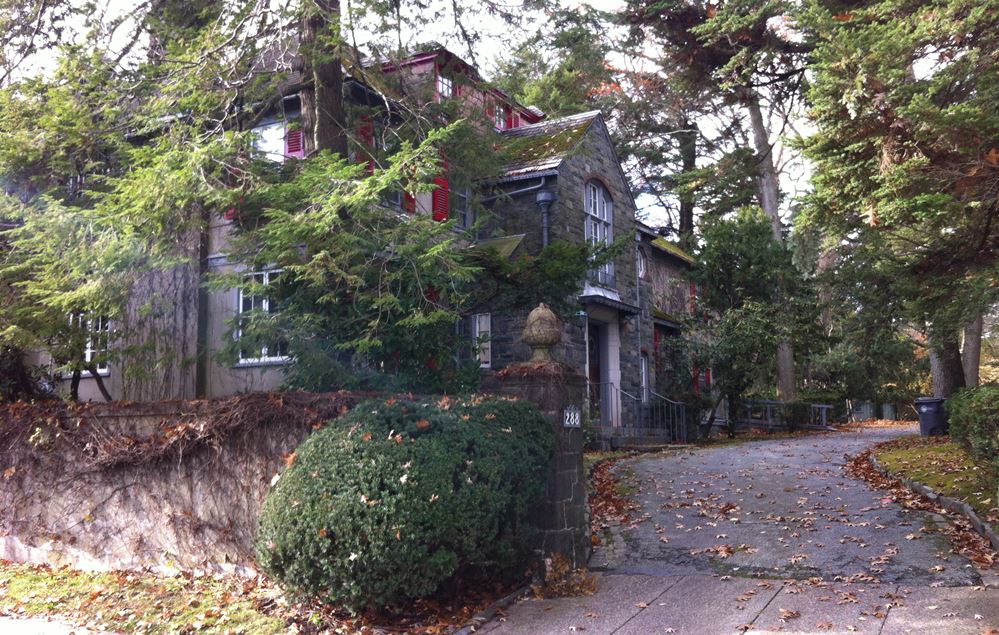
PROVIDENCE – One of the last great estates on the East Side of Providence could be subdivided into 10 house lots that critics say are better suited to a suburb such as East Greenwich.
The property owner and development company, represented by attorneys, argue the historical structures, including a 1909 house and a carriage house, can be torn down today without city permission because the site isn’t located in a local historic district.
The Providence City Plan Commission, after listening to more than 90 minutes of public testimony about the subdivision proposal, voted to continue its hearing and a decision until January. That will give members time to think about their positions, and tour the 3-acre property on Blackstone Boulevard, said chairwoman Christine West.
And it will give the applicant time to think about whether a subdivision of 10 lots, which would necessitate the removal of all historical structures on the property, and which would impact a stone wall on Slater Avenue, is the best way forward, she said.
The Beresford-Nicholson Estate, which covers three lots on Blackstone Boulevard and Slater, is in a national register historic district. But it is not covered by a local historic district, under which the structures would get some protection through a review by the Providence Historic District Commission, according to city officials.
If the property was in a local historic district, it would be subject to both demolition review and new construction design. But according to City Councilman Sam Zurier, who represents the area, homeowners in the general area have not wanted a local district, which also restricts what they can do to the exterior of homes.
The proposed developer — Cranston-based Bilotti Group — is represented by Providence attorney Zachary Darrow of DarrowEverett LLP. The developer has the property under contract, pending approvals.
In a staff report, Bob Azar, deputy director of planning and zoning for Providence, said the property generates a tax bill of $96,000 in city taxes annually — which he said speaks to the pressures facing large land owners in modern times.
“The way the city land is assessed, it makes absolutely no sense to own a property of three acres of land,” Azar said.
Facing a subdivision and new construction, neighbors — some of whom have lived in the Blackstone neighborhood for 50 years — spoke Tuesday at a public hearing on the subdivision, uniformly urging the city to reject it.
Joseph Chazan, who has lived at an adjoining property since 1970, said his neighbor had occupied the house and property for almost a century, from his birth to his death.
Six years ago, when another development threatened the property adjoining his house to the other side, Chazan bought it and turned it into an extended fruit orchard. This, despite the significant economic benefit he could have gained from selling it.
The current property owner of the Beresford-Nicholson estate, though this plan, wants to maximize the monetization of the property, he said.
“I appeal to the sellers and to the developers” for a subdivision plan with fewer lots that would enhance the neighborhood, he said.
Deming Sherman, who lives on a street in the general area of the property, urged the commission to consider the guidance of the comprehensive plan, which says that development should be compatible with the existing neighborhood.
The 10-lot subdivision, he said, which would require the removal of tall trees and demolition of supporting structures, including the house, the children’s playhouse, and a greenhouse, is “simply not consistent with this goal.”
The Providence Preservation Society has opposed the subdivision as well.
Darrow, who spoke briefly, cautioned the commission members to consider the plan as presented — a subdivision in which each of the lots meets or exceeds the current city zoning requirements. The project before the commission is not a development, but a subdivision, he said.
He rejected the idea that the subdivision violates the comprehensive plan, which takes into accounts neighborhoods, not specific sites.
“This property is, in fact, an anomaly,” Darrow said, referring to the size of the estate compared to surrounding lots in the neighborhood. “This is becoming an issue of independent property rights.”
Mary MacDonald is a staff writer for the PBN. Contact her at macdonald@pbn.com.