The University of Rhode Island is hoping a new partnership with the utility company PPL Corp. will pay off by bringing in millions of dollars of research funding for emerging green technology called carbon dioxide capture.
That’s what has happened in Kentucky, where more than 100 researchers on renewable energy have been powered by $92 million in federal funding over nearly two decades for a collaboration between PPL, the University of Kentucky and others.
Now, PPL and its local subsidiary, Rhode Island Energy, are looking to generate that level of productivity in the Ocean State.
“One thing we hope to accomplish – we will accomplish – is win federal grants,” said Aron Patrick, head of research and development for PPL. “The goal is to bring millions to stand up a bigger and stronger research program at URI.”
For researchers at the College of Engineering at URI, the partnership means more money for research and additional workforce development opportunities.
Vinka Oyanedel-Craver, professor and associate dean of research at the College of Engineering, says it will allow her colleagues to compete for more funding, namely from the U.S. Department of Energy. That’s because solicitations for these grants typically look favorably upon or require an industry partner, and it’s because PPL will be able to cover the matching funds, or a “cost share,” that is typically required from the federal government, she says.
“For every dollar the DOE will give us, we need to find 20 cents or even 50 cents,” Oyanedel-Craver said. “If we are competing for a $4 million proposal, it can be a million or more in matching funds. So we are very limited. But when PPL now expresses interest in a large solicitation in a topic they would be interested in, they would be willing to provide some of these matching funds. It will allow us to go there and fight for proposals.”
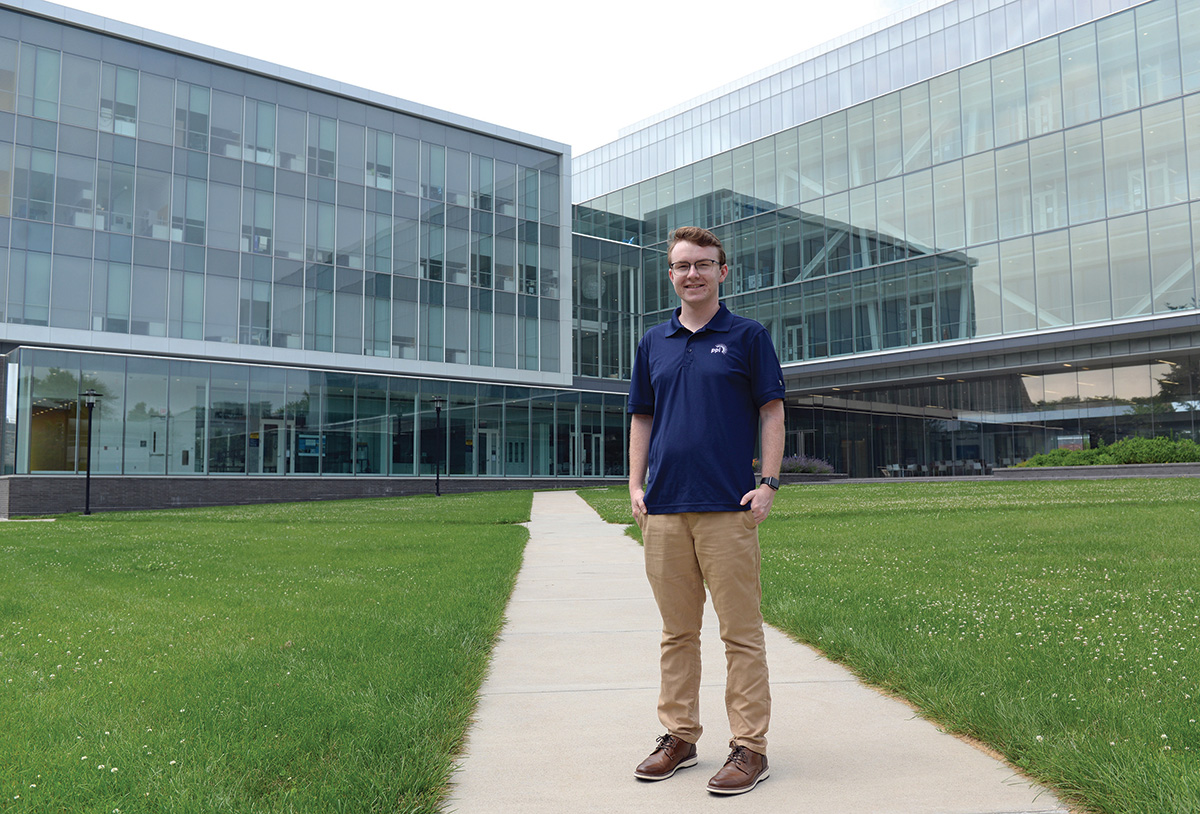
Casey Egan, 22, an engineering major heading into his senior year at URI who started an internship with PPL in January, said the new strategic partnership is exciting for researchers such as him who “fell in love with the environment at a young age” and want to contribute to the fight against climate change.
“This is going to bring a lot of opportunities,” said Egan, whose work has involved the improvement of battery technology. “The R&D [research and development] team I’m on has hundreds of projects in the renewable field. We’re trying to expand that. The state of Rhode Island in general has super progressive carbon-reduction goals. I think this is a really important partnership for meeting those goals.”
Patrick says the partnership, established through an initial five-year commitment, is of mutual benefit.
In addition to PPL establishing a $100,000 Brighter Futures scholarship and employing researchers and students from URI, the utility company is providing university researchers with information from the power grid. But the university also lends its academic and research reputation and capabilities to PPL, which three years ago announced its ambitious sustainability goal of achieving net-zero carbon emissions by 2050.
“The partnership between PPL and Rhode Island Energy and the University of Rhode Island is going to go further than we can go by ourselves if we went looking for federal grants,” Patrick said. “We wouldn’t have the same capability or expertise as the university does. The government wants to see that the work will be applied.”
Patrick says PPL has already financed about five projects in partnership with URI, including one project that received a grant from the National Science Foundation for $250,000, with PPL and the University of Kentucky as partners, to study the possibility of carbon dioxide capture and storage in the ocean.
Patrick says while in Kentucky the company has more than 100 people working on its research and development projects at its affiliate Kentucky Utilities, there are only five employees at PPL in Rhode Island who are focused on renewable energy and decarbonization, with another five students supporting them.
Patrick says carbon dioxide capture involves preventing carbon dioxide emissions from power plants from getting into the atmosphere, instead injecting the gas through pipes into storage containers. Ocean carbon capture entails keeping those carbon dioxide-packed containers underwater, he says. The goal is to reverse or decrease the damage caused by the carbon dioxide emissions from fossil fuel combustion, but the technology is still far from being economical and there are concerns about leaks, Patrick says.
In Kentucky, PPL has a 20-story-tall structure that is capable of capturing hundreds of tons of carbon dioxide.
“We’d be looking at the possible opportunity to do this in the future in Rhode Island,” Patrick said.
While carbon dioxide capture is a component of this strategic research partnership, it’s not really the priority, Patrick says. The primary focus is increasing the practicality, efficiency and widespread usage of renewable energy technology.
Electricity storage technology also needs to be improved so renewable energies can be used around the clock, not just when the sun is shining or wind is blowing.
“There’s a lot of research and development required to find the right balance,” Patrick said. “We already have lithium-ion batteries deployed in Rhode Island and other states. We’re looking now at 100 different technologies that could store solar power to be used at night, or used in lieu of wind when wind is not blowing.”