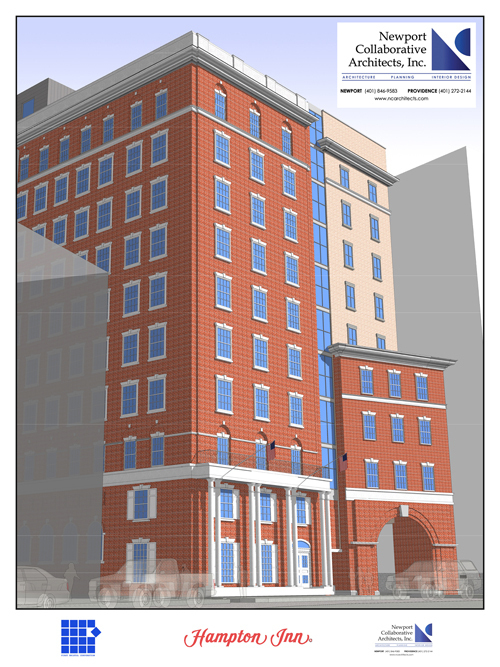
In Rhode Island there are not many empty hotels sitting vacant, waiting to be rehabilitated, said Newport Collaborative Architects Inc. Principal J. Michael Abbott.
So, boutique hotels have sprung from buildings with other past uses, including YMCAs, offices, dormitories and banks. And those are just the projects designed by NCA during the last 10 years, he said.
“Most of the time, we’re working on some old building that wasn’t a hotel to begin with,” Abbott said in an interview last week. “So we’re trying to do an adaptive reuse of the building.”
Since the mid-1990s, NCA has designed six hotel rehabilitations in Rhode Island and another project is now being constructed in Providence. The newest is a 10-story, 107-room Hampton Inn, which is the $17 million project of Fall River-based developer First Bristol Corp.
The building at 58 Weybosset St. had been constructed as a First National Bank. It was converted during the early 1990s to the St. Francis Chapel & City Ministry Center by Franciscan Friars, Abbott said.
The lobby where bank tellers once helped customers had been converted into a room for masses to be held, Abbott said. Now, the room – with ornate wood moldings, marble walls and columns – will serve as the hotel’s lobby.
“These buildings go through many multiple lives throughout their years,” Abbott said. “It’s rare to have them keep one use their whole lives.”
Along with rehabilitating the original property, NCA’s hotel and inn designs have all included “sympathetic” additions that mimic the original structure’s materials and designs, Abbott said. That allows the number of rooms to be increased without ruining the hotel’s style, which for a boutique hotel is part of what draws customers in.
“The thing is, they’re supposed to more unique, not your run-of-the-mill brand hotel,” Abbott said. “That’s why doing these historic rehabs make a lot of sense. Just by their nature, you’re going to end up with something that’s not cookie-cutter, that’s unique, just because you’re working with the old building.”
One of the first hotel rehabilitations that NCA undertook was the Francis Malbone House in Newport, built in 1760. The Colonial house was expanded by adding an enclosed walkway connected to a Colonial-style carriage house addition.
“We were able to double the number of rooms – get it up to 21 rooms – making it much more economically viable,” Abbott said. “Then they had enough room to host weddings and events like that, where one person comes in and rents the whole place.”
With the current Hampton Inn project, the addition – under construction now – is a re-creation of a five-story building that was once next to the main building. NCA’s research into the history of the property heavily influenced the design of the addition, much of which will have a brick façade like the original building.
“We’re kind of bringing that back to re-create the street edge along Weybosset,” Abbott said. “That’s kind of important because Weybosset is an old Indian trail and it has bends and crooks in it and the Hampton Inn sits right at one of the crooks.”
The concrete and steel frame for the addition to that building is now about three stories out of the ground. But the brick façade of that addition is far less practical given today’s construction materials and labor costs, Abbott said.
“The addition is costing more than the [purchase of the] building,” Abbott said. “That’s what makes some of these rehabs very attractive. You get a lot of bang for your dollars.” In that main building, there are ornate moldings, a marble-clad lobby and marble columns “that we wouldn’t be able to build today … because costs to build things were so much cheaper 100 years ago.”
The design elements seem to be working, too, Abbott said. The Hotel Providence, an 80-room hotel completed two years ago, was the rehabilitation and joining of buildings that had been an office building and Johnson & Wales University dormitories.
That hotel has since been named as one of the 100 best hotels in the world by Expedia’s 2007 Insiders’ Select List and as the best hotel in the Ocean State by the Zagat’s 2008 Guide. That, though, can’t be completely attributed to the design. There is also a management and hospitality level that these hotel designs inspire, Abbot said.
“That’s what’s kind of unique about the boutique [hotels],” he said. “They take pride in being service-oriented and offering special services.” •