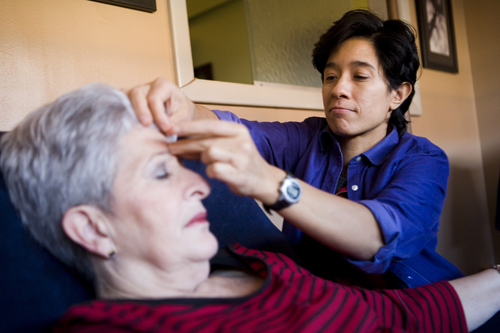
When Cris Monteiro started Providence Community Acupuncture – a business formed in an effort to make acupuncture affordable – on the city’s East Side in 2006, she had an all-volunteer front desk staff taking messages and setting up appointments.
“They were patients, friends – originally, my first volunteers were just friends of mine who knew I was transitioning to this new [business] model,” Monteiro said recently. “They called up and said, ‘I really want to help you. What can I do?’ ”
Having volunteers was great – Monteiro credits volunteers with helping the business get through the first year. “But the downside is that nobody ever knows what’s happening.”
So now that business is picking up, she’s brought in two part-time receptionists, she said.
The volunteers were paid, however, with a free acupuncture visit. And that “community” feel is exactly the type of business that Monteiro has tried to foster with her office. She has an office with four treatment rooms with chairs in each. Patients stay fully clothed and much of the time they doze off during treatment.
Acupuncture, the strategic placement of needles into the body, is an ancient form of Oriental medicine and has had a difficult transition into the world of Western Medicine. It’s a studied field – Monteiro, for example, has a master’s degree in it – and there are techniques and different schools of thought.
“I’m not trying to prove acupuncture works,” Monteiro said. “I’ve got my patients out there telling people it works.”
On the city’s East Side, many of the clients who have been attracted to Monteiro’s practice are educated, older and white. Recently, however, she’s started seeing more people from different areas of the city. By keeping the same price structure and moving either to the western edge of the East Side, to downtown or to the city’s West Side, she’d like to attract a more financially and ethnically diverse crowd, she said.
She plans to move within the next year, she said, and hopes “to change the demographic of who in this country gets acupuncture. There are so many people … who could be served by a neighborhood acupuncture clinic.”
At least part of the reason it hasn’t caught on in the United States is that the relationship between acupuncturists and insurance companies can be tenuous.
“The insurance is supposed to be an access point, but it’s really more of an obstacle, in a way,” she said. “If you’re running a small business, as most acupuncturists are … chasing down your money with insurance companies is a pretty time-consuming thing. While the reimbursement rates are getting better, it’s not like you’re making a killing.”
In an attempt to sidestep the insurance industry’s involvement, Monteiro has lowered her prices. With a sliding scale of $20 to $40 per visit, her services are far less than the $100 to $150 that some clinics charge.
“If you just look at census data, household income, only two-fifths of the population could afford that discretionary spending at $65 on up,” she said.
And the affordable price might also draw in some skeptics.
“I’ll get some old Yankee codger who has neck pain and he’ll try acupuncture because he’s tried everything else and doesn’t want to take the drugs,” she said.
Without an inexpensive option – even more appealing during a recession – Monteiro wouldn’t have had a chance of getting him in the door, never mind booking him for a return visit, she said.
“Now, with my price structure … you decide what’s important for you. I can say to that guy, ‘I want to see you every day this week,’ ” she said. “I’m much more confident – everything’s not teetering on these 10 needles I’m putting in on one day.”
Monteiro sticks her needles, which are about five-times smaller than a sewing needle, into distal points – mostly on the arms and legs.
She said some patients tell her that they don’t get sick as easily once they begin an acupuncture routine.
“You’re going to get more benefit from it if you do it more frequently over a period of time or possibly incorporate it into your weekly or monthly maintenance plan,” she said, comparing it to exercising once or twice a month instead of a few times a week.
“It promotes the balanced functioning of the body,” Monteiro said. “If you felt fine, this would just improve the functioning of your body, but if you feel even the littlest bit stressed, it will help ease that, too.” •
COMPANY PROFILE
Providence Community Acupuncture
OWNER: Cris Monteiro
TYPE OF BUSINESS: Acupuncturist
LOCATION: 144 Waterman St., Suite 2, Providence
EMPLOYEES: 7 (including owner)
YEAR ESTABLISHED: 2006
ANNUAL SALES: $53,000 in 2007