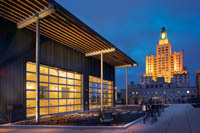
During the recession of the early 1990s, housing development in Providence slowed along with the city’s real estate values. Just ask Arnold “Buff” Chace Jr., who in a recent interview recalled buying the historic Smith Building during that time for $5 per square foot.
“There was no real hope for improving the building until new uses were found for it,” said Chace, president and CEO of Cornish Associates. The Smith Building was part of the downtown historic district – known as Downcity – so tearing it down was not an option.
Your Business Has Gone Global. Has Your Insurance?
A decade ago, “doing business internationally” was mostly a large-company concern. Today, a manufacturer in…
Learn More
But later in the decade, the best use for the vacant office building became clear: housing.
Housing has become one of the most popular answers to the questions of what to build and how to use property in Providence. And with no apparent end in sight, the city’s recent surge in housing development qualifies as one of Rhode Island’s biggest business stories of the last 20 years.
What has led to the boom? Developers and politicians say it was a “perfect storm” of local initiatives and national phenomena.
For starters, amenities were added to the city in the 1990s, with the completion of Providence Place mall and Waterplace Park. Coupled with cultural events such as WaterFire, they made the city a more attractive place to live.
Then in 2001, the General Assembly adopted a state historic tax credit program, unleashing a tide of investment in old, vacant or underused structures such as the Smith Building.
Chace used the state tax credits to turn five former retail and office buildings downtown into more than 190 loft-style apartments. Others did the same with mill buildings.
Take Struever Bros. Eccles & Rouse, which has redeveloped mills along Valley Street in the city’s Olneyville section. The Baltimore-based firm has now launched four projects, with a blend of uses, which will eventually bring close to 1,000 housing units to the neighborhood.
Further east, on Promenade Street, work was finished last year to transform a former Brown & Sharpe manufacturing complex into 220 luxury apartments that have drawn people from Boston and as far as New York, according to development partner Anthony J. Thomas Jr.
Falling interest rates earlier in this decade also helped fuel the housing boom. And with real estate a hot commodity, many investors have chosen to get involved in Providence.
Last fall, for example, New York real estate firm The Athena Group joined Providence’s Paolino Properties in the $81 million purchase of the Jefferson at Providence Place apartments on the west side of the mall. Aiming to capitalize on the city’s hot housing market, the firms then decided to convert the development’s 330 apartments into condos.
Housing values have more than doubled in the city in the past five years, according to statistics on single-family homes sales from the R.I. Association of Realtors. While investors have rejoiced at the jump in prices, housing costs are unaffordable to many families in the city, said Carla DeStefano, who heads a local nonprofit housing group.
“The housing boom has brought some for-profit develop developers who are buying lots and putting up housing here, there and everywhere,” said DeStefano, executive director of Stop Wasting Abandoned Property. “[But] we still need affordable housing in Providence.”
Downtown now a college town
By Justin Sayles, Staff Writer
A suspicious fire at the Outlet Co. building on Weybosset Street in 1986 helped pave the way for colleges to move into downtown Providence. The department store had closed in 1982, but many had hoped to find a new retailer to occupy it.
After the fire, Johnson & Wales University bought the property, razed the old store, and built dormitories; today its downtown campus dominates that part of the city.
In 1994, Roger Williams University took over a building on Washington Street. The following year, the University of Rhode Island moved into the Shepard Building – a former department store on Westminster Street – after vacating its old building near the State House to make way for the Providence Place mall.
For most of Providence’s history, colleges have been concentrated in College Hill and Mount Pleasant, not in the heart of the city. But in the last two decades, the presence of higher education has grown so much that it’s created a campus-like environment in parts of downtown and the Jewelry District.
In 2000, Rhode Island School of Design set up studios for graduate students in the Fletcher Building on Union Street. A year later, it took over the Mason Building next door and put the Center for Design and Business there, among other programs. It also opened a new store, risd|works, in a small building on Westminster Street.
Most notably, RISD has since taken over 15 Westminster St., known as the Rhode Island Hospital Trust building; the banking hall is being turned into a new library, and the upper floors have already been turned into student housing.
Brown University has been downtown since the early 1990s, when it teamed up with the Trinity Repertory Company to create the Pell Chafee Performance Center in the former Citizens Bank building on Empire Street. It also has set up labs in the Jewelry District, and last year it bought the former Old Stone Bank building on South Main Street – east of the river, but nevertheless a key piece of business real estate.
Daniel Baudouin, executive director of the Providence Foundation, said in an interview that colleges’ presence downtown has helped spur retail and residential development. URI is now looking at building student housing downtown, he noted, and that “is certainly consistent with the vision for downtown. If the university wants to do it, I think it is realistic.”