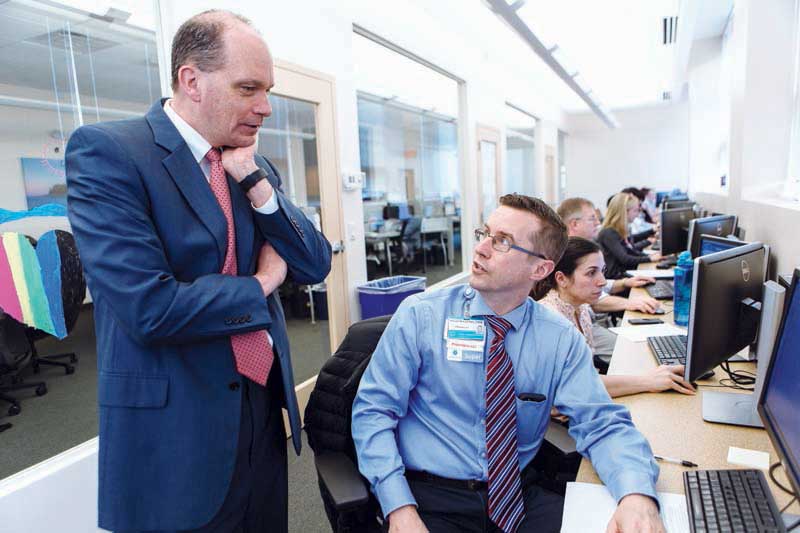
Dr. Cedric Priebe | Lifespan, senior vice president and chief information officer
Dr. Cedric Priebe has been keeping busy since becoming Lifespan’s chief information officer 17 months ago. He’s launched a major information technology systems upgrade, created a new self-service information-systems portal for employees, and started a multiyear project to convert and modernize its telecommunication systems.
ISO 9001:2026: A Practical Opportunity to Build for What’s Next
For Rhode Island manufacturers, ISO 9001 has been much more than a certificate on the…
Learn More
Lifespan President and CEO Dr. Timothy J. Babineau said Priebe is the architect of a data-governance process that has improved Lifespan’s IT systems through collaborative effort.
“In 17 months, Dr. Priebe has turned Lifespan’s information-services operation on its head by instilling a service-oriented culture that not only considers the physician but nurses, finance staff, administrators and so on,” Babineau said.
Preibe oversees a $60 million operation and more than 300 employees, who are responsible for 15,000 workstations, 30,000 devices, more than 1,000 servers, 1,000 network switches and 300 applications, Babineau noted.
“On any given workday, 5,000 of our 15,000 trained users of LifeChart are concurrently logged in as they view patient records, transact orders, schedule appointments and manage reimbursement of care,” he said. “This happens across 75 locations throughout the state.”
Priebe, Babineau said, is “an incredibly open-minded, fair and balanced executive. He’s also scary smart. I think the combination of those traits makes him one of the top 10 CIOs in the country. He brings a nice collaborative nature to the CEO’s executive council and has earned a tremendous level of respect from other Lifespan leaders. Dr. Priebe has a diplomatic approach to his wide scope of responsibilities, which includes many thorny issues, as you could imagine. While the cost and needs related to information services are enormous, Dr. Priebe understands that resources are not unlimited and the system’s resources have to be managed to meet numerous pressing needs.”
Preibe said that since joining Lifespan, he has led the information-services department’s successful completion of more than 100 IT projects, and an additional 70 IT projects are in progress.
His goal at Lifespan, he said, has been to “optimize the group’s information technology for clinicians and other users so that, in the end, they will deliver better health care. The goal is to make these systems more efficient, understandable and user friendly for all the stakeholders who use them.”
While emphasizing that none of the department’s accomplishments is his alone but a team effort, he nonetheless acknowledged his leadership in improving the technical-service desk he manages and implementing a self-service portal to help employees submit IT service requests that do not require a full-scale project.
Requests for special IT service solutions, he said, used to require searching for the right person or the right procedure to follow. “Now, Lifespan staff has a website to go to and request and track IT services from an online catalog,” he said. “Since going live last August, over 9,000 services requests have been submitted to Lifespan information services using this self-service portal.”
Lifespan’s service desk receives 9,000-11,000 calls per month. Priebe’s goal was to resolve a majority of those calls in one sitting, rather than referring the call to a second technician, and to do so by carefully crafting the on-screen solutions to standard computer problems that help-desk personnel rely on when answering calls. “The department has currently achieved the industry standard of a 40 percent, one-call-resolution rate,” he said, “but I am aiming to get it up to 60 percent.”
His interest in information technology started when he was a pediatric residency physician at Boston Children’s Hospital in the early 1990s, “when the only information technology [tools] at my disposal were a beeper and a pen,” he said.
Building his own computer applications to help his patients led him to working part time in hospital IT while also as a staff physician. Priebe pursued full-time IT work, “when I realized I could make more significant improvements to people’s health and health care in IT than by serving as a physician alone,” he said.