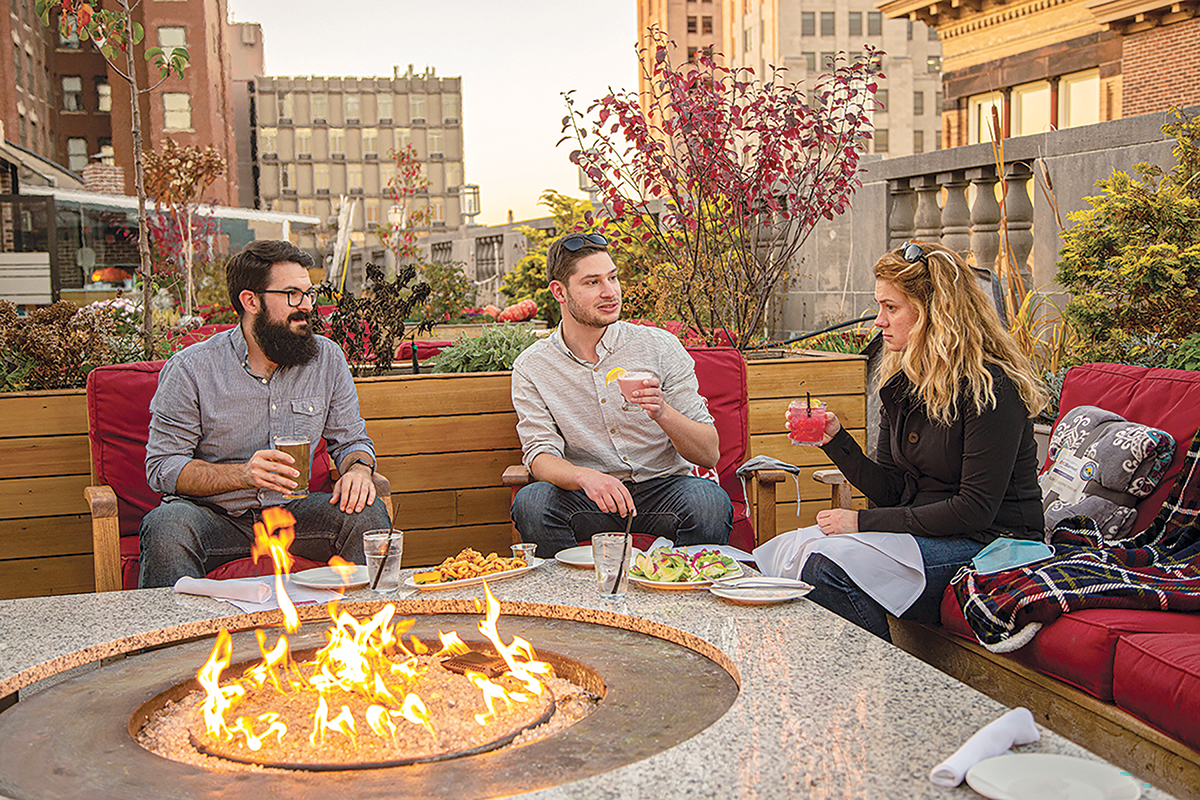
The nightlife landscape in Providence is evolving skyward.
There is a trend toward rooftop establishments that seek to offer what industry experts call a “differentiated” customer experience, transforming rooftops into spaces where patrons can enjoy both food and tantalizing views.
There is a power in vertical dining experiences, said Bryan Michie, CEO of Michie Design & Build, who wants to accelerate this shift. He says it is necessary if Providence is to compete with larger metropolitan areas such as New York City and Boston.
“It really gives you the aesthetic of feeling like you’re in a big city,” he said.
The idea in the United States dates back to the 1890s, when the “garden” trend began transforming many tall buildings in New York City into popular spots for dancing and live music.
But today, an intelligently designed rooftop establishment is a draw for many patrons, particularly the younger generation, always on the hunt for a good backdrop for a social media post.
The surge in demand for ventilated outdoor spaces is undeniable. Limited land opportunities in urban locations have led to “vertical” growth and more high-rise developments, inspiring hospitality operators to capitalize on any spaces with panoramic views.
The most recent rooftop venue getting an overhaul in Providence is Blu Violet at the hotel Aloft Providence Downtown at the corner of Dorrance and Dyer streets. The $500,000 renovation went for a speakeasy vibe and aims to embody “the next era of hospitality in Providence,” said Damaris Messina, general manager of Aloft Providence, who describes Blu Violet as “a gem in the sky” and “an atmosphere unlike anything else in the city.”
With its intimate seating and sleek, modern feel, designers say one of the pluses of rooftop revelry is the fact it encourages guests to stay longer.
Down at the Bellini Club at The Beatrice hotel, a private, members-only rooftop experience offers patrons not only views of the city skyline but also the surrounding architecture.
Alex Pendergrass, executive general manager at Bellini, sees the demand for outdoor environments as evidence of a more discerning clientele.
“You’re seeing a real overlap right now between rooftop venues and private clubs,” he said.
Both the Bellini Club and Bellini Restaurant are operated by Cipriani USA Inc. Pendergrass says that another of the company’s restaurants, Casa Cipriani in Manhattan, is currently expanding its rooftop bar as a private amenity.
Such moves are being made elsewhere, too. The Bellini rooftop club will be integrated into the company’s West Palm Beach, Fla., property as well, which he said indicates a clear market trend toward these curated experiences.
National commercial property reports indicate that rooftop venues generate up to 30% more revenue per square foot compared with ground-level counterparts.
That type of boost is hard to ignore for Providence.
According to the city Department of Art, Culture and Tourism’s “Life at Night Report,” Providence’s nighttime economy encompasses 632 businesses and 7,903 jobs, contributing $990 million in annual revenue – around 3.3% of the city’s overall economic output. The nightlife also generates approximately $47 million in tax revenue for Rhode Island.
Business owners looking to join the trend are advised to invest in outdoor heating and weather protection. These include energy efficient lighting systems, seating arrangements, and the use of sustainable materials, wood-fired ovens and pergolas.
The Rooftop at Providence G, the first-of-its-kind “urban garden” in the city, boasts a retractable roof. The lounge is weatherized and open year-round.
Over at Mare Rooftop, patrons can drink and dine inside winter “igloos.”
Rooftop bars and restaurants provide customers with the feeling of a “special occasion,” said Alana Cerrone O’Hare, senior director of communications &andspecial projects at Providence Warwick Convention & Visitors Bureau.
This “experiential travel” has amplified interest in these venues, she said, giving a vantage point allowing guests to take in the character and architecture of Providence’s skyline.
“Travelers are looking for experiences and ways to feel connected to the places they visit,” she said.
Michie, who serves on the Providence Downtown Design Review Committee, acknowledges that local regulators have historically been hesitant toward modern design concepts, choosing to prioritize more “Victorian” aesthetics.
But there is growing acceptance today. There is not an abundance of additional space on most commercial properties, and costs have been driven up.
“There needs to be more freedom in design and architecture,” Michie said. “I’m telling my clients all the time – and not just restaurant and bar owners – you need to consider refurbishing your rooftop.”