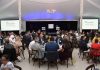
WARWICK – Rhode Island business leaders remain confident in their own companies despite ongoing pessimism about the national economy, according to a survey conducted Thursday during the annual Economic Outlook Breakfast hosted by Santander Bank N.A. and the Greater Providence Chamber of Commerce.
Nearly 60% of respondents, taken from a poll of more than 160 participants across a wide swath of local sectors, said they expect the U.S. economy to be in worse shape over the next 12 months, including 40% who anticipate it will be “somewhat worse.”
At the same time, most indicated their own businesses are holding steady or improving, with about 70% reporting they are in the same or better shape than a year ago.
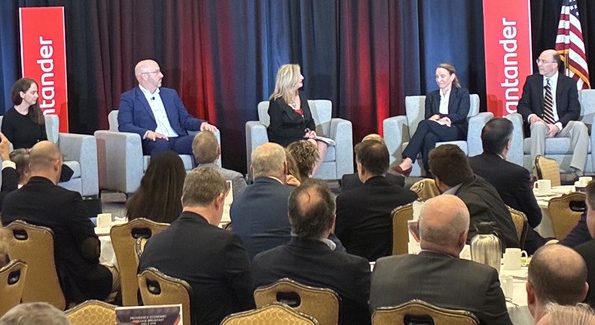
Stephen Stanley, chief U.S. economist with Santander U.S. Capital Markets, said during a panel discussion, that divide underscores a broader pattern of resilience despite ongoing uncertainty.
“What I thought was really interesting is we started with a view of the U.S. that was a little worried, but as we got down to people’s own businesses, it got progressively better,” he said.
That caution is still shaping business decisions. More than half of respondents said they expect no change in hiring over the next year, while another 31% anticipate only slight increases.
Capital spending plans were similarly measured, with roughly 75% planning either no change or modest increases.
Stanley described the U.S. economy as “resilient,” but said geopolitical tensions and shifting trade policy still continue to weigh on outlooks.
About 85% of respondents said they are at least somewhat concerned about geopolitical impacts on their business.
The panel discussion also included Ruth Benbow, North America ecosystem development director at Navigator Global, who provided insight on international trade and market connections, Erik Smith, president and CEO of Saab Inc., and Kelly Mendell, president of MIKEL Inc.
Smith noted the state’s defense and marine technology industries are a bright spot.
“There’s tremendous demand for suppliers and advanced capabilities, and Rhode Island is well-positioned to support that growth,” he said.
Revenue and sales growth emerged as the top challenge for the year ahead, cited by 47% of respondents, followed by global disruptions such as tariffs and conflict.
Mendell said Rhode Island companies can leverage local expertise to remain competitive.
“We’re seeing businesses build resilience by connecting with both domestic and international partners,” she said.
Still, Stanley said companies are beginning to move forward after a period of hesitation.
“You can’t stay on the sidelines forever,” he said. “We’re starting to see businesses looking to expand again.”
Respondents identified defense and national security as the state’s top economic opportunity over the next decade.
In his opening remarks, Gov. Daniel J. McKee pointed to job growth and continued investment in education and infrastructure as signs of momentum.
“Rhode Island has momentum,” he said.
Matthew McNulty is a PBN staff writer. He can be reached at McNulty@PBN.com or on X at @MattMcNultyNYC.