to be based at T.F. Green Airport.
An entrepreneur is courting investors and drafting a business plan to launch a small regional airline based at T.F. Green Airport – and he’s got the initial backing of former Rhode Island Governor Bruce Sundlun.
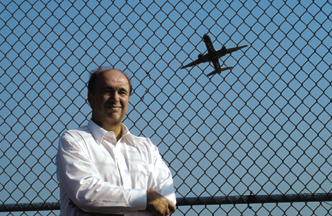
Code named “Air X,” the new airline is the dream of Michael McDade, a 48-year-old Warwick native who is a certified commercial pilot but has not worked in the aviation industry.
The new airline would start doing business with two or three small jets that seat no more than 90 passengers, and would fly to small and medium-sized cities that don’t currently have nonstop service from T.F. Green, McDade said.
McDade would not reveal what cities, or how many cities he is targeting.
Air X would be a point-to-point regional airline focusing on business flyers and high-end leisure travelers, along the lines of Midwest Express in Milwaukee, or Jet Blue, based at New York’s John F. Kennedy International Airport, McDade said.
Contacted Wednesday, Sundlun confirmed that he is one of the project’s potential investors, and said that he has acted as an informal consultant to McDade on the project.
“[McDade] approached me to see if I was interested. He seemed to be approaching the problem in the right way,” said Sundlun. “I consulted with him on a couple of occasions. When he gets around to raising funds, I’ll probably make some sort of investment or contribution.”
McDade is working with a leading aviation industry consultant, Back Aviation Solutions, to draft a business plan and raise the $35 million to $50 million needed to start the airline. McDade said he is talking to five or six early-stage investors, and planning a private placement of stock in Air X, to be completed by the end of the month.
The business plan will probably be completed by Jan. 1, said McDade. Back Aviation Solutions, based in Washington, D.C., has a cache of heavy-hitting potential investors to draw from if the initial private stock offering is successful, said McDade.
In July, Bombardier Aerospace, a Toronto-based manufacturer of small regional airline jets, ran feasibility studies on some of McDade’s proposals, and they came back quite positive, McDade said.
“They have a computer program that takes your proposal and predicts how you‘d do on a given route. Numerous ones have come back quite positive,” said McDade.
At a Sept. 23 meeting in Warwick, a consultant from Back Aviation Solutions made an initial presentation for eight potential local investors. The consultant, David Beckerman, told the group that the numbers look pretty good for developing a new regional airline based in Providence, said George diTarnowki, a director at the Central Rhode Island Development Corporation, who was at the meeting.
McDade is modeling his business plan to resemble successful regional airlines such as Midwest Express, a Milwaukee-based regional carrier with lower capacity and a higher level service than the major airlines. He is targeting business and high-end leisure travelers in Rhode Island and the cities and suburbs south and west of Boston – a population base of more than 3 million people.
McDade said his jets would seat no more than 90 passengers, and might have such amenities as meals served on china. Fares on Air X would not be as low as can be found at other low-fare airlines, he said, but the airline would offer fast, nonstop service to cities that aren’t otherwise easily accessible from T.F. Green.
He estimated that one route could generate $10 million to $12 million a year.
“We wouldn’t be the lowest-fare operator – we wouldn’t be a Southwest Airlines. But we’d go where others don’t. And our research shows that you’ve got to compete on service. You just can’t compete on price,” said McDade. “There’s a perception of the airlines as being not a good vehicle to invest in. But people who look beyond the immediate situation, and understand what the regional-jet approach is doing to the airline industry, see the ‘Jet Blue’ potential in this. Regional airlines are revolutionizing the industry.”
At airports nationwide, the airline industry is being revolutionized by the success of regional airlines that offer low fares and quick service by traveling point to point – 20- to 120-seat airliners the fastest growing segment in the market. In many cases, the regional airlines have gained market share in major metro areas by developing secondary airports, where less congestion and lower fees kept costs down.
For example, the fleets of the Big Six carriers – American, Delta, United, U.S. Airways, Continental, Northwest – will decline 2.1 percent this year, while the fleets of regional carriers will jump 13.8 percent, according to a Sept. 30 report in Airline Financial News, an industry journal.
Based on the conclusions of a 57-page study by several airline analysts at Deutsche Bank Securities, the journal reported that regional airlines will increase in capacity growth by 26.6 percent in 2002 and 9.4 percent in 2003. According to analysts, aircraft fleet and capacity growth are significant indicators for airline investors to watch.
Those statistics are punctuated by the spectacular success of a few regional airlines in recent years. Utah-based Regional Skywest Airlines, an independent regional airline, has seen growth and profits unlike any other part of the industry. The airline is taking on two or three new planes a month, has 87 on order and options for 119 more, according to a July 30 USA Today report. Skywest’s annual revenue is expected to hit $1 billion sometime in the next few years, the traditional threshold for a major airline, according to USA Today.
Two-year-old Jet Blue, based at JFK in New York, went public in April in a record-setting initial public offering, and has plans to quadruple its 27-jet fleet in five years.
McDade is also selling Air X to potential investors in the public sector, as a catalyst for development in Rhode Island and Southern Massachusetts.
“We’re financing hotels, hatching high-tech firms, giving money for bio research – why not this? Having a hometown airline in Rhode Island would be a big deal to the business community. It would be a real advantage in trying to attract more business to the area,” he said.
McDade said he has had initial conversations with officials at the Rhode Island Airport Corporation about starting Air X. The Rhode Island Airport Corporation owns and manages T.F. Green Airport.
“Structured appropriately, it’s something you would always entertain. We’re in the business of encouraging air service development in the region. Should his business plan come to fruition and he has the aircraft, we’d be very happy to discuss it with him,” said Patti Goldstein, a spokeswoman for the Rhode Island Airport Corporation.
McDade said he has also received a warm welcome from four or five corporate travel managers at prominent local firms.
But McDade’s most prominent endorsement thus far has come from Sundlun, who served as governor of Rhode Island through the 1990s, and is touted as the visionary responsible for T.F. Green’s transformation into a successful regional airport. Before serving as governor, Sundlun was president of Executive Jet Aviation. The airline, perhaps the biggest jet taxi service in the U.S, is now owned by the venture capitalist Warren Buffet.
McDade, a Warwick native, has no experience either as an entrepreneur or in the aviation industry. Asked about his current employment, McDade said he works in the hospitality industry at an unspecified Hampton Inn. He said he has an associate’s degree from Community College of Rhode Island and a bachelor’s degree in psychology from Roger Williams University. McDade said he is a trained commercial pilot, but has never worked as a pilot.