
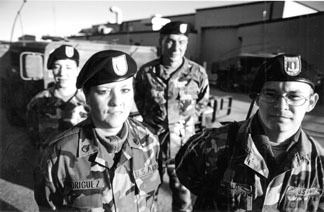
For military reservists called to active duty, war is financial hell.
Military pay has improved, but a majority of reservists still take pay cuts when they leave their civilian jobs to serve their country during wartime. What’s more, members of the U.S. National Guard and Reserves are often deployed at short notice, making it difficult to line up financial assistance and otherwise put their house in order before leaving.
And that can cause financial problems down the road. Without proper planning, a lengthy tour of duty can produce financial wounds that take years to recover from, say experts. What’s more, the main legal protection available to reservists while they serve overseas provides only temporary relief from the bills that can pile up during a lengthy tour of duty.
Military reservists who own their own businesses can be particularly at risk, say experts. They still have to pay all the overhead of their practice while serving overseas. At the same time, employees and customers may go elsewhere if the business is put on hold so that the boss can take up arms for his or her country. For many reservists who served in the Gulf War, the price of serving was the loss of a business or bankruptcy, according to a recent report by Jennie L. Phipps, a contributing editor for the online financial planning journal Bankrate.com.
Even for reservists who don’t own businesses, personal finances are often put in harm’s way, not only due to salary differences but also because managing financial affairs from a war zone can be tricky, Phipps wrote.
The advice for military reservists from financial experts: those anticipating a call to duty should safeguard their financial situations by taking a handful of specific actions before the call comes from Uncle Sam.
Perhaps most important, military reservists should save as much money as possible before getting called overseas, according to Anne Pollard Brust, a financial educator with Debt Counselors of America who used to provide financial counseling to Marines.
“If you are going to stay in the reserves that’s a good reason to have savings, so you’ll have that cushion for when you get called to active duty,” Pollard Brust wrote in a recent report.
Reservists who have a family member who might need to sell a car or house or enroll a reservist’s child in school should be granted a power of attorney to allow that person to conduct that business, according to Phipps.
Reservists should also take advantage of a federal law that helps to protect their finances while they serve overseas – the Soldiers’ and Sailors’ Civil Relief Act. When a soldier is called to active duty, the law suspends many civil legal proceedings until the service person returns home, such as bankruptcy proceedings, divorce cases and civil suits.
The law also halts home foreclosures and tenant evictions, but it only protects reservists with rents of $1,200 or less. However, most courts will grant greater protection to reservists who live in a region with a high cost of living, according to a separate advice column for military reservists published recently on the Bankrate.com Web site by Daniel P. Ray and Michael R. Abramowitz. But it’s necessary to start any legal actions months before being called to military duty, they warned.
Under the law’s protection, a reservist’s life insurance policy can’t lapse while the service member is on active duty or up to two years afterwards. The SSCRA law also guarantees reservists a temporary 6 percent interest rate on credit cards, auto loans, mortgages, equity lines and other installment loans. But reservists should be careful – the protection extends to jointly held accounts but doesn’t cover consumer debt held separately by a spouse. And the lower rate is only good on charges made before the military call-up. It doesn’t apply to debt incurred by a reservist or spouse once the soldier is on active duty, according to Ray and Abramowitz.
There are drawbacks to the legal protection offered by the law, however. As soon as a reservist returns to civilian life, the obstacles to creditors fall away. Instantly, soldiers who did not protect their finances can be faced with bills, ruined credit ratings and foreclosure proceedings.
For that reason, the U.S. Armed Forces urges reservists and their families to get more sophisticated financial and legal assistance in advance, according to retired Lt. Col. Jim Moon, deployment assistance program manager for USAA, a military financial services company.
“Preparing to go to war is like preparing for a tornado. You’ll go through a range of emotions, including wanting to avoid the whole topic, but you’ll be sorry if you do,” said Moon.
Because many reservists’ homes are their biggest asset, they should protect their homes by letting local police departments know of their upcoming absence. Where appropriate, reservists should shut off utilities or ask about a limited-usage program, according to Phipps.
Reservists should also make any appropriate changes to insurance policies, say the experts. Most reservists probably have a car that won’t be driven, property that will sit empty or insurance policies that will expire while they’re gone. They should extend insurance policies that will lapse, discontinue others, and purchase new policies such as homeowner’s insurance or renter’s insurance, to safeguard property left behind in an empty home.
For reservists who are serving in designated combat zones, much of their military pay and reimbursements will be exempt from federal tax. But expert tax advice could come in handy, because a shift to active duty could affect unforeseen tax-related financial matters such as retirement plans, student loans and relocation expenses.
Before leaving, reservists are also encouraged to talk with their employer and find out how their workplace benefits will be handled in their absence. Employers are legally obligated to let their workers fulfill their military service and then give them the same or similar position when they return. Generous employers may continue all or part of the salaries of employees called to active duty. It never hurts to ask your company’s policy, advise Ray and Abramowitz.
Finally, reservists are advised to consider how much money they are prepared to spend keeping in touch with family. The high cost of chatting with folks on the home front came back to haunt some Gulf War reservists, according to Moon.
“We did see lots of problems in the Gulf War with people running up thousands in phone bills, and they have to eventually pay them,” he said.
A variety of phone plans offer savings on overseas long-distance calls. E-mail is even more economical, and experienced military people say it is available almost anywhere.
For the complete current issue, visit our subscription Web site, or call (401) 273-2201, ext. 227 or 234.