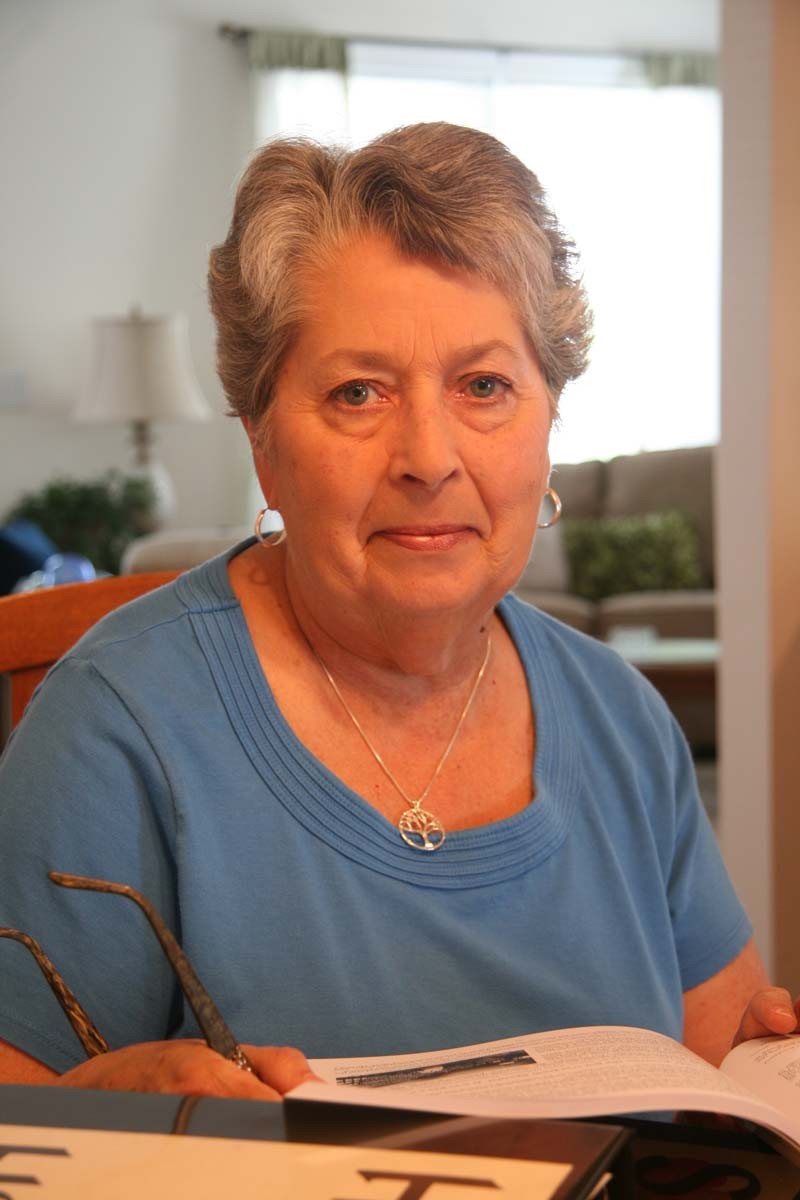
Barbara R. Carroll has long known how hard the Italian immigrants in her own family worked when they first came to Rhode Island: Her grandfather had worked in mills operating by the B & B Knight Co. in West Warwick starting at the age of 12.
But as she poured over dozens of oral histories taken from descendants of Italian immigrants across the state, Carroll was struck by how often those stories reflected the same themes of hard work, perseverance and making sacrifices to build a brighter future for the next generation.
It wasn’t all hardship and hard work, of course. The histories also reflect a love of family and pastimes – helping to make homemade wine, or spending long Sunday afternoons at the state’s beaches.
Carroll, a retired teacher who took up genealogy in the 1980s to explore her own family’s multi-cultural roots, helped compile the stories of 51 immigrant families from all parts of Rhode Island that make up “Voices of Rhode Island’s Italian-Americans,” which the Italian-American Historical Society recently sent for a second printing.
PBN: How did you become interested in genealogy?
CARROLL: One of my uncles and I were looking through a family bible from the mid-1880s and we saw a lot of unfamiliar names. So I started doing some research and before long had found my great-great grandparents and went back even farther than that. That was the beginning.
PBN: How did the “Voices of Rhode Island’s Italian-Americans” book project come about?
CARROLL: An oral history had been started about 10 years ago that focused on the experiences of our [Italian-American Historical Society] members. About three years ago, the society decided to revive that project and expand it beyond our membership so we could get a better representation from across the state. When they started sending transcripts to me, I thought, “This is incredible stuff.” We didn’t want it just sitting on a shelf, so we decided to compile some of the most compelling and interesting into a book.
PBN: What struck you as you read through the transcripts?
CARROLL: As I read between the lines, I found the value system the stories represented was just incredible. So many of the stories were about the hard work and the hard times they faced, but they were also about cooperation, about how all members of the family helped, and their determination to succeed. There are also some really wonderful, happy memories.
PBN: The book is dedicated to the young people of today. Why?
CARROLL: We did that specifically so they could see and concentrate on those values of hard work and cooperation and how everybody pulled together to make a brighter future. Those immigrants came here in hard times, with very little, but they got through it because everybody pulled together.
PBN: Did that cooperation extend beyond families?
CARROLL: People formed communities. Often, people would settle near where people from the same part of Italy had already moved, so there would be neighborhoods that would have almost their own language and customs. People would send money back to Italy or save up money to pay for others to make passage.
PBN: Is that work ethic unique to Italian immigrants?
CARROLL: I think it’s something all immigrants across history share. I have done a lot of work with the stories of Jewish immigrants and Irish immigrants as well and that ideal seems to be something that all immigrants share.
PBN: Did the immigrants realize the American dream right away?
CARROLL: There are some stories about people starting businesses or moving into professional positions, but typically those were the next generation. People would do whatever they could to make a better life for their children. Even though everyone had to work, education was still considered a priority. One guy in the book became a pharmacist, a successful professional, and he talks about watching his father drag a pushcart up and down Regent Avenue in Providence, calling out for junk that he could sell, literally for pennies. He did it so his son could go to college and have a better life.
PBN: Why did so many Italian immigrants come to Rhode Island?
CARROLL: There were jobs. The factories were at the height of their operation. The farmlands in Johnston and Cranston needed laborers as did the granite quarries in Westerly, the factories in Bristol and Warren and the brickyards in Barrington.
PBN: Is there any one story that is particularly memorable?
CARROLL:. There are so many. One woman tells about coming over alone with her brother and sister because their father, who they hadn’t seen in 13 years, had finally sent for them. When they got to Ellis Island the judge asked the man if these were his kids, and he said, “I don’t know” and he asked the kids and they said the same thing. Finally, he let the father take them home. That was pretty dramatic – for a while the kids thought they might have to go back to Italy. That lady, one of the children, is still alive today at [older than] 100. •
INTERVIEW
Barbara Carroll
POSITION: Retired teacher/professional genealogist
BACKGROUND: Carroll taught elementary school for 32 years, including 30 in Cranston public schools, before retiring in 2000. During summer months, she waitressed, worked at summer camps and directed a Girl Scout camp for five summers. In the 1980s, she began researching her own family’s history, tracing the roots of her Italian, French-Canadian and English lineage, and launching a second career as a genealogist.
EDUCATION: B.A. in education, Emmanuel College, 1968
FIRST JOB: At age 11, the librarian at the Cranston Public Library paid Carroll 50 cents an hour – out of her own pocket – to shelve books.
RESIDENCE: Cranston
AGE: 66