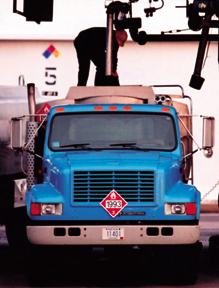
Allen's Avenue terminal.
Home heating oil dealers live in a world of uncertainty, subject to the gyrations of futures markets that can turn on a dime. But seldom has the future looked so murky.
With cold weather fast approaching, local heating oil dealers normally would be busy locking in futures contracts to assure adequate supplies through the winter. But oil prices have crept higher over the last two months amid the ever-present debate over possible U.S. military action against oil-rich Iraq.
Should dealers rush out to buy oil under the assumption that prices will soar even higher if the U.S. moves against Iraq? Or should they wait to see if the Bush administration backs the country away from a war footing, likely pushing prices lower?
“It’s a Solomon’s decision,” said Jack Sullivan, director of the New England Fuel Institute in Watertown, Mass. “There’s risk on either side.”
The decision is paramount for many of Rhode Island’s 190 or so heating oil dealers, who increasingly compete on the price caps and “lock-in” prices they can offer consumers. If prices drop, for example, a dealer who has delayed buying supplies can quickly buy oil on the spot market and offer a better deal than a dealer who bought earlier at a higher price.
“Dealers are all over the place,” said Victor Allienello, chairman of the Oil Heat Institute of Rhode Island and owner of East Providence Fuel Oil Co. “Some guys have purchased all their product for the winter, some have bought a portion and some are waiting. And everything is predicated on what happens with Iraq.”
Some say the “Iraq effect” already is baked into the price of oil. Sullivan estimates that there is a 5-cent to 10-cent premium on heating oil in New England because of the uncertainty over Iraq. (The price of a gallon of home heating oil in Rhode Island stood at $1.30 as of Sept. 18, up about 10 cents from December of last year, according to the State Energy Office.)
But many also agree that if the U.S. moves on Iraq, prices could spike – at least temporarily. Then again, how long will prices stay high if the United States attacks Iraq? Analysts say oil prices could spike and then plummet just as rapidly – to prices even lower than pre-attack levels – if a war appears to be short-lived.
“The general feeling is that if we go (into Iraq), it won’t be a particularly long process, and prices won’t stay high for long,” Sullivan said.
Allienello still remembers the evening of Jan. 17, 1991, the night of the United States’ first strike against Iraq during the Persian Gulf war.
He got a call from a Northeast Petroleum representative, who said the storage terminal on Allens Avenue would be closed the next morning because they were expecting a rush on product. There had been talk of prices spiking above $60 a barrel shortly after the attack began, according to a Jan. 18, 1991 story in The New York Times.
But at 6 a.m. the next morning, the rep called back saying that the terminal would be open for business after all. Oil prices had plummeted overnight amid optimism over a relatively quick and easy war.
That day, Jan. 17, the price of oil continued to fall, posting its biggest one-day drop ever, down $10.56 a barrel to $21.44 on the New York Mercantile Exchange. Heating oil futures for February dropped 30 percent that day, plunging 29 cents a gallon to 62 cents, according to the Times story.
Fast forward to the fall of 2002, and Allienello said that memory makes the decision now even cloudier.
“If we go into Baghdad tomorrow and it’s done by Columbus Day, I made a big boo-boo if I bought early,” he said. “Do I want to be sitting on high-priced oil for January when it could be 20 cents lower by then?”
Besides the uncertainty over Iraq, dealers now are facing another problem: Many were snake bitten last year after buying their entire supply in late summer, when prices appeared low. But last winter’s mild weather drove prices into the ground. All that cheap oil that many dealers thought they were sitting on turned out to be fool’s gold.
“A lot of guys went out and bought early last year because it appeared they were getting a good deal,” Sullivan said. “Then all the sudden there was no winter. Many dealers lost a tremendous amount of money last year, because when you enter into that (futures contract), you must buy regardless of demand.”
But many small dealers who buy “at the rack,” or on the spot market, don’t offer price caps or lock-ins, and aren’t as concerned about the future price of oil.
Alan Couture, owner of Westside Oil Co. in West Greenwich, said he buys only enough oil to fill his customers’ orders.
“I won’t lock in prices because I can’t predict the market,” Couture said. “I buy day-to-day at the rack, deliver it to the customer and make my 15- or 20-cent margin.”
Couture said consumers only need price caps or fixed prices in years of extreme shortages or oil shocks, such as in December 2000, when a bad storm prevented barges from delivering oil to the Port of Providence. The state’s supply dwindled to a one-day reserve.