 CLICK HERE. / " title="RHODE ISLAND ranked second on the list of states most dependent on property taxes in 2008.
For a larger version of this chart, CLICK HERE. /"/>
CLICK HERE. / " title="RHODE ISLAND ranked second on the list of states most dependent on property taxes in 2008.
For a larger version of this chart, CLICK HERE. /"/>(Updated, 11:10 a.m.)
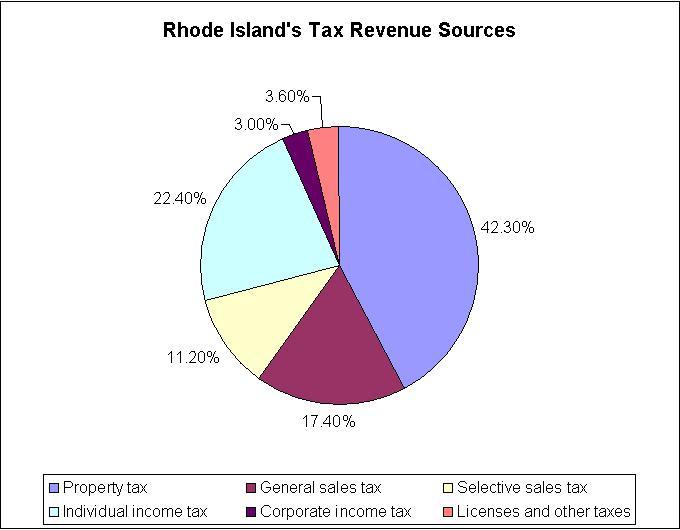
PROVIDENCE – Rhode Island earned 42.3 percent of its total tax revenue from property tax, making it the second-most property tax dependent state in the nation, according to a Tax Foundation report.
Massachusetts earned the No. 3 slot among the most income tax dependent states, deriving 36.8 percent of its revenue from individual earnings, said the report, which based its calculations on the 2008 fiscal year. Rhode Island ranks No. 32 in a listing of the 50 states & District of Columbia for percentage of revenue derived from income tax. The Bay State tied for 11th place with South Dakota on its property tax dependence.
In addition to property tax revenue, Rhode Island taxes breaks down to 22.4 percent in individual tax income, 3.6 percent in licenses and other taxes and 3.0 percent in corporate taxes. General sales tax accounts for 17.4 percent of the state’s revenue and selective sales tax comes in at 11.2 percent.
Massachusetts reported that 34.3 percent of its tax revenue came from property taxes, 6.4 percent from corporate income and 4.2 percent was generated by licenses and other taxes. General sales tax accounted for 12.1 percent of the revenue pool and the selective sales tax, 6.3 percent.
“Nationwide, states and localities are most dependent on property taxes, collecting over 30 percent of their total tax revenue from that source,” said the Tax Foundation in the report published Friday.
New Hampshire beat out Rhode Island on the Top 10 list of the most property tax dependent states; New Jersey, Florida, Vermont, Texas, Michigan, Illinois, Wisconsin and Connecticut also made the list.
Alaska had the highest rate of tax revenue coming from licenses and other taxes, at 73.1 percent, thanks to its oil industry. “States heavily endowed with valuable natural resources, such as Alaska and Wyoming, will usually exploit those tax revenue sources, which they can do without much fear of driving the activity out of the state,” said the Tax Foundation.
States with large tourism industries, such as Nevada and Florida, relied on a high percentage of sales tax revenue in order to forgo taxing income. Nevada’s combined general and selective sales tax came in at 55.7 percent and Florida’s totaled 46.9 percent.