Even in a doctor’s office, it can be a challenge – shuffling charts from the front desk to the exam room to the doctor’s desk; filing laboratory results, X-rays and MRIs, and materials from other providers; making sure all the information is on hand when needed.
Now imagine this on a massive scale, with scores of doctors, nurses, technicians, clerks and others contributing to thousands of patient charts, and the paperwork for a single person coming from multiple departments in different buildings.
That’s how hospitals have traditionally operated, and how most still do, even if they now use computerized systems for many records. It works, yes – charts do get put together, and patient information does find its way to the bedside, and to the person’s doctor after discharge. But it can take a long time, sometimes delaying treatment in urgent situations.
Roger Williams Medical Center is now trying to end that.
In the culmination of a years-long effort to computerize medical records, Roger Williams is now going all the way, promptly scanning the roughly one-third of each chart that is still done on paper to produce a complete electronic medical record.
The project, which has been eight months in the making and went live on Dec. 4, makes Roger Williams the first independent hospital in Rhode Island with complete EMRs.
That is not to say that others are using all paper: Edward J. Quinlan, president of the Hospital Association of Rhode Island, said all facilities in the state are using electronic records, at least for some purposes or in some units.
The Lifespan and the Care New England networks are particularly far along in computerizing all records and orders – and Newport Hospital, a Lifespan member, has been nationally certified for using every aspect of the EMR, which puts it in the top 1 percent of hospitals nationwide, according to Dr. Reid Coleman, chief medical information officer at Lifespan.
The long-term goal for all hospitals, and for state and federal policymakers, is to make EMRs the norm, and to connect the electronic systems to one another in such a way that information can be securely and seamlessly exchanged between providers, and patients can access their own information and use it to better manage their own health care.
The Rhode Island Quality Institute is spearheading a project, in close collaboration with the R.I. Department of Health, providers, insurers and others, to develop a statewide health-information exchange, and legislation to begin shaping it and ensure it properly protects patient confidentiality is in the works right now.
It will be years, however, before such an exchange is in place, all agree. So in the meantime, it’s individual efforts – from doctors’ practices to hospitals – that are demonstrating the impact of EMRs on health care.
Roger Williams has kept some electronic records, such as lab results, for more than a decade, said Katie Holland, director of applications at the hospital. Over time, it has gone electronic with more parts of patients’ records: nurses’ notes starting in March 2005, operating room documentation since April 2006.
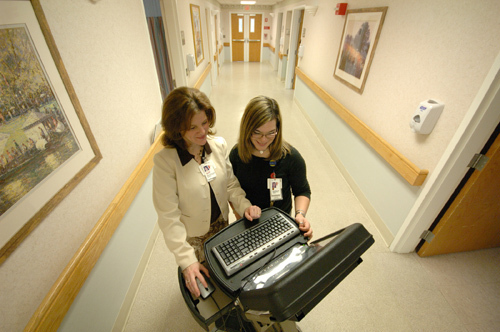
All across the hospital, more than 100 “computers on wheels” provide quick access to the electronic records, which by now include, by default, about 65 to 70 percent of each patient’s information, said Laurie Fiore, director of clinical information services.
Through a secure online system, doctors also can access those records remotely from their home computers or their offices – both to follow up on patients, and to provide direction to nurses when they are off site and a patient needs them.
And if a patient who has been treated at Roger Williams before comes into the emergency room, the triage nurse can pull up his chart and see critical items such as the discharge notes, test results and imaging.
But if certain materials were not produced electronically in the first place – and not all Roger Williams units, especially on the outpatient side, are truly paperless – getting that information to the bedside could take awhile, especially if the patient comes back within just a few days.
That’s because the paper charts would go from office to office, and documents would be held for doctors’ signatures, and then the completed charts would be filed away. So if there were an urgent situation, at best the chart would have to be retrieved – at worst, it would first have to be completed, with an hour or longer lag time.
With the scanning, those delays are being eliminated, Holland and Fiore said. Physician progress notes, physician order sheets, anesthesia records, even power-of-attorney papers are now scanned within 24 hours, and if an order sheet lacks a signature, for example, it doesn’t sit waiting, but rather it gets transmitted to the doctor to be signed.
Darlene Kershaw, clinical nurse manager of the geriatric psychiatry unit, said in an interview that electronic records were “a huge improvement” for nurses. “It makes the communication between all disciplines clean and clear. The immediacy is apparent: Whenever you need information it’s right there.”
And the complete EMR project is making things even better, Kershaw said, because there are still too many documents that are not yet electronic by default.
Ultimately, Fiore said, Roger Williams’ goal is to do far less scanning and more direct electronic entry of medical information. Some behavioral medicine units, for example, are already using no paper, and computerized physician order entry is being phased in across the facility.
“Our goal is to be 100-percent electronic,” said Holland.
The cost of the scanning has been insignificant, Fiore said, because it involves employees who had been handling paper before and were retrained to do this.
Roger Williams also has built in some protocols into its electronic systems to ensure doctors and nurses follow the best practices and avoid preventable errors, Holland said. For example, the system will flag problems with conflicting medications, and it gives nurses guidelines on how to dress a wound, administer an IV, and so forth. •