for AIDS research.
Biomed research nears critical mass
In a gleaming top-floor lab on Claverick Street in Providence’s Jewelry District, Dr. Suzanne de la Monte is searching for a killer.
A neurosurgeon at Rhode Island Hospital, de la Monte leads a team of researchers looking for causes of Alzheimer’s disease, among other degenerative brain disorders. The building – now packed with beakers, computers and centrifuges – once served as a large jewelry making factory.
A few blocks away, in a bright new lab on Chestnut Street, Dr. Maureen Chung, a cancer surgeon at Women & Infants’ Hospital, is developing a vaccine for breast cancer. Before the new research facility opened a year ago, the building churned out delicate chains made from precious metals.
Around the corner, in the Coro Building on Point Street, Dr. Michael Ehrlich, chief of orthopedics at Rhode Island and Miriam hospitals, is leading a team of researchers that is growing new bone tissue from adult stem cells. Throughout much of the 20th century, the 160,000-square-foot building was one of the country’s largest producers of costume jewelry.
The Jewelry District – a 200-acre triangle of manufacturing plants and office buildings south of downtown Providence – emerged in the late 19th century as the heart of the jewelry manufacturing industry in the United States. But over the past few years, microscopes and white lab coats have supplanted hulking metal presses, as new biomedical labs in the district have multiplied like cells in a petri dish.
Seemingly overnight, the Jewelry District has become a biomedical-research cluster. Today, nearly 300 biomedical researchers from Brown Medical School and nearby teaching hospitals are at work in the neighborhood – compared with almost none just four years ago.
“The Jewelry District clearly is on everyone’s radar screen for biomedical and biopharmaceutical research,” said Dr. James F. Padbury, the pediatrician-in-chief at Women & Infants’ and vice chairman of pediatrics at Brown Medical School. “There’s getting to be a critical mass of research going on there.”
Seeds of a biotech hotbed?
A confluence of factors makes the Jewelry District a natural fit for biomedical labs. It is ripe with large buildings that are sturdy enough to house refrigerator-sized incubators and centrifuges as big as washing machines. The area is within a mile or two of Women & Infants’ and Rhode Island hospitals and other teaching hospitals. And it is a short cross-town trip for faculty and students of Brown Medical School.
Meanwhile, real estate on Brown’s campus is infamously tight, and land development on the East Side can be fraught with complications. Look no further than Brown’s plan to build a $94 million life sciences building on Meeting Street, which has encountered a raft of opposition from nearby residents and businesses.
Some in the biomedical community say that the seeds have been sown to transform the industrial neighborhood into a biotechnology hotbed like One Kendall Square in Cambridge, Mass. That area – a neighborhood of dilapidated factories as recently as the early 1980s – now is considered one of the premiere biotech centers in the world, buoyed by the growth of Genzyme Corp. and Biogen Inc.
Once Cambridge startups, each company now has thousands of employees and more than $1 billion in annual revenue.
“When One Kendall Square was starting, it didn’t look a whole lot different than the Jewelry District does today,” said Richard Horan, executive director of the state-funded Slater Center for Biomedical Technology, which assists startup biomedical companies in Rhode Island.
Three dinosaurs transformed
Wires were still sticking out of the walls and ceilings of the newly renovated Galletti Building at 55 Claverick St. when de la Monte, the neurosurgeon, began working at Rhode Island Hospital in 1999.
“I couldn’t imagine how it would work out,” said de la Monte, who spends about 75 percent of her time in the lab. “But now it’s bustling.”
De la Monte arrived in Providence as part of a 20-person research team led by Dr. Jack R. Wands, a professor of medicine at Brown University, who came to Lifespan from Massachusetts General Hospital and Harvard Medical School in 1999. Wands is the director of both the Division of Gastroenterology and the Liver Research Center at Lifespan.
His team, which occupies the fourth floor of 55 Claverick St., now includes 45 researchers from all over the world, including Germany, France, Hungary, China, South Korea, India and Canada. The floor is filled with millions of dollars worth of research equipment: digital microscopes, stainless steel vats of liquid nitrogen, large centrifuges, incubators storing thousands of tumor cells for making antibodies.
In January 2002, Women & Infants’ opened the $5 million Kilguss Research Institute at 200 Chestnut Street. The 25,000 square-foot building enabled the hospital to consolidate some 75 researchers who had been scattered across the city in cramped, isolated labs. Twelve research teams are working in developmental and reproductive biology, with hopes of creating vaccines for HIV, cervical and breast cancer.
Meanwhile, Lifespan continues to add lab space at the Coro Building, which also serves as its corporate headquarters. Last year it opened its new 11,000-square-foot orthopedics department and a new center for diabetes research.
‘Lab geekdom’
The vast majority of research done in the Jewelry District is basic scientific discovery: attempting to understand diseases at their biological or genetic level.
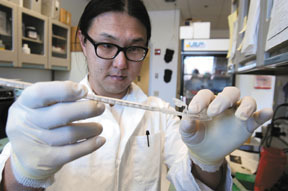
Bharat Ramratnam, an assistant professor of medicine who works in the Center for AIDS Research at the Claverick Street building, says his team’s research falls into the realm of “lab geekdom.”
Ramratnam leads a team of researchers that is trying to figure out why certain AIDS patients form resistance to their drugs over time. He is quick to point out, though, that any resulting drugs or therapies are many years away from clinical testing.
But in many labs, there are kernels of commercialization. Institutional researchers commonly partner with private biotechnology companies to move their research closer to preclinical or human trials.
“If you’re going to transfer your discoveries from the bench to the bedside, you need to hook up with the people who are experts in doing that,” Wands said.
His research team has five “ongoing relationships” with private biotech firms, Wands said.
After more than eight years of tedious research, Chung, the Women & Infants’ researcher, has applied for a patent on her breast cancer vaccine. She hopes it will reach early stage human trials within two years.
In Ehrlich’s orthopedics lab, Dr. Hugh S. Keeping recently applied for a patent on a technique that would allow a patient’s own stem cells to morph into fresh bone cells for use in spinal fusion surgeries. A team of venture capitalists from San Francisco recently visited the lab to observe Keeping’s work, Ehrlich said.
Spinoffs
Already, some 20 research-based biotech companies have spun off from biomedical work at Brown and the state’s teaching hospitals, creating the nucleus of a fledgling Rhode Island biotech sector that has attracted more than $100 million in venture capital.
Yet only a few of those businesses have taken root in the Jewelry District. Many of the state’s promising biotech firms have set up shop elsewhere in Rhode Island – most notably in Lincoln, filling lab space vacated by CytoTherapeutics Inc. That company relocated to California in 1999, leaving a glut of available biotech space.
But because of the Jewelry District’s location, nascent biotech firms are likely to continue looking to the area as a viable location, said Horan of Slater Biomedical.
“In the biomedical world, the interaction between basic biomedical research at the institutions and the commercial spin-offs is very much a continuum,” Horan said.
In other words, researchers don’t stop being doctors and teachers when they start companies.
Instead, most bounce back and forth between their classrooms and labs, hospitals and private offices.
Dr. Anne S. De Groot, an associate professor at Brown, is also the chief executive officer of EpiVax Inc., a biotech startup that applies computer science to the development of vaccines for HIV and other diseases.
The company recently relocated from the East Side to an office on Basset Street in the Jewelry District. De Groot spends most of her time in a lab in the Kilguss building – a two-minute walk from her office at EpiVax.
“We moved to the Jewelry District because that’s where everything is,” De Groot said.
Providence Mayor David N. Cicilline said he hopes there are more biomedical companies that will plant their roots in the capital city.
“The biomedical and biotechnology research done by Brown and the teaching hospitals has the potential to attract private investment in the city,” Cicilline said. “Unfortunately much of that investment has gone outside the city in the past, because we didn’t have a city government that worked collaboratively with the state.”
Cicilline said he hopes to work with officials from Brown, the city’s teaching hospitals and the state to develop a long-range plan for the growth of biotech sector in Providence.
Most researchers say they are too engrossed in their own work to think much about commercialization. But that is, after all, the ultimate goal – to deliver new cures to real-life patients.
“Every professor worth his or her salt in Boston or at Harvard has spun off a company,” Wands said. “But to be able to do that you have to have the infrastructure and the critical mass.
“And I think that’s happening in Providence,” he said. “I think we’re in the beginning of the beginning.”
For the complete current issue, visit our subscription Web site, or call (401) 273-2201, ext. 227 or 234.