
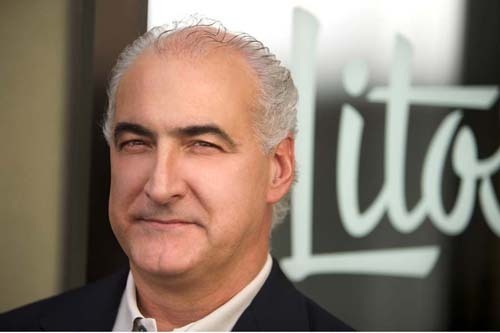
In an effort to build awareness about the need to invest in upgrading the nation’s electric grid, the U.S. Department of Energy recently turned to East Providence-based marketing firm Litos Strategic Consulting, which works with businesses that market renewable energy and other “green” technologies. Litos came up with a colorful 43-page book, “The Smart Grid: An Introduction,” which is available both at www.energy.gov and in print form. The firm’s president, Mark Litos, talked with Providence Business News about the project and the opportunity for a modern energy system.
PBN: What is the “smart grid”?
LITOS: It’s sort of a difficult question, because it’s so hard to get your arms around it. But in the simplest fashion, the smart grid is a modernized electric grid that enables green, clean, smart technologies that would advance us toward sustainable energy and practices, such as renewable resources – wind and solar being the big ones.
PBN: What sort of benefits would we see from a smart grid?
LITOS: The benefits range from homeland security, and a secure grid with regards to terrorist attacks or natural disasters, to [mitigating] the huge cost associated with blackouts and brownouts, which are getting more frequent given the nature of our grid today. We’ll also have tremendous environmental impacts if we don’t watch ourselves … and there are many new smart-grid technologies that will enable us to exploit renewable resources. The cost of producing energy today is high – we need a much more reliable and affordable energy supply, and that has the trickle-down effect to manufacturers in the country who want to compete.
PBN: So what are some examples of changes that would move us toward a smart grid?
LITOS: There [are] technologies today that are simply cleaner. There [are] technologies today that would enable more exploitation of renewable resources. There are, more specifically, products today, even for transmission lines, that reduce [electricity] line loss, which is significant. So improvements have been made for every area of the grid, from generation to consumption, that have not been applied. It’s time to start to apply these technologies in an effort to modernize our grid.
A very good example is digital two-way communications. We still have in this country folks walking across lawns to read meters. That’s absurd. There’s no reason for that. Also, in many cases a utility doesn’t know that an area has lost power until a customer calls in. That is sad. So even something as simple as two-way communication has not been injected into our nation’s grid. Right now it’s always a one-way ticket – you produce energy and you sell it. … The consumer really has no choice.
With a smart grid, the consumer can be in control of their energy usage. They can participate in demand-response programs. They can have some say in their spending.
PBN: How did we let the grid get so outdated anyway?
LITOS: It’s a really good question. In our book, we reference a chart that shows research and development [spending] as a percentage of revenue for different industries, and the electric-utility area is embarrassing, less than 2 percent – the amount of R&D is as high as 12 percent for office machines or health care. …
I think one factor that has made the light go on – no pun intended – is that our population growth is significantly increasing, so the demand and the stress it’s putting on the grid is much more critical today. We live in bigger houses, we have bigger TVs, there are many more computers, so the need for more energy is significantly increased.
PBN: What can businesses and consumers do now?
LITOS: We have tremendous energy-efficiency technologies available to us, whether in the lighting sector, with advanced lighting-intelligence systems, or in the hot-water pump area. Certainly, anybody can bring solar and wind to their facilities – there are some upfront costs, and that’s one of the challenges. …
PBN: How close are we to a smart grid?
LITOS: In the bigger picture, the word on the street is we’re 20 years away from a complete, updated, modernized grid. It’s in sight, and we’re already taking steps forward. I think that what we do have here is we have the nation’s attention. We absolutely understand it’s a critical need and it cannot be ignored. … We’re looking for ways to increase awareness. There’s at least a dozen, if not more, smart-grid demonstration projects around the country, and their existence lets people know that positive steps have been taken, that things are happening now, and that the concept of the smart grid is far, far more than just a concept or a theory. •
INTERVIEW
Mark Litos
POSITION: President, Litos Strategic Communication.
BACKGROUND: Founded Litos Strategic Communication in 1984 following early experience in advertising agencies and design studios.
EDUCATION: B.A. in visual design, University of Massachusetts Dartmouth (then Southeastern Massachusetts University), 1981.
FIRST JOB: Worked as dishwasher at Giovanni’s Italian Restaurant in Raynham at age 14.
RESIDENCE: South Dartmouth
AGE: 52


