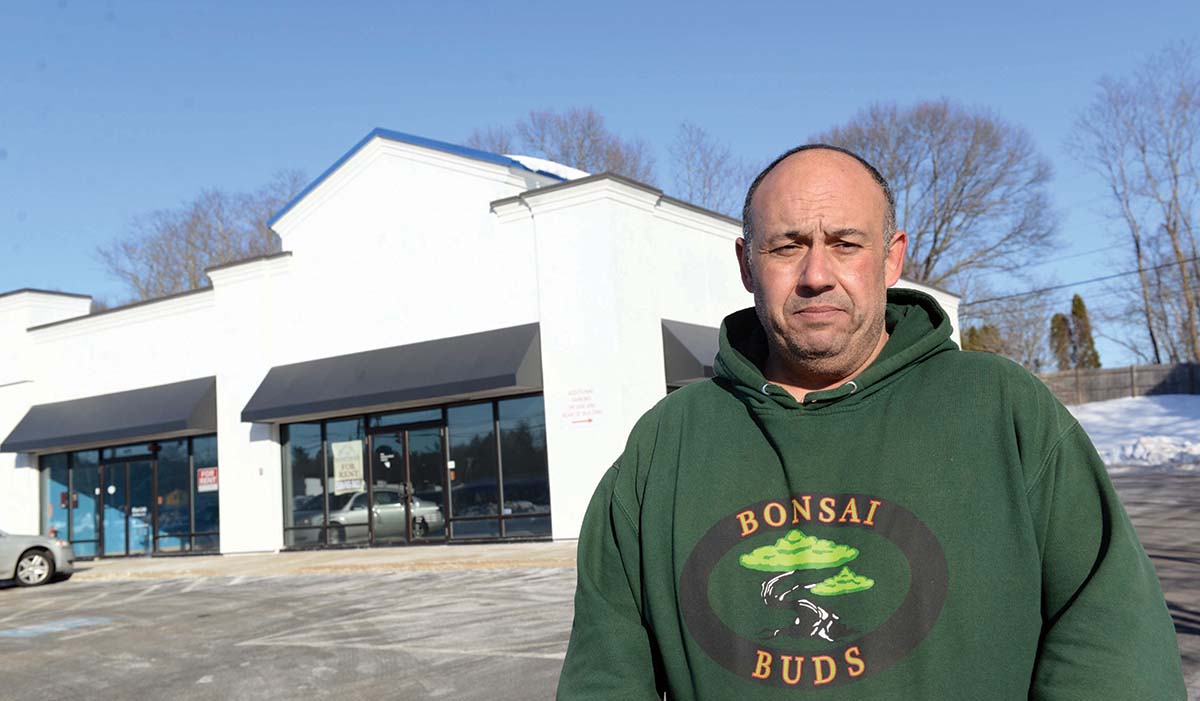
For Jason Calderon, CEO of marijuana cultivator Bonsai Buds in Exeter, the pursuit of a cannabis dispensary license has become a smoke-filled hall of mirrors.
Under regulations adopted by the state’s Cannabis Control Commission last May, applicants must obtain final local zoning approval in order to qualify for the long-awaited lottery for what was originally up to 24 new adult-use recreational cannabis retail licnses but has since been reduced to a maximum of 20.
In fact, aspiring dispensary owners must submit extensive documentation and demonstrate compliance with local zoning ordinances by March 1 in order to remain eligible.
For Calderon, the process seemed promising initially. His application received local zoning approval to allow a cannabis store on Post Road in North Kingstown from the town’s planning commission on Jan. 6.
There was no public opposition during the hearings.
But that decision was quickly clouded by an appeal filed in R.I. Superior Court by Janet Kurucz, an abutting property owner at the site where Calderon plans to open the retail cannabis store.
Now, with the March 1 deadline looming to get zoning documentation, the court action throws Calderon’s eligibility in the cannabis license lottery into question.
Observers say Calderon’s situation highlights a broader challenge for many prospective license applicants: While larger, well-financed cannabis companies can leverage their resources and connections to secure properties – sometimes applying in multiple zones designated under the R.I. Cannabis Act – some smaller operators are struggling to navigate a bureaucratic process.
“I am not politically tied. I am just a regular guy doing everything by the book,” Calderon said. “And it’s only cost me a lot of money.”
The Cannabis Control Commission has made it clear that evidence of final zoning approval is not just a formality but a necessary condition for advancing to the licensing lottery.
Calderon appeared before the cannabis commission on Jan. 16 to call attention to his dilemma.
Asked later about situations such as the one facing Calderon, the commission’s spokesperson, Charon Rose, declined to comment on whether the R.I. Cannabis Office or the commission had considered that such snags could happen when officials were crafting the regulations.
“The commission is considering the issue raised at the last meeting and will review each application to ensure all requirements are met,” she said.
The cannabis commission said in January that 98 entities had applied for the retail cannabis dispensary licenses that will be made available in a lottery that has yet to be scheduled.
State officials have moved cautiously in issuing the licenses. The residents of 25 cities and towns voted in November 2022 to permit retail recreational cannabis sales in their municipalities.
Still, there have been bureaucratic challenges.
For the municipalities that approved retail cannabis sales, they were given some authority to regulate cannabis businesses within their borders. But some communities, such as Pawtucket, waited until 2026 to finalize their approaches. The delay resulted in added steps for applicants, such as municipal reviews and additional stipulations for special-use permits, creating further hurdles.
Andre Dev, a member of the Community Cannabis Network of Rhode Island, said the decision to add layers of municipal approval has forced small entrepreneurs to grapple with local governments, which are often ill-prepared for new regulations.
“The problem is you just have people not talking to each other,” Dev said.
Eric Larsen, an associate professor of criminal justice at the University of Massachusetts Dartmouth who has been advising several cooperatives in their bids to establish dispensaries, talked about the challenges at a recent Cannabis Control Commission meeting.
The Pawtucket City Council held a public hearing on the proposed amendments to its zoning rules on Feb. 11 and still needs two votes of passage and the signature of Mayor Donald R. Grebien.
And then applicants would still need to apply under the new rules, which include the city planning board weighing in on community impacts, buffers, parking, traffic management, signage, hours of operation, security and public safety.
“If [the applicants] have to get this documentation by March 1, most of us know that’s never going to happen,” Larsen said.
Back in North Kingstown, Calderon’s situation is up in the air, too, because of Kurucz’s Superior Court appeal of the town planning commission’s decision on his zoning case.
The legal filing, submitted through her attorney, Robert Flaherty, alleges “a substantial violation of rights.”
A former state representative, Flaherty is not a land-use attorney but has ties to larger cannabis companies.
During the run-up to a 2021 lottery the state held to administer licenses to five new medical marijuana dispensaries, Flaherty was a director of Atlas Enterprises Inc., which was trying to launch a dispensary in Newport, and he was also listed as a director of Ascend Rhode Island Compassion Center, an affiliate of New York-based Ascend Wellness Holdings Inc., a multistate operator focused on cultivating, processing and marketing medicinal cannabis.
The appeal blindsided Calderon, and his attorney quickly filed a motion to intervene. Neither Kurucz nor Flaherty attended the Feb. 4 hearing in Washington County Superior Court. And the next court date is scheduled for Feb. 17.