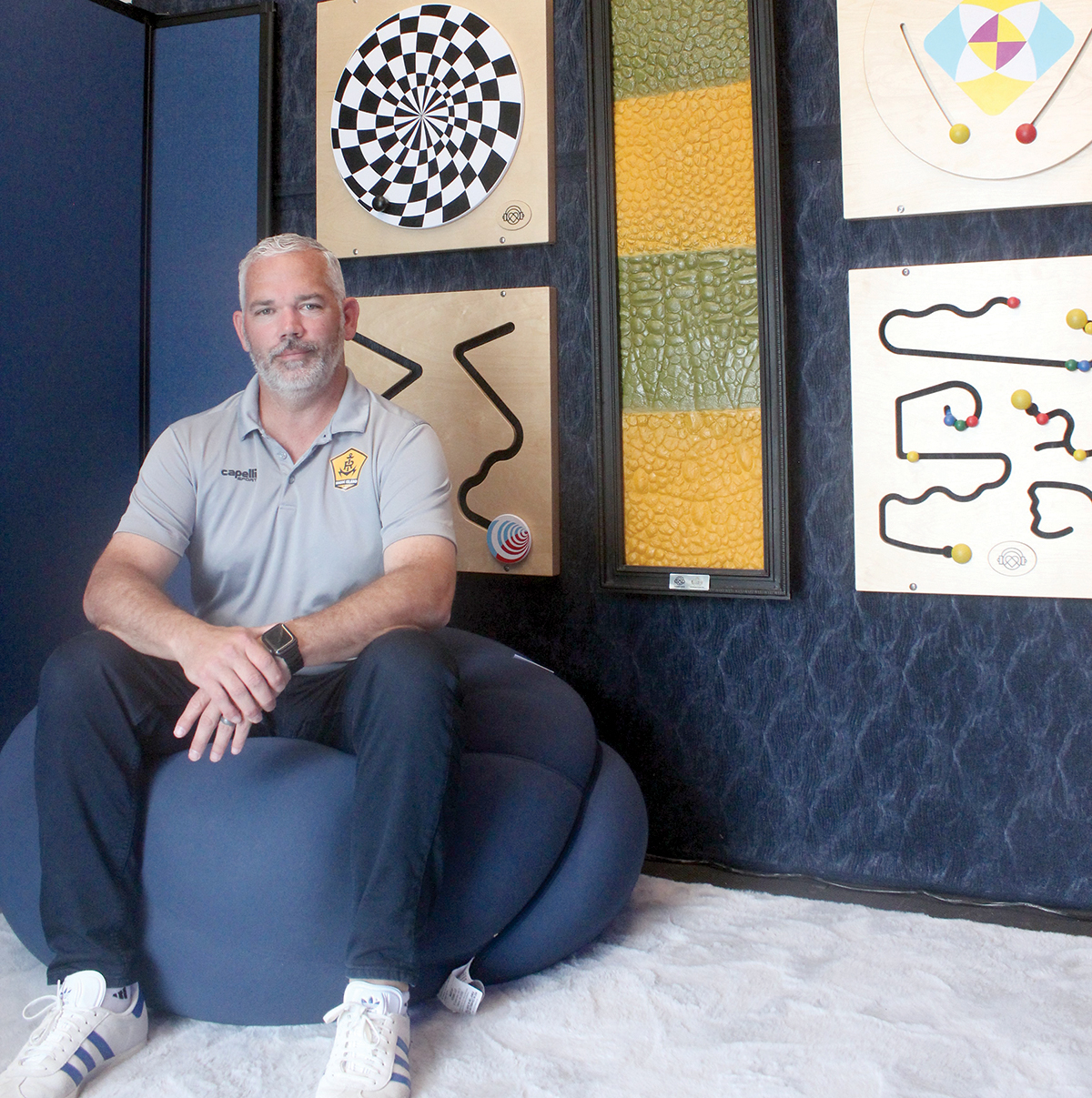
Amid the cheering, chants, drumming and pyrotechnics during a Rhode Island FC soccer match, a small room located on Centreville Bank Stadium’s south end provides a brief respite to those who develop elevated sensory issues.
Adjacent to the Defiance 1636 supporter group seated in Section 115 and the concession area exists a sensory room, sponsored by the national organization KultureCity and The Groden Network, a Providence nonprofit that offers treatment services for those with autism spectrum disorder. The room contains beanbag chairs, fidget tools, specialized lighting, mirrors, noise-canceling headphones and other elements to help relax those who are experiencing sensory overload.
It is also a room that promotes inclusiveness and healthy well-being for all who attend events at the 10,500-seat venue along the Seekonk River in Pawtucket. Sensory rooms are also a rare find around New England, even though similar rooms are popping up in other arenas across the U.S. – especially in NFL stadiums.
Rhode Island’s new outdoor stadium joins Gillette Stadium in Foxborough, Mass., and TD Garden in Boston as the only sports and entertainment venues in New England equipped with a sensory room.
The Providence Performing Arts Center offers “sensory-friendly performances,” in which shows are modified to relax the theatrical environment. However, Centreville Bank Stadium is the only large-scale venue in the Ocean State that houses a specific sensory room.
“[This room] sets us apart,” Centreville Bank Stadium General Manager Paul Byrne said. “We put together a very good accessibility plan that I’ve been working with fans on making sure they have everything they need. Our building was built across the board to make sure it was accessible.”
Byrne says KultureCity first partnered with Rhode Island FC last year by providing “sensory bags” for some attendees – consisting of sound-muffling headphones, fidget spinners and other calming tools – when the team played its home matches at Bryant University. That partnership continues into this season with both sensory bags and the sensory room.
The room was originally designed to be for storage, but stadium officials believed it could be put to better use.
So far, the sensory room has been used at least once in all of the stadium’s large-scale events, such as Rhode Island FC matches, the June 1 international friendly soccer match between Puerto Rico and Nicaragua, and the recent Boston Banshees rugby matches, Byrne said. He didn’t have a specific number of users.
“People who suffer from post-traumatic stress disorder who can’t handle loud noises, or just need a few minutes to reset, this room is critically important for those folks,” Byrne said.
Various autism organizations and groups say loud noises and large crowds can elevate the senses in those who are on the spectrum. As a result, people on the spectrum struggle to cope with the environment, covering their ears to minimize loud noises or performing other self-stimulatory behaviors known as “stimming.”
Local health care professionals applauded the sensory room because it makes the stadium more accessible to those on the autism spectrum or who have mental health illnesses.
“We think this is a fabulous idea that will allow more families to enjoy the new stadium,” said Lisa Rego, president of Autism Society Rhode Island. “We are so thankful to the Groden Network for working on this project to support more-inclusive activities.”
Including the sensory room as part of the stadium’s infrastructure was a pet project for Byrne from the start. His daughter has sensory needs, so wearing headphones during Rhode Island FC’s first few matches was necessary. Byrne empathizes with fellow parents of children who struggle with loud noises and large crowds.
Michael Pearis, Groden’s CEO who has a 24-year-old nonverbal autistic son, can relate, too.
“I know [from] a very young age, trying to take him to sporting events and getting overwhelmed by the crowds, sudden changes in sound and atmosphere, [is challenging],” Pearis said.
Pearis says Groden’s partnership with the stadium and Rhode Island FC began from a chance occurrence. While touring the stadium before its May 3 opening, Pearis heard randomly that the stadium would have a sensory room. Immediately, Groden got involved.
Pearis declines to say how much Groden is financially investing in the room through its sponsorship agreement, but says money contributed by the social services nonprofit was used to design and complete the room’s construction. Pearis did say Groden, as part of the partnership, wants to eventually train stadium staff on de-escalating individuals who may have sensory issues, such as an outburst.
The sensory room is a major piece in the stadium’s and soccer club’s push to include anyone and everyone at events. That philosophy aligns with Groden’s mission in helping those on the spectrum and related disabilities through relaxation techniques so its clients can experience community activities comfortably, Pearis says.
“For us, the ‘why’ on what we do is so families can go to a Saturday afternoon soccer game, grab a hot dog, soda and sit and watch a game,” he said. “If the behaviors sort of peak, they have a space to go to. We want an opportunity for them to normalize family activities, and that’s what we’re about.”
PBN staff writer Katie Castellani contributed to this report.