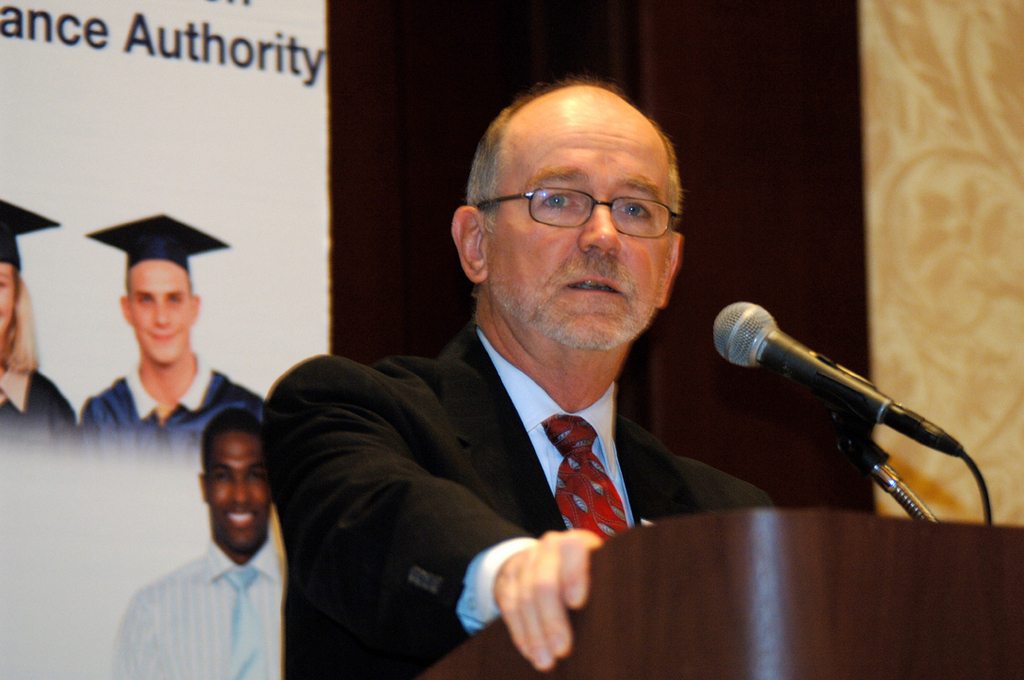
Education leaders celebrating the 30th anniversary of Rhode Island’s only state-funded college financial aid program on Nov. 16 said that efforts to make higher education accessible to all are falling short of the need, both in the state and nationwide.
Speakers at the R.I. Higher Education Assistance Authority (RIHEAA) celebration, held at the Crowne Plaza Hotel at the Crossings in Warwick, said many disadvantaged students – those from poor or immigrant families – still are not getting the opportunity to attend college.
“Their numbers are growing in our state,” said William Hurry Jr., RIHEAA’s executive director. “And they succeed in navigating through the educational pipeline at significantly lower rates than is either desirable or necessary if our state is to remain socially, culturally and economically vibrant in an increasingly competitive environment.”
Keynote speaker C. Adolfo Bermeo, senior scholar with the Pell Institute for the Study of Opportunity in Higher Education, said his data show that of every 100 Latino and Native American students nationwide, 50 will drop out of high school, and only 10 will advance to college – and eight of those students will attend a community college, Bermeo said.
“A system that says it wants to bring you in appears to be designed to filter you out,” said Bermeo, a retired University of California Los Angeles professor whose own family immigrated from Mexico when he was a child.
Part of the problem, he said, is an educational system that makes excuses: The students come from broken homes, they’re underprepared, they’re culturally disadvantaged or they’re at risk.
“We put the blame on the students,” Bermeo said. “We tell them about their weakness when we should be looking at their strengths. … Expect less, teach less, and you get less.”
Another keynote speaker, Arnold Mitchem, president of the Washington-based Council for Opportunity in Education, said making higher education more affordable should be a top priority in order for the nation to remain economically competitive with other countries.
Mitchem said he has seen statistics that show China and India are producing 600,000 and 350,000 engineers each year, respectively, while the United States is producing only 72,000. “I think we’re at some risk,” he said. “Why isn’t participation in education considered a matter of national security?”
RIHEAA officials said they have been doing their part to lower the financial barriers, awarding almost 300,000 grants totaling $227 million since the agency was established in 1977.
And, despite a ballooning state budget deficit, Rhode Island officials have increased RIHEAA’s funding by $4.3 million to $10 million in 2007-08. That funding increase, coupled with $4 million in revenue generated from the CollegeBoundfund college savings program, allowed the agency to boost its maximum grant from $1,200 to $1,400.
Still, Gov. Donald L. Carcieri said that’s not enough assistance, noting at the RIHEAA event that he received a $1,000 annual grant from the state in the early 1960s to attend Brown University, when tuition, room and board was $2,400.
RIHEAA is attempting to help students in other ways, however.
The agency unveiled a new Web site – WayToGoRI.org – that will help children and their parents plan for college and a career, starting as early as elementary school.
“This will teach the student how to plan. … It’s about reaching the student where he or she is and where they best respond,” said J. Michael Thompson, CEO of XAP Corp., which designed the site for RIHEAA.
Carcieri and Peter McWalters, the state education commissioner, also outlined efforts to implement a new Rhode Island high school diploma system in which all students are required to meet similar educational standards in order to graduate.
The new system, which will be applied for the first time to students graduating next June, requires seniors to show their proficiency in subject areas either by assembling a portfolio, completing a senior project or taking an exam.
The state is also requiring districts to ensure that every student has at least one faculty member following his or her educational progress.
Under the new system, McWalters will review school district’s graduation requirements every two years, though he acknowledged that many districts won’t be in full compliance by June.
“We can’t afford to lose this battle,” McWalters said of improving the state’s educational system. “We’re only going to get one shot at this.” •