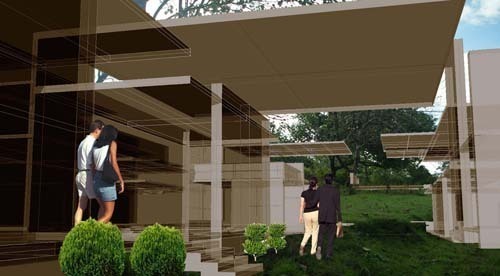
Fourteen Rhode Island School of Design students and two professors are wrapping up initial designs for a master plan for a new 3,700-acre campus and conference center for Earth University in Guanacaste, on the Pacific coast of Costa Rica.
The parcel, a 2005 gift from former Costa Rica President Daniel Oduber Quiros’ family, so far hasn’t been much changed from its former life as the president’s estate. The university is looking to create a second campus there, to be called La Flor, to work with its current Caribbean-coast campus.
In his cluttered Providence office, sitting in front of a wall plastered with designs that came out of the studio, RISD professor Charlie Cannon said recently that the approximately five-month project has been a cooperative effort with Earth University, a sustainable-practices school, which was founded in 1989 with USAID funds.
“It’s an opportunity for them to expand, in some ways, their audience, but also expand their ability to focus on sustainable agriculture in the tropics at large,” he said.
Cannon has taught at RISD since 1998. In 1999 he started teaching in the Innovation Studio, a partnership between the landscape architecture and industrial design master’s programs. That semester-long studio ended in December, but students, Cannon and professor Enrique Martinez are still finalizing the work, which will be used as a guide as Earth University hires professional planners and architects.
The RISD studio is a chance for students to work collaboratively on a large-scale design project, which isn’t always destination-based, Cannon said. “Because it’s a collaborative environment, the students end up deciding for themselves what the project is that we’ll be pursuing,” he said. “We may be designing a marine trash-transfer station for the City of New York or, in this case, thinking about a master plan for Earth University.”
Cannon’s students developed a land plan, including the order in which sites should be developed, what the current buildings should be used for and what land should be preserved. And they looked at controlling flooding issues and the agricultural abilities of the land, on which mangos, bananas, rice and papaya are now grown.
“And, of course, it is the nature of RISD and the Innovation Studio that that isn’t really a broad enough problem,” Cannon said. So the project also took on possible programming, curriculum and technology that could be used on the new campus.
RISD students studied closed loop bio-digestion systems that would take methane from pig excrement and convert it to usable energy. Other students designed a new harvester tool that would capture the protein-rich heads of sugar-cane plants. Some looked at what products could be produced at the campus – banana-based paper is already made there.
“We looked at creating new products out of the agricultural waste that’s happening on the site, but then in our work we looked at that from a product-design standpoint,” Cannon said. “We said, ‘The paper is one thing, but the real value-add, the potential for profitability, comes from turning that into some kind of product.”
Another part of the plan includes a hotel and walking paths for tourists. The site, Cannon said, has more than 250 species of tropical birds. Students looked at public libraries and the use of smart phones and GPS systems to enhance research and tourism walks around the site.
For the RISD students, the project has been a way to develop the skills necessary to solve large, overarching land-use and master plan problems, but it also provided them with practical knowledge about pitching designs to a client, Cannon said.
The students and Cannon kept a running blog during the project, which can be found at http://innovation-earth.blogspot.com. •