Although the Cold War ended nearly two decades ago, the views promoted during that time have left a gap in cultural understanding between the people of the United States and Russia, says Dennis McCarthy, managing director of the World Trade Center Rhode Island.
“In both countries, messages were delivered to the common citizenry that may or may not have been accurate,” McCarthy said in an interview. “So there’s still a lot of ignorance in each country about the culture of the other.”
To counter that problem, Bryant University, which runs the World Trade Center in partnership with the state, has forged a new alliance with the Russian-American Business Council in Moscow. The goal, McCarthy said, is not just to counter misconceptions about the past, but also about the present.
“The Putin administration and the Bush administration seem to be saber-rattling in regards to managing world affairs, and internally, Russia is really struggling with the right to free press and the right to assemble,” he said. “So there are a lot of changes that Americans don’t understand. I think we need to understand what the opportunities are and how you manage that relationship. But any type of diversity lesson requires education, and this Russia program is designed to raise awareness about all aspects of culture to the people in each country.”
The program, which is being run by Bryant’s John H. Chafee Center for International Business, grew out of conversations with Sergei A. Grigoriev, executive vice president of the Russian-American Business Council, who contacted McCarthy in September 2005 and expressed interest in the center because of its network of global relationships.
“It started out as us talking about how we could help companies with trade opportunities in the U.S. and Russia,” said McCarthy. “So that’s what we started to do, and one of his members was the National Reserve Bank of Russia, which is owned by Alexander Lebedev. He’s the chairman of many companies, and we asked if [Grigoriev] would invite [Lebedev] to be a speaker at World Trade Day.”
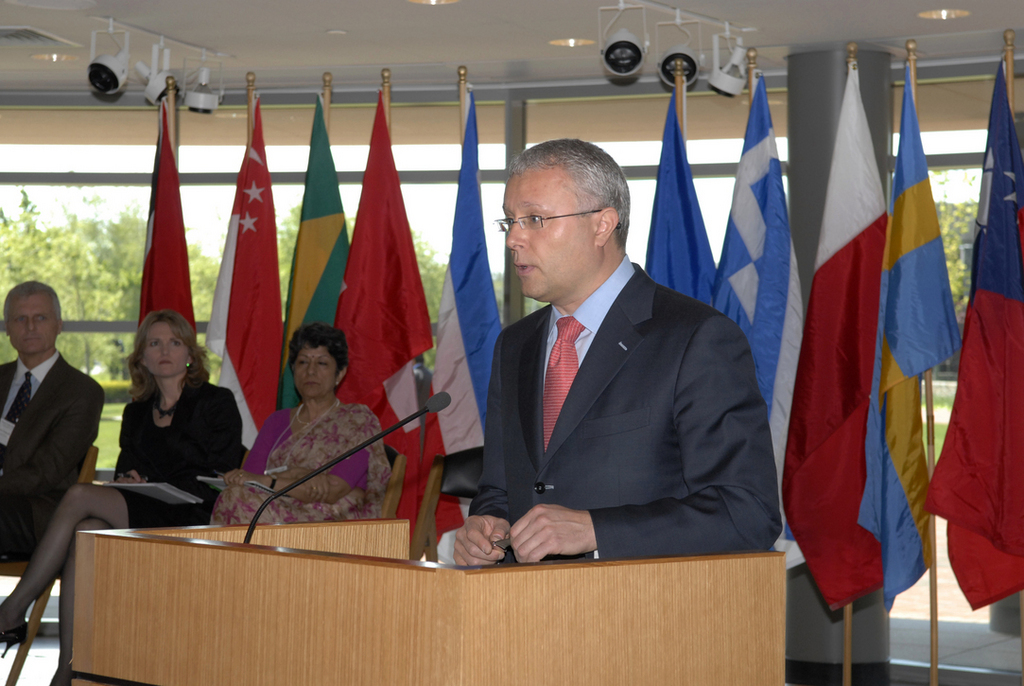
Lebedev spoke at World Trade Day last May, and it was then that a formal Russia program was established at the university, with Lebedev paying for 50 percent of the cost.
So far the partnership has led to an “Apprentice”-like reality television show taped at Bryant for broadcast in Moscow, a small business training program in Russia and a trip to Russia by McCarthy. It has also led to research into student lending opportunities in Russia, affordable housing possibilities in Russia and into best trade practices between the U.S. and Russia.
There is also a planned trip to Russia by 30 Bryant students, and discussions are under way on how to broaden Americans’ knowledge of Russia through the arts. And Grigoriev is being courted to be a guest lecturer at Bryant.
Raymond Fogarty, director of the Chafee Center, said he believes this partnership will enrich students and give them valuable insights – whether they’re majoring in business or liberal arts.
“Russia is one of the giants in the world economy, especially on the energy side, and I think we can learn from each other about what we’re strong at and what they’re strong at,” he said. “Our goal is to look at the similarities and to see what we can do together in business, academic and cultural ways, because now almost everybody is affected by the global economy. We want to make sure [Bryant students] have a sense what it’s like to travel and to understand another language, culture and their businesses, so they have a good handle of what’s going on in the world.”